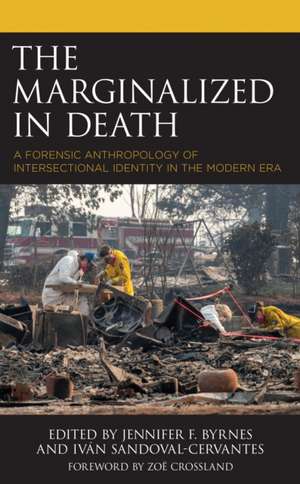
The Marginalized in Death: A Forensic Anthropology of Intersectional Identity in the Modern Era
Editat de Jennifer F. Byrnes, Iván Sandoval-Cervantes Contribuţii de Paulina Domínguez Acosta, Janna M. Andronowski, Jared S. Beatrice, William R. Belcher, Cate E. Bird, Jason D. P. Bird Cuvânt înainte de Zoë Crossland Contribuţii de Randi M. Depp, Elizabeth A. DiGangi, Janet E. Finlayson, Amanda N. Friend, Matthew C. Go, Amanda Hale, Jaxson D. Haug, Allison Hutson, Jennie Jin, Sadé J. Johnson, Molly A. Kaplan, Jaymelee J. Kim, Meredith G. Marten, Daniel E. Martínez, Chloe P. McDaneld, Samuel Mijal, Mariah E. Moe, Megan K. Moore, Briana T. New, Enrique Plasencia, Courtney C. Siegert, Angela Soler, M. Kate Spradley, Daniela Santamaria Vargas, Taylor Walkup, P. Willey, Devin N. Williams, Allysha P. Winburn, Katharine C. Woollenen Limba Engleză Paperback – 15 mar 2024
| Toate formatele și edițiile | Preț | Express |
|---|---|---|
| Paperback (1) | 248.09 lei 6-8 săpt. | |
| Bloomsbury Publishing – 15 mar 2024 | 248.09 lei 6-8 săpt. | |
| Hardback (1) | 646.93 lei 6-8 săpt. | |
| Bloomsbury Publishing – 2 sep 2022 | 646.93 lei 6-8 săpt. |
Preț: 248.09 lei
Preț vechi: 332.88 lei
-25%
Puncte Express: 372
Preț estimativ în valută:
43.92€ • 51.14$ • 38.16£
43.92€ • 51.14$ • 38.16£
Carte tipărită la comandă
Livrare economică 24 februarie-10 martie
Preluare comenzi: 021 569.72.76
Specificații
ISBN-13: 9781666923117
ISBN-10: 1666923117
Pagini: 374
Ilustrații: 11 b/w illustrations; 15 b/w photos; 21 tables;
Dimensiuni: 148 x 226 x 26 mm
Greutate: 0.56 kg
Editura: Bloomsbury Publishing
Colecția Lexington Books
Locul publicării:New York, United States
ISBN-10: 1666923117
Pagini: 374
Ilustrații: 11 b/w illustrations; 15 b/w photos; 21 tables;
Dimensiuni: 148 x 226 x 26 mm
Greutate: 0.56 kg
Editura: Bloomsbury Publishing
Colecția Lexington Books
Locul publicării:New York, United States
Cuprins
Foreword by Zoë Crossland
Acknowledgments
Introduction by Jennifer F. Byrnes and Iván Sandoval-Cervantes
Part I: At the Border: International and Domestic Efforts Towards Identification
Chapter 1: Oral Pathologies as a Reflection of Structural Violence and Stigma Among Undocumented Migrants from Mexico and Central America by Angela Soler, Jared S. Beatrice, and Daniel E. Martínez
Chapter 2: Forgotten Spaces: The Structural Disappearance of Migrants in South Texas by Molly A. Kaplan, Courtney C. Siegert, Mariah E. Moe, Chloe P. McDaneld, and M. Kate Spradley
Chapter 3: Qué pena con usted: The Struggle for Victim Identification in Colombia by Elizabeth A. DiGangi and Daniela Santamaria Vargas
Chapter 4: Devaluing the Dead: The Role of Stigma in Medicolegal Death Investigations of Long-Term Missing and Unidentified Persons in the United States by Cate E. Bird and Jason D. P. Bird
Part II: At the Intersection: Social Identities and Forensic Anthropology
Chapter 5: Theorizing Social Marginalizati
Acknowledgments
Introduction by Jennifer F. Byrnes and Iván Sandoval-Cervantes
Part I: At the Border: International and Domestic Efforts Towards Identification
Chapter 1: Oral Pathologies as a Reflection of Structural Violence and Stigma Among Undocumented Migrants from Mexico and Central America by Angela Soler, Jared S. Beatrice, and Daniel E. Martínez
Chapter 2: Forgotten Spaces: The Structural Disappearance of Migrants in South Texas by Molly A. Kaplan, Courtney C. Siegert, Mariah E. Moe, Chloe P. McDaneld, and M. Kate Spradley
Chapter 3: Qué pena con usted: The Struggle for Victim Identification in Colombia by Elizabeth A. DiGangi and Daniela Santamaria Vargas
Chapter 4: Devaluing the Dead: The Role of Stigma in Medicolegal Death Investigations of Long-Term Missing and Unidentified Persons in the United States by Cate E. Bird and Jason D. P. Bird
Part II: At the Intersection: Social Identities and Forensic Anthropology
Chapter 5: Theorizing Social Marginalizati
Recenzii
Taken collectively, the chapters in this volume effectively demonstrate how a forensic anthropology informed by social theorizing makes visible violences (political, structural, symbolic, everyday, posthumous) experienced by certain marginalized and vulnerable groups. Authors' case studies-about undocumented migrants, rural villagers, gender-diverse individuals, the urban poor and houseless, victims of natural disaster, deceased military personnel, opioid users-are sure to instigate needed policy changes, as well as help realize a praxis that is more compassionate and ethical.
A superb collection of essays making an important and timely connection between forensics and cultural anthropology. The Marginalized in Death pushes our understanding of the lives of vulnerable populations in new directions while simultaneously making the much needed argument that we can no longer imagine a forensic science that is not in deep conversation with ethnography.
This committed group of scholars and scientists explores the many reasons why some bodies are more vulnerable than others to preventable deaths, disappearance, and erasure--including the erasure of histories, identities, and basic dignity through forensic casework. In response, they offer clear, necessary steps towards more ethical deathwork and more rigorous ways of knowing the dead.
This field-defining volume demonstrates how forensic anthropology is uniquely positioned as both a tool for making visible direct violence perpetrated against the living and a discipline capable of revealing how more insidious forms of violence-structural violence, postmortem violence, and the violence of stigmatization-harm entire communities long before and long after death. The insights regarding how violence operates and how it changes the human body make this a must-read for scholars of mass violence, medical anthropology, and the sociology of health and illness.
A superb collection of essays making an important and timely connection between forensics and cultural anthropology. The Marginalized in Death pushes our understanding of the lives of vulnerable populations in new directions while simultaneously making the much needed argument that we can no longer imagine a forensic science that is not in deep conversation with ethnography.
This committed group of scholars and scientists explores the many reasons why some bodies are more vulnerable than others to preventable deaths, disappearance, and erasure--including the erasure of histories, identities, and basic dignity through forensic casework. In response, they offer clear, necessary steps towards more ethical deathwork and more rigorous ways of knowing the dead.
This field-defining volume demonstrates how forensic anthropology is uniquely positioned as both a tool for making visible direct violence perpetrated against the living and a discipline capable of revealing how more insidious forms of violence-structural violence, postmortem violence, and the violence of stigmatization-harm entire communities long before and long after death. The insights regarding how violence operates and how it changes the human body make this a must-read for scholars of mass violence, medical anthropology, and the sociology of health and illness.