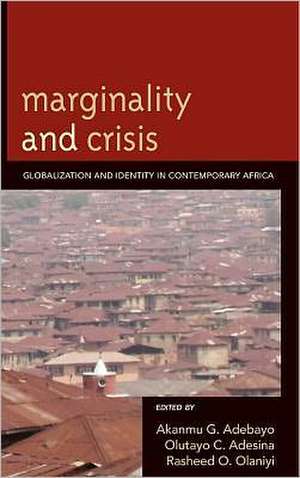
Marginality and Crisis: Globalization and Identity in Contemporary Africa
Editat de Akanmu G. Adebayo, Olutayo Charles Adesina, Rasheed Olaniyi Olaniyi Contribuţii de Olutayo C. Adesina, Osita Agbu, Olajide Olayemi Akanji, Moses T. Aluaigba, Ronald Olufemi Badru, H O. Danmole, Obademi Olalekan Emmanuel, Sheriff Folarin, Agbo Uchechukwu Johnson, Olayinka Idowu Kareem, Eamon Lenihan, Flavius Mokake, David Moveh, Mwanakombo Mohammed Noordin, S O. Ogundele, Ayo Ogunsiji, Aloysius-Michaels Okolie, Rasheed O. Olaniyi, Stephen Onakuse, Henry Okodua, Andrew Oseloka Sawyeren Limba Engleză Hardback – 25 mai 2010
Preț: 710.59 lei
Preț vechi: 1054.06 lei
-33%
Puncte Express: 1066
Carte tipărită la comandă
Livrare economică 02-16 decembrie
Livrare prin curier în România Termenul estimat este afișat lângă disponibilitate.
Transport gratuit pentru acest produs Plată online sau ramburs, în funcție de opțiunile comenzii.
Retur gratuit în 14 zile Comandă securizată și suport în română.
Specificații
ISBN-13: 9780739145562
ISBN-10: 0739145568
Pagini: 294
Dimensiuni: 164 x 240 x 25 mm
Greutate: 0.58 kg
Ediția:New.
Editura: Bloomsbury Publishing
Colecția Lexington Books
Locul publicării:New York, United States
ISBN-10: 0739145568
Pagini: 294
Dimensiuni: 164 x 240 x 25 mm
Greutate: 0.58 kg
Ediția:New.
Editura: Bloomsbury Publishing
Colecția Lexington Books
Locul publicării:New York, United States
Cuprins
Part 1 Section I: Discourse on Globalization
Chapter 2 1. Introduction
Chapter 3 2. Globalization: The Politics of "We" and "Them"
Chapter 4 3. Origin and Dynamics of Globalization: A Historical Approach
Chapter 5 4. Compatriotism vs. Cosmopolitanism: Exploring a New Cosmo-Morality of Human Relations from the Yoruba in the Age of Global-ization
Part 6 Section II: Globalization and Culture
Chapter 7 5. Kiswahili Language and the Future of East African Integration in the Age of Globalization
Chapter 8 6. The Kabba Dress: Identity and Modernity in Contemporary Cameroon
Chapter 9 7. Beyond Memoir: Echoes of Globalization, Identity and Gender Struggle in Wole Soyinka's Ake: The Childhood Years
Chapter 10 8. From the Global to the Local: The Media and Islam in Nigeria, 1979-2006
Part 11 Section III: Marginality: Africa and the Political Economy of Globalization
Chapter 12 9. Globalization and the Privatization of State Owned Enterprises: An Empirical Analysis of the Impact of Privatization on the Nige-rian Economy
Chapter 13 10 Contemporary Trade, Investment Practices, and the Challenges of Poverty Alleviation in Africa
Chapter 14 11. Community-Based Organizations: Household Food and Liveli-hood Security in Southern Nigeria
Chapter 15 12. Trade Liberalization and Employment in Nigeria
Chapter 16 13. Globalization, Poverty, and the Failure of States in Africa: Is There a Connection?
Part 17 Section IV: Crisis: Hotspots and Contestations
Chapter 18 14. A Cross-Regional Analysis African Conflicts in the Age of Globalization
Chapter 19 15. Globalization, Identity Politics, and the Escalation of Ife-Modakeke Crisis
Chapter 20 16. The 2001 Tiv-Jukun Ethnic Crisis: The "Indigene-Settler" Fac-tor Reconsidered
Chapter 21 17. Petroleum, the Environment, and the Economics of Nationalism in the Niger Delta
Chapter 22 18. Oil Conflict in the Niger Delta: Revisiting the Odi Genocide
Part 23 Section V: Conclusion
Chapter 24 19. Conclusion
Chapter 2 1. Introduction
Chapter 3 2. Globalization: The Politics of "We" and "Them"
Chapter 4 3. Origin and Dynamics of Globalization: A Historical Approach
Chapter 5 4. Compatriotism vs. Cosmopolitanism: Exploring a New Cosmo-Morality of Human Relations from the Yoruba in the Age of Global-ization
Part 6 Section II: Globalization and Culture
Chapter 7 5. Kiswahili Language and the Future of East African Integration in the Age of Globalization
Chapter 8 6. The Kabba Dress: Identity and Modernity in Contemporary Cameroon
Chapter 9 7. Beyond Memoir: Echoes of Globalization, Identity and Gender Struggle in Wole Soyinka's Ake: The Childhood Years
Chapter 10 8. From the Global to the Local: The Media and Islam in Nigeria, 1979-2006
Part 11 Section III: Marginality: Africa and the Political Economy of Globalization
Chapter 12 9. Globalization and the Privatization of State Owned Enterprises: An Empirical Analysis of the Impact of Privatization on the Nige-rian Economy
Chapter 13 10 Contemporary Trade, Investment Practices, and the Challenges of Poverty Alleviation in Africa
Chapter 14 11. Community-Based Organizations: Household Food and Liveli-hood Security in Southern Nigeria
Chapter 15 12. Trade Liberalization and Employment in Nigeria
Chapter 16 13. Globalization, Poverty, and the Failure of States in Africa: Is There a Connection?
Part 17 Section IV: Crisis: Hotspots and Contestations
Chapter 18 14. A Cross-Regional Analysis African Conflicts in the Age of Globalization
Chapter 19 15. Globalization, Identity Politics, and the Escalation of Ife-Modakeke Crisis
Chapter 20 16. The 2001 Tiv-Jukun Ethnic Crisis: The "Indigene-Settler" Fac-tor Reconsidered
Chapter 21 17. Petroleum, the Environment, and the Economics of Nationalism in the Niger Delta
Chapter 22 18. Oil Conflict in the Niger Delta: Revisiting the Odi Genocide
Part 23 Section V: Conclusion
Chapter 24 19. Conclusion
Recenzii
Marginality and Crisis: Globalization and Identity in Contemporary Africa is essential reading for those seriously interested in understanding the complex political, social, and economic dimensions of globalization in African societies and the imaginative response of these societies to this enigmatic post-war phenomenon. Adebayo, Adesina, and Olaniyi, three renowned African scholars, and their colleagues have given us a critical volume on the transformative impact of globalization in contemporary African states, effectively engaging intersections of the local and the global, tradition and modernity, state and society. With compelling case studies, especially from Nigeria, Africa's most complicated postcolony, this volume is an important and timely contribution to African studies.
Marginality & Crisis, a companion volume to Globalizations & Transnational Migrations: Africa & Africans in the Contemporary Global System competently documents and analyzes the manipulation, marginalization, and fragmentation of the mass of the African people through the agency of a decadent, materialistic, and fanatically secular culture that contemporary transnational capitalism purveys across the globe. To the extent that the sociology of economic life in Africa is more about community welfare and less about rational economic individualism, political and policy elites across the globe would do well to heed the call of this must-read volume?that the way forward is a return to the ontology of globalization as a commitment to the construction of an authentic global village, where shared human values and social solidarity are given free rein.
This is a detailed study of an important subject. Marginality and Crisis brings out some of the neglected dimensions of globalization on a continent that has always been at the receiving end of global vicissitudes. The chapters are rigorous and lucid, and they provide all the analysis one needs to know on a phenomenon that is bound to dominate discussions in Africa for some time to come.
Marginality & Crisis, a companion volume to Globalizations & Transnational Migrations: Africa & Africans in the Contemporary Global System competently documents and analyzes the manipulation, marginalization, and fragmentation of the mass of the African people through the agency of a decadent, materialistic, and fanatically secular culture that contemporary transnational capitalism purveys across the globe. To the extent that the sociology of economic life in Africa is more about community welfare and less about rational economic individualism, political and policy elites across the globe would do well to heed the call of this must-read volume?that the way forward is a return to the ontology of globalization as a commitment to the construction of an authentic global village, where shared human values and social solidarity are given free rein.
This is a detailed study of an important subject. Marginality and Crisis brings out some of the neglected dimensions of globalization on a continent that has always been at the receiving end of global vicissitudes. The chapters are rigorous and lucid, and they provide all the analysis one needs to know on a phenomenon that is bound to dominate discussions in Africa for some time to come.