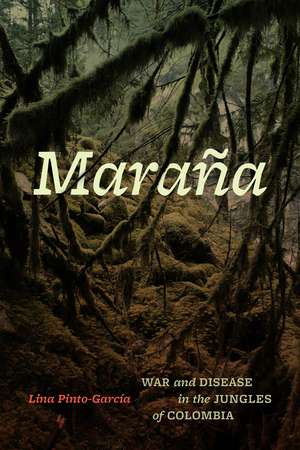
Maraña: War and Disease in the Jungles of Colombia
Autor Lina Pinto-Garcíaen Limba Engleză Paperback – 29 apr 2025
Cutaneous leishmaniasis, transmitted by female sandflies, produces skin lesions of varying size and shape. In Colombia, the insect vector of the disease is native to the same forested environments that have served as the main stage for one of the longest and most violent wars in Latin American history. As a result, the populations most affected by leishmaniasis in Colombia are members of the state army and nonstate armed groups.
Lina Pinto-García explores how leishmaniasis and the armed conflict are inextricably connected and mutually reinforcing. Maraña means “tangle” in Spanish but is also commonly used in Colombia to name the entangled greenery, braided lianas, and dense foliage that characterize the tropical forests where leishmaniasis transmission typically occurs. Pinto-García argues that leishmaniasis and the war are not merely linked but enmarañadas to each other through narratives, technologies, and practices produced by the state, medicine, biomedical research, and the armed conflict itself. All told, Maraña is a passionate study of how war has shaped the production of scientific knowledge about leishmaniasis and access to its treatments in Colombia.
Preț: 227.84 lei
Preț vechi: 239.83 lei
-5%
Puncte Express: 342
Carte disponibilă
Livrare economică 16-30 octombrie
Livrare express 01-07 octombrie pentru 22.78 lei
Livrare prin curier în România Termenul estimat este afișat lângă disponibilitate.
Transport gratuit de la 400.00 lei Plată online sau ramburs, în funcție de opțiunile comenzii.
Retur gratuit în 14 zile Comandă securizată și suport în română.
Specificații
ISBN-13: 9780226839349
ISBN-10: 0226839346
Pagini: 240
Ilustrații: 19 halftones
Dimensiuni: 152 x 229 x 15 mm
Greutate: 0.31 kg
Ediția:First Edition
Editura: University of Chicago Press
Colecția University of Chicago Press
ISBN-10: 0226839346
Pagini: 240
Ilustrații: 19 halftones
Dimensiuni: 152 x 229 x 15 mm
Greutate: 0.31 kg
Ediția:First Edition
Editura: University of Chicago Press
Colecția University of Chicago Press
V-ar putea interesa
-
 The Language of WarOleksandr Mykhed-30%Preț: 107.57 lei154.07 lei
 -
 TankMark UrbanPreț: 194.63 lei
 -
 -26%Preț: 89.74 lei121.26 lei
 -
 The UndrownedToby Vieira-18%Preț: 75.89 lei92.86 lei
 -
 Urban Warfare in the Twenty-First CenturyAnthony KingPreț: 166.26 lei
 -
 GazaJulie M. NormanPreț: 157.16 lei
 -
 The State and the SoldierKori SchakePreț: 167.30 lei
 -
 Everything Is TuberculosisJohn Green-20%Preț: 124.66 lei155.51 leiRecomandat
 -
 False WarCarlos Manuel ÁlvarezPreț: 96.03 lei
 -
 Just the PlagueLudmila UlitskayaPreț: 70.24 lei
 -
 I Brought the War with MeLindsey HilsumPreț: 121.08 lei
 -
 We Are Green and TremblingGabriela Cabezón CámaraPreț: 133.80 lei
 -
 War and MoneyMaurizio LazzaratoPreț: 127.10 lei
 -
 MissionariesPhil KlayPreț: 92.27 lei
 -
 Slash and BurnClaudia HernándezPreț: 86.32 lei
 -
 The Invisible CampaignJane Gulliford LowesPreț: 146.09 leiNou
 -
 War in the Smartphone AgeMatthew FordPreț: 178.50 lei
 -
 Frontlines and LifelinesTim HodgettsPreț: 134.75 lei
 -
 A Botany of ViolencePierre BélangerPreț: 300.87 lei
 -
 They Poisoned the WorldMariah BlakePreț: 135.19 lei
Notă biografică
Lina Pinto-García is a postdoctoral fellow in the Connected Minds program at York University in Canada. She is also a research affiliate of the School of Anthropology and Museum Ethnography at the University of Oxford.
Cuprins
Note on the Cover
Note on Terminology
Introduction
1. Leishmaniasis: A War Disease
2. The Pharmaceuticalization of War
3. Leishmaniasis within the Colombian Army
4. Glucantime and the Politics of Cure
5. Pacified Scientific Accounts on Leishmaniasis
Conclusion
Acknowledgments
Notes
References
Index
Note on Terminology
Introduction
1. Leishmaniasis: A War Disease
2. The Pharmaceuticalization of War
3. Leishmaniasis within the Colombian Army
4. Glucantime and the Politics of Cure
5. Pacified Scientific Accounts on Leishmaniasis
Conclusion
Acknowledgments
Notes
References
Index
Recenzii
“A formidable contribution to a variety of entangled subdisciplines, from medical anthropology, disabilities studies, and science and technology studies to the anthropology of war and peace. . . . Maraña’s ethnographic acumen and conceptual ambition points to a new direction in understanding the ever-entangled realm of medicine, disease, and social conflict.”
“Maraña makes a significant contribution to the history and anthropology of science, medicine and war. It demonstrates how technoscientific practices, including drug regulation, clinical protocols and research writing, participate in the production of wartime social orders. By centering a disease that is neither spectacular nor usually fatal, Pinto-Garcia illuminates how the costs of war accumulate in bodies, infrastructures and epistemologies beyond armed confrontation.”
“There are moments in our careers when we don’t realize we’ve been waiting for a book until it lands in our laps—one that encompasses so many of our interests, both academic and personal. Pinto-García’s book, Maraña . . . does just that. It speaks to militarism, political ecologies of the jungle, geopolitics of war and peacemaking, infectious disease management, and biopolitics, all beautifully woven together through a rich ethnography that is at once theoretically dense and eminently readable.”
“In Maraña, Pinto-García envelops the reader in the complex maraña of the armed conflict and leishmaniasis. . . . Pinto-García makes clear that without disrupting the entrenched systems of violence within medicine and militarism, any solution will remain partial at best.”
“Maraña . . . reconfigures how we understand infectious disease in conflict zones by embedding cutaneous leishmaniasis within the entangled ecologies of Colombia’s armed conflict. Situated at the intersection of medical anthropology, Science and Technology Studies (STS), and political economy, this book challenges biomedical and military logics that treat disease as apolitical and isolate it from the broader forces that shape its emergence and management.”
“Maraña makes a significant contribution to the history and anthropology of science, medicine and war. It demonstrates how technoscientific practices, including drug regulation, clinical protocols and research writing, participate in the production of wartime social orders. By centering a disease that is neither spectacular nor usually fatal, Pinto-Garcia illuminates how the costs of war accumulate in bodies, infrastructures and epistemologies beyond armed confrontation.”
“There are moments in our careers when we don’t realize we’ve been waiting for a book until it lands in our laps—one that encompasses so many of our interests, both academic and personal. Pinto-García’s book, Maraña . . . does just that. It speaks to militarism, political ecologies of the jungle, geopolitics of war and peacemaking, infectious disease management, and biopolitics, all beautifully woven together through a rich ethnography that is at once theoretically dense and eminently readable.”
“In Maraña, Pinto-García envelops the reader in the complex maraña of the armed conflict and leishmaniasis. . . . Pinto-García makes clear that without disrupting the entrenched systems of violence within medicine and militarism, any solution will remain partial at best.”
“Maraña . . . reconfigures how we understand infectious disease in conflict zones by embedding cutaneous leishmaniasis within the entangled ecologies of Colombia’s armed conflict. Situated at the intersection of medical anthropology, Science and Technology Studies (STS), and political economy, this book challenges biomedical and military logics that treat disease as apolitical and isolate it from the broader forces that shape its emergence and management.”
“Based on a scrupulous ethnography conducted in the Colombian jungle, Pinto-García thoroughly demonstrates how leishmaniasis is both socially produced by the armed conflict and metaphorically constructed through the state’s biopolitics. At the interface between medicine, epidemiology, and ecology, she offers a critical anthropology of the complex interactions between warfare and disease.”
“War exacts many obvious costs upon bodies and ecologies: grave injuries, toxic waste, psychological trauma. In Maraña, Pinto-García calls our attention to a slower and more elusive, yet no less consequential, cost of war. Her gripping account of how cutaneous leishmaniasis came to be the signature pathology of Colombia’s protracted armed conflict blends a keen eye for scientific detail with an incisive and meticulous critique of militarized health care. A major contribution to environmental and medical anthropology, this book illustrates how relations of care for people and landscapes are shaped by economies of violence—and how it might be otherwise.”
“This outstanding book constitutes a pathbreaking ethnography rooted in scientific evidence, technological studies, and medical anthropology, through which Pinto-García underscores and unwraps the maraña, or the entanglement, of the armed conflict with leishmaniasis in Colombia. She reveals how in this violent context, which takes place mainly in the tropical jungle, leishmaniasis has been constructed as a war or guerrilla disease. As the testimonies of soldiers, guerrillas, nurses, scientists, and local residents are unraveled, it becomes clear that the stigmatization of the disease has led to a biomedical war regime that prioritizes war over public health. The author leaves readers with the question of how to disentangle leishmaniasis and war, and how to consider a non-pharmaceutical solution to a public health problem.”
“Pinto-García negotiated remarkable access to both the Colombian Army and FARC guerrilla members. She deploys what she learned to tell multifaceted stories about the complex entanglements (or maraña) of war, disease, medicine, and violence, tracing the reciprocal interactions of leishmaniasis and its treatments amid a war that determined who fell sick and who could access care. Maraña offers poignant testimony of the suffering, stigma, and stigmata that endure long after formal hostilities cease.”
“Pinto-García’s Maraña is a milestone in new anthropologies of infectious diseases. No other monograph brings together the ethnographic study of war and zoonosis in such thought-provoking, boundary-breaking tension.”
“Maraña is a work of remarkable methodological ambition and incisive interdisciplinary imagination. This tale of microscopic Leishmania parasites and the literal armies raised against them over the course of the Colombian armed conflict and its aftermath is not only a compelling story of the politics of knowledge and healing, but a conceptual account of the ways that war is made in the violence of cure. This is a book for a world in which war, disease, toxicity, and inequality can only be understood through their inescapable entanglement with one another. And just as crucially, it is a book that reveals those entanglements as places where peace, justice, and human and more-than-human flourishing may yet take root.”
“Maraña, which means entanglement but also jungle, presents a very original examination of the insidiousness of war, which includes critters, the state, and persistent ulcers. Considered a guerrilla disease, leishmaniasis has shaped the army, just as the war has shaped the ways in which this disease is spread, experienced, treated, and studied. Pinto-García reveals the maraña to prompt the healing of suffering bodies.”
“Tracing leishmaniasis is an elusive task, even if the peace accords signed in 2016 that ended the forty-year Colombian armed conflict made it possible for Pinto-García to undertake this extraordinary work. The jungle-like maraña we are guided through is a complex ethnography of a disease, of sick bodies, of a fragile peace process, and of the painful politics of the military-pharmaceutical complex in our contemporary world. But we are not condemned to get lost in this maraña. Pulling these links can also open a path towards the possibility of another world.”