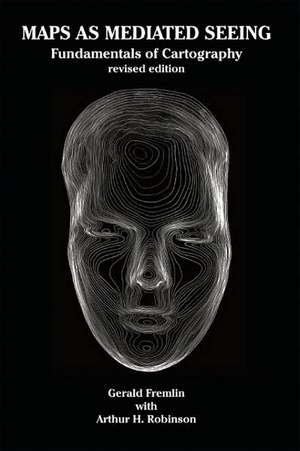
Maps as Mediated Seeing
Autor Gerald Fremlin, Gerald Fremlin with Arthur H. Robinsonen Limba Engleză Paperback – 23 ian 2006
*The idea of mediated seeing - systems that intervene between the seer and the thing seen, allowing views not otherwise available.
*Explanation of vertical orthogonal projection, by which the map-viewer is vertically above all points on the represented ground simultaneously.
*Definition of a map: a map is a projectionally modified physical model of the surface-of-zero-elevation of a planet, with added apparitional modeling.
*Explanation of apparitional modeling.
*Differentiation of maps into topographical, and twelve kinds of thematic.
*Explanation of visual metaphor as imagery by which things unseeable, e.g. temperature, are made seeable.
*Application of the idea of homologue and analogue in explanation of various kinds of map imagery.
*Definition of the subject of topographical maps as stopped-time subaerial landscape.
*Definition of landscape.
*A classification of landscape objects.
*Definition of the subjects of thematic maps as localized processes of the universe.
*Division of the signage of maps into signatures, three kinds of symbols, and typography.
*Definition of "symbol" and "signature."
*Methods of providing identity to features on maps: by mimesis, and several kinds of adjectival modifying.
*Analysis of the visual structure of maps into 'layered' components.
*Explanation of the optional transparency of cartographical surfaces.
*Identification of the visual structure of maps with that of trompe-l'oeil art in which represented objects 'protrude' into the viewer's space.
*Time and synchronicity on maps.
* Definition and explanation of generalization.
*Asummary of relief representation.
*The functions of color on maps: adjectival and graphic.
*A description of the three-dimensional variations of holistic color, and a chart of systematic color gradations.
*The idea of continuums, one- two- and three-dimensional, as applied to discussion of graphics and description of space.
*New terminology and tighter definition of old.
Preț: 157.73 lei
Puncte Express: 237
Carte disponibilă
Livrare economică 17-31 iulie
Livrare prin curier în România Termenul estimat este afișat lângă disponibilitate.
Transport gratuit de la 400.00 lei Plată online sau ramburs, în funcție de opțiunile comenzii.
Retur gratuit în 14 zile Comandă securizată și suport în română.
Specificații
ISBN-13: 9781412066822
ISBN-10: 1412066824
Pagini: 292
Dimensiuni: 152 x 229 x 17 mm
Greutate: 0.48 kg
Ediția:Revised
Editura: Troubador Publishing
ISBN-10: 1412066824
Pagini: 292
Dimensiuni: 152 x 229 x 17 mm
Greutate: 0.48 kg
Ediția:Revised
Editura: Troubador Publishing
V-ar putea interesa
-
 OCR A2 Geography TextbookMichael RawPreț: 127.64 lei
 -
 ScaleAndrew HerodPreț: 459.67 lei
 -
 Physical Geography: The BasicsJoseph HoldenPreț: 164.05 lei
 -
 Visualizing Physical GeographyTimothy Foresman-18%Preț: 955.18 lei1164.86 lei
 -
 Never Eat Shredded WheatChristopher Somerville-29%Preț: 64.66 lei90.92 lei
 -
 Climate Adaptation and Flood Risk in Coastal CitiesJeroen Aerts-18%Preț: 1115.07 lei1359.85 lei
 -
 Das EiszeitalterJürgen EhlersPreț: 308.75 lei
Notă biografică
Arthur H. Robinson was Lawrence Martin Professor of Cartography at the University of Wisconsin, Madison. He served as president of the International Cartographic Association, and president of the American Association of Geographers, and was the author of many professional papers and books, including multiple editions of Elements of Cartography. In retirement he lived in Madison with his wife Martha. Robbie died 10 October 2004 in his ninetieth year.
Gerald Fremlin was born in Clinton, Ont. in 1924. He joined the Royal Canadian Air Force in 1942, and did active service as a bomb-aimer, attached to R.A.F Bomber Command in England. He graduated with a degree in English and Philosophy from the University of Western Ontario in 1950 under sponsorship of the Department of Veterans Affairs. After a period of philosophic rumination, he returned to Western and obtained an M.A.in Geography which got him employed in the Geographical Branch in Ottawa where he worked on compiling the 3rd edition of the National Atlas of Canada (1957). On completion of the atlas, and after a number of miscellaneous assignments in applied geography for the federal government, he was sponsored by the Geographical Branch and the Canada Council to two years graduate work in cartography at the University of Wisconsin, under Arthur H. Robinson. On return to Ottawa he became editor-in-chief of the National Atlas of Canada, produced the 4th edition (1974), and, immediately after setting up plans for the Canada Gazetteer Atlas (1980), took early retirement. He and his wife Alice live in Clinton, Ontario.