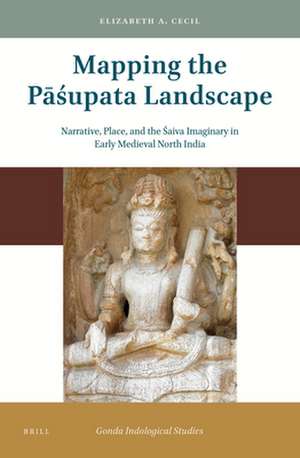
Mapping the Pāśupata Landscape
Autor Elizabeth A Cecilen Limba Engleză Hardback – 12 mar 2020
Preț: 549.41 lei
Preț vechi: 678.28 lei
-19%
Puncte Express: 824
Carte tipărită la comandă
Livrare economică 25 noiembrie-09 decembrie
Livrare prin curier în România Termenul estimat este afișat lângă disponibilitate.
Transport gratuit pentru acest produs Plată online sau ramburs, în funcție de opțiunile comenzii.
Retur gratuit în 14 zile Comandă securizată și suport în română.
Specificații
ISBN-13: 9789004423947
ISBN-10: 900442394X
Pagini: 272
Dimensiuni: 160 x 239 x 22 mm
Greutate: 0.72 kg
Editura: Brill
ISBN-10: 900442394X
Pagini: 272
Dimensiuni: 160 x 239 x 22 mm
Greutate: 0.72 kg
Editura: Brill
Cuprins
Acknowledgements
List of Figures
Introduction: Mapping a Religious Landscape
1 A Geographic Imaginary: the Skandapurāṇa, Lakulīśa and the Localization of Tradition
2 At the Crossroads: Śaiva Religious Networks in Uparamāla
3 The Salt Lakes: Pāśupatas and Śaiva Centers in Jambumārga
4 The Sahya Mountain: Śiva Religion in the Port Polity of the North Konkan
5 Seeking the ‘Lord with a Club’: Encountering Lakulīśa in the Pāśupata Landscape
Coda: Temple, Community, and Heritage-Making
Bibliography
Index
List of Figures
Introduction: Mapping a Religious Landscape
1 A Geographic Imaginary: the Skandapurāṇa, Lakulīśa and the Localization of Tradition
2 At the Crossroads: Śaiva Religious Networks in Uparamāla
3 The Salt Lakes: Pāśupatas and Śaiva Centers in Jambumārga
4 The Sahya Mountain: Śiva Religion in the Port Polity of the North Konkan
5 Seeking the ‘Lord with a Club’: Encountering Lakulīśa in the Pāśupata Landscape
Coda: Temple, Community, and Heritage-Making
Bibliography
Index
Notă biografică
Elizabeth A. Cecil, Ph.D. (2016), is Assistant Professor of Religion at Florida State University. Her scholarship explores the history of Hindu religions in South and Southeast Asia through the study of text, image, monument, and landscape.
Recenzii
'Elizabeth Cecil’s investigation into the emergence of a Pāśupata landscape between the 6th and 10th centuries CE is an important contribution to early Śaiva studies for multiple reasons. Historically, the Pāśupatas are considered one of the earliest and most influential groups of Śiva worshipers, active across much of the North-Indian landscape. Cecil comprehensively writes their history with an at once broad and granular approach drawn from several disciplines – philological, art historical, theoretical, economic, sociological, and historical.' - Benjamin J. FlemingNew York University, South Asian Studies, 37,1 (2021).
'In this thoroughly documented book, Elizabeth Cecil marshals textual, architectural,epigraphic, and art-historical evidence to aid in the recovery of the fascinating history of the spread of Śaivism in northern India from the sixth to the tenth centuries.(...) we are offered here a fascinatingwindow into the history of the development of this vital tradition in its myriad forms, in a study that opens the way for further discovery and debate, and, with and through this volume, new precision in the recovery of the social history of Śaivism—and Pāśupata Śaivism—in South Asia.' - John Nemec, University of Virginia, Indo-Iranian Journal 65 (2022).
'In this thoroughly documented book, Elizabeth Cecil marshals textual, architectural,epigraphic, and art-historical evidence to aid in the recovery of the fascinating history of the spread of Śaivism in northern India from the sixth to the tenth centuries.(...) we are offered here a fascinatingwindow into the history of the development of this vital tradition in its myriad forms, in a study that opens the way for further discovery and debate, and, with and through this volume, new precision in the recovery of the social history of Śaivism—and Pāśupata Śaivism—in South Asia.' - John Nemec, University of Virginia, Indo-Iranian Journal 65 (2022).