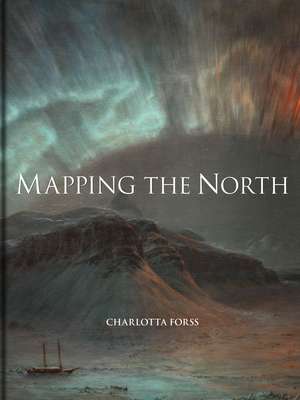
Mapping the North: Myth, Exploration, Encounter
Autor Charlotta Forssen Limba Engleză Hardback – 18 noi 2025
Maps have played a central role in our understanding of what and where defines the North. At the same time, the northernmost reaches of our world have, for much of history, been difficult to navigate and verify, from the mythical islands on medieval maps to the itineraries of Arctic explorers in the nineteenth century. This has inspired inventive mapping strategies, as well as ongoing struggles to define what constitutes believable cartographic information.
This beautifully illustrated book takes the reader on a journey to examine the rich, and sometimes contentious, history of how mapmakers have understood and processed knowledge about a region they described as the North. In the process of mapping, the North as a place changed from an inaccessible and vividly imagined unknown to a region claimed and exploited by southern nations. What emerges is a riveting story of exploration, survival, and cartographic skill bound up with conceptions of nature, religion and politics extending far beyond the Arctic.
Preț: 210.16 lei
Puncte Express: 315
Carte disponibilă
Livrare economică 07-21 noiembrie
Livrare express 24-30 octombrie pentru 50.97 lei
Livrare prin curier în România Termenul estimat este afișat lângă disponibilitate.
Transport gratuit de la 400.00 lei Plată online sau ramburs, în funcție de opțiunile comenzii.
Retur gratuit în 14 zile Comandă securizată și suport în română.
Specificații
ISBN-13: 9781851245727
ISBN-10: 1851245723
Pagini: 224
Ilustrații: 77 color plates
Dimensiuni: 170 x 224 x 25 mm
Greutate: 0.82 kg
Editura: Bodleian Library, University of Oxford
Colecția Bodleian Library, University of Oxford
ISBN-10: 1851245723
Pagini: 224
Ilustrații: 77 color plates
Dimensiuni: 170 x 224 x 25 mm
Greutate: 0.82 kg
Editura: Bodleian Library, University of Oxford
Colecția Bodleian Library, University of Oxford
Notă biografică
Charlotta Forss is associate professor in history at Södertörn University, Stockholm.
Cuprins
Preface
INTRODUCTION
THE UNKNOWN NORTH
MAPS AND FICTIONAL TRAVEL
ENCOUNTERS & EXPLOR ATION
ANIMALS ON NORTHERN MAPS
Epilogue
Notes
INTRODUCTION
THE UNKNOWN NORTH
MAPS AND FICTIONAL TRAVEL
ENCOUNTERS & EXPLOR ATION
ANIMALS ON NORTHERN MAPS
Epilogue
Notes
Recenzii
"Forss’s account promises a range of subtle and nuanced perspectives across the centuries as outsiders sought to understand this apparently alien world beyond the margins of the known–and as those who lived there fought to shape their own identities on the global stage and to take control of the ideas through which their homelands were understood elsewhere."