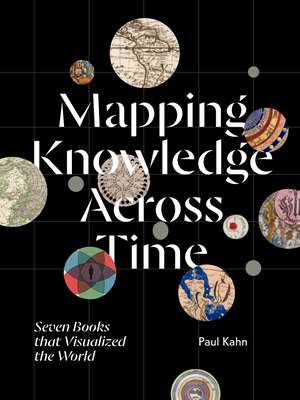
Mapping Knowledge Across Time: Seven Books that Visualized the World
Autor Paul Kahnen Limba Engleză Paperback – 17 iul 2028
The result is a tour of the information design patterns from Modernist diagrams of evolution to medieval Islamic maps, from Chinese representations of rivers to Jewish diagrams of astrological cycles. Each chapter flows back and forth between centuries and cultures, interweaving cartography with data visualization, atlases with encyclopedias. Examples unfold from these seven extraordinary book masterpieces, drawn by illuminators, carved into woodblocks, printed from copperplate, cut and pasted onto boards, demonstrating how designers drive a picture of the world into the reader’s mind. The result exposes entire visual systems that continue to inspire designers today.
This book will lead you to new ways of seeing connections between the past and the present. You will encounter maps, books, diagrams, data visualization, and global views of our common world that will surprise and inspire the general reader and the specialist.
Preț: 343.72 lei
Preț vechi: 484.59 lei
-29% Nou
Puncte Express: 516
Carte nepublicată încă
Doresc să fiu notificat când acest titlu va fi disponibil:
Se trimite...
Specificații
ISBN-13: 9781041148920
ISBN-10: 1041148925
Pagini: 336
Ilustrații: 730
Dimensiuni: 210 x 280 mm
Ediția:1
Editura: CRC Press
Colecția CRC Press
ISBN-10: 1041148925
Pagini: 336
Ilustrații: 730
Dimensiuni: 210 x 280 mm
Ediția:1
Editura: CRC Press
Colecția CRC Press
Public țintă
Academic, General, Postgraduate, Professional Practice & Development, and Undergraduate AdvancedCuprins
Pre-Face: A Book That Describes the World Through the Eyes Chapter 1: Circles Chapter 2: Time Chapter 3: Tracing Lineage Chapter 4: Transportation and TradeChapter 5: Classifying HumanityChapter 6: Heaven is round, Earth is squarePost-Face: Imagine a Book
Notă biografică
Paul Kahn is an information designer and author whose engagement with visualization of large knowledge structures began with hypertext research at Brown University in the 1980s. Throughout his career he has specialized in visual techniques for describing information. He led Dynamic Diagrams in Providence Rhode Island, Kahn+Associates in France, and was Experience Design Director at Mad*Pow in Boston. His teaching included the Information Design and Data Visualization program at Northeastern University; Docent at Media Lab, Aalto University; and instructor in information architecture at several digital media programs in Paris.
Recenzii
"This masterwork of a history belongs on the shelf of anyone interested in maps, information design more broadly, and how language and representation make the world in which we live. It is a beautiful, richly illustrated, and thoughtful comparison of seven beautiful, richly illustrated, and thoughtful books — each of which attempted to describe the world of their culture and time. The author, Paul Kahn, may be our preeminent historian of information design. He brings a design practitioner's eye and considerable critical depth and scholarship to this massive undertaking. The book offers a masterclass for both design students and practitioners." --Hugh Dubberly, Dubberly Design Office
"Paul Kahn, wise sage of information design, goes deep into the roots of visual communication with his review of some of the greatest images of data humanity has ever produced. He brings us deep into fantastic books our fast-moving era has sadly forgotten. This book takes us way farther than anywhere you’ll go on the internet." -- David Rothenberg, author of SECRET SOUNDS OF PONDS and THE POSSIBILITY OF REDDISH GREEN
"This is a deeply researched, beautifully written journey through eight centuries of information design, showing how seven extraordinary volumes teach us to see books themselves as world-making visual systems. Kahn’s historical matrix of recurring visual strategies makes a case that information design has always been a powerful technology to support the flow of information between people across time." -- Jason Forrest, Chair of Data Visualization & Communication, School of Visual Arts, New York
"Paul Kahn tells us the history of information design in an unusual way. By juxtaposing and comparing historical representations of the world that are distant in time, space, and motivation, he uses an iconographic method similar to that of an art historian to show that information design leads creators to use similar forms, ideas and concepts to visualize knowledge regardless of culture. Paul Kahn presents all this in a way that satisfies academic requirements but is also accessible to a wider audience. It is a feast for the eyes and the mind." -- Attila Bátorfy, Master teacher at Eötvös Loránd University, Budapest, and author of Adatvizualizáció (Data Visualization)
"Information design lives in context. Mapping Knowledge Across Time goes beyond techniques to explain the motives and circumstances behind design choices. By including the Chinese example Tushubian alongside other cultures, it offers a richer and more complete view of how design purposes and rationales differ across time and societies." --Liuhuaying Yang, Data visualization specialist and faculty, Complexity Science Hub
"Paul Kahn’s Mapping Knowledge Across Time is a fascinating account of sweeping historical breadth. Examining seven canonical books from diverse eras and locales, Kahn highlights the inventive design strategies that each of these volumes used to visualize the world, uncovering surprising similarities across centuries. With his emphasis on these books as unified works of design, Kahn argues that their physical forms, narrative structures, and methods of production are essential to interpreting their graphic visualizations. Richly illustrated and visually stunning, this study offers an original and valuable contribution to the history of information design, book arts, and material culture." -- Benjamin Benus, Professor of Art History, Loyola University New Orleans, and author of Herbert Bayer's World Geo-Graphic Atlas and Information Design at Midcentury
"Paul Kahn's beautiful work takes us to an imaginary library comprised of seven books from different cultures and periods, revealing remarkable similarities in their visual languages employed to depict the world. Rather than focusing on formalisms, however, Kahn introduces rich visual systems deeply contextualized in ideological, religious, and political settings. Challenging the notion of the lone cartographer, Kahn shows that mapping is always a collective endeavor. Highlights include the strikingly contemporary-looking, monochromatic diagrams of the seventeenth-century Chinese Tushu Bian and the Arabic manuscript behind the twelfth-century Tabula Rogeriana, which blends pictorial representation and calligraphy." -- Dietmar Offenhuber, Professor at Northeastern University and author of Autographic Design - the Matter of Data in a Self-inscribing World
"Mapping Knowledge Across Time is both scholarship and a manifesto for information design. Through seven “world books,” Paul Kahn shows that visualization is never neutral: every map, diagram, or atlas is an authored point of view, built by collecting, arranging, and making design choices throughout. The result is a cross-cultural meditation on Homo sapiens’ compulsive need to make meaning out of chaos—and on the representations, sometimes accurate, sometimes delusional, sometimes both, that we build to share a world with others." -- Giuseppe Attoma Pepe, Senior Design Strategist — Paris–Milan
"In this book, author and information designer Paul Kahn takes us on a profoundly fascinating journey spanning no fewer than eight centuries of history. He demonstrates how different cultures, over the course of centuries, have attempted to represent the world through the book — that object-support-medium whose general form has endured (and resisted) through time. From the Tabula Rogeriana by al-Idrisi to the World Geo-Graphic Atlas by Herbert Bayer, Kahn brings to light the visual strategies devised to organize and transmit knowledge. His approach, spanning eras and continents, reveals surprising connections between medieval cosmologies, Enlightenment atlases, and modern information design. He does not merely recount the history of cartography; rather, he offers a reflection that is, in many respects, deeper and broader on the ways in which visualization structures our understanding and perception of the world. Through clear, elegant prose and extensive documentation, Kahn builds a bridge between (so-called) academic research and design practice.
In my view, this stimulating work stands as an essential reference for historians of the book, cartography, and data visualization, while also providing contemporary designers with a resource that is as abundant as it is inspiring — urging them to consider the vastness of their inheritance. Kahn demonstrates, for anyone who might still doubt it, that information design is not a recent field, but one with a long, multi-century history, rooted in humanity’s enduring and compelling desire to see and to understand the world." -- David Bihanic, Designer and Associate Professor at the University of Paris 1 Pantheon-Sorbonne
"Paul Kahn, wise sage of information design, goes deep into the roots of visual communication with his review of some of the greatest images of data humanity has ever produced. He brings us deep into fantastic books our fast-moving era has sadly forgotten. This book takes us way farther than anywhere you’ll go on the internet." -- David Rothenberg, author of SECRET SOUNDS OF PONDS and THE POSSIBILITY OF REDDISH GREEN
"This is a deeply researched, beautifully written journey through eight centuries of information design, showing how seven extraordinary volumes teach us to see books themselves as world-making visual systems. Kahn’s historical matrix of recurring visual strategies makes a case that information design has always been a powerful technology to support the flow of information between people across time." -- Jason Forrest, Chair of Data Visualization & Communication, School of Visual Arts, New York
"Paul Kahn tells us the history of information design in an unusual way. By juxtaposing and comparing historical representations of the world that are distant in time, space, and motivation, he uses an iconographic method similar to that of an art historian to show that information design leads creators to use similar forms, ideas and concepts to visualize knowledge regardless of culture. Paul Kahn presents all this in a way that satisfies academic requirements but is also accessible to a wider audience. It is a feast for the eyes and the mind." -- Attila Bátorfy, Master teacher at Eötvös Loránd University, Budapest, and author of Adatvizualizáció (Data Visualization)
"Information design lives in context. Mapping Knowledge Across Time goes beyond techniques to explain the motives and circumstances behind design choices. By including the Chinese example Tushubian alongside other cultures, it offers a richer and more complete view of how design purposes and rationales differ across time and societies." --Liuhuaying Yang, Data visualization specialist and faculty, Complexity Science Hub
"Paul Kahn’s Mapping Knowledge Across Time is a fascinating account of sweeping historical breadth. Examining seven canonical books from diverse eras and locales, Kahn highlights the inventive design strategies that each of these volumes used to visualize the world, uncovering surprising similarities across centuries. With his emphasis on these books as unified works of design, Kahn argues that their physical forms, narrative structures, and methods of production are essential to interpreting their graphic visualizations. Richly illustrated and visually stunning, this study offers an original and valuable contribution to the history of information design, book arts, and material culture." -- Benjamin Benus, Professor of Art History, Loyola University New Orleans, and author of Herbert Bayer's World Geo-Graphic Atlas and Information Design at Midcentury
"Paul Kahn's beautiful work takes us to an imaginary library comprised of seven books from different cultures and periods, revealing remarkable similarities in their visual languages employed to depict the world. Rather than focusing on formalisms, however, Kahn introduces rich visual systems deeply contextualized in ideological, religious, and political settings. Challenging the notion of the lone cartographer, Kahn shows that mapping is always a collective endeavor. Highlights include the strikingly contemporary-looking, monochromatic diagrams of the seventeenth-century Chinese Tushu Bian and the Arabic manuscript behind the twelfth-century Tabula Rogeriana, which blends pictorial representation and calligraphy." -- Dietmar Offenhuber, Professor at Northeastern University and author of Autographic Design - the Matter of Data in a Self-inscribing World
"Mapping Knowledge Across Time is both scholarship and a manifesto for information design. Through seven “world books,” Paul Kahn shows that visualization is never neutral: every map, diagram, or atlas is an authored point of view, built by collecting, arranging, and making design choices throughout. The result is a cross-cultural meditation on Homo sapiens’ compulsive need to make meaning out of chaos—and on the representations, sometimes accurate, sometimes delusional, sometimes both, that we build to share a world with others." -- Giuseppe Attoma Pepe, Senior Design Strategist — Paris–Milan
"In this book, author and information designer Paul Kahn takes us on a profoundly fascinating journey spanning no fewer than eight centuries of history. He demonstrates how different cultures, over the course of centuries, have attempted to represent the world through the book — that object-support-medium whose general form has endured (and resisted) through time. From the Tabula Rogeriana by al-Idrisi to the World Geo-Graphic Atlas by Herbert Bayer, Kahn brings to light the visual strategies devised to organize and transmit knowledge. His approach, spanning eras and continents, reveals surprising connections between medieval cosmologies, Enlightenment atlases, and modern information design. He does not merely recount the history of cartography; rather, he offers a reflection that is, in many respects, deeper and broader on the ways in which visualization structures our understanding and perception of the world. Through clear, elegant prose and extensive documentation, Kahn builds a bridge between (so-called) academic research and design practice.
In my view, this stimulating work stands as an essential reference for historians of the book, cartography, and data visualization, while also providing contemporary designers with a resource that is as abundant as it is inspiring — urging them to consider the vastness of their inheritance. Kahn demonstrates, for anyone who might still doubt it, that information design is not a recent field, but one with a long, multi-century history, rooted in humanity’s enduring and compelling desire to see and to understand the world." -- David Bihanic, Designer and Associate Professor at the University of Paris 1 Pantheon-Sorbonne
Descriere
What patterns do we use to represent knowledge of the world? Opening seven books side by side, Mapping Knowledge Across Time asks these difficult questions.