
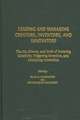
Managing Path-Breaking Innovations: CERN-ATLAS, Airbus, and Stem Cell Research: Technology, Innovation, and Knowledge Management
Autor Shantha Liyanage, Rudiger Wink, Markus Nordbergen Limba Engleză Hardback – 30 dec 2006
In-depth analysis of science and technology initiatives at CERN-ATLAS, Airbus, and in stem cell research, the authors explore and illuminate how profound changes in product, process, and service can be explained and managed. Covering such issues as organizational culture, types of knowledge, and large-scale project management and resource distribution, the authors consider the practical implications of radical innovation for scientific, organizational, institutional, and political leaders concerned with channeling innovation toward economic growth.

Preț: 475.34 lei
Preț vechi: 676.06 lei
-30%
Puncte Express: 713
Carte tipărită la comandă
Livrare economică 27 noiembrie-11 decembrie
Livrare prin curier în România Termenul estimat este afișat lângă disponibilitate.
Transport gratuit pentru acest produs Plată online sau ramburs, în funcție de opțiunile comenzii.
Retur gratuit în 14 zile Comandă securizată și suport în română.
Specificații
ISBN-13: 9781567204964
ISBN-10: 1567204961
Pagini: 348
Dimensiuni: 156 x 235 x 31 mm
Greutate: 0.64 kg
Editura: Bloomsbury Publishing
Colecția Praeger
Seria Technology, Innovation, and Knowledge Management
Locul publicării:New York, United States
ISBN-10: 1567204961
Pagini: 348
Dimensiuni: 156 x 235 x 31 mm
Greutate: 0.64 kg
Editura: Bloomsbury Publishing
Colecția Praeger
Seria Technology, Innovation, and Knowledge Management
Locul publicării:New York, United States
V-ar putea interesa
-
 Design of Enzyme Inhibitors as Drugs, Volume 2Merton Sandler-33%Preț: 1816.33 lei2697.69 lei
 -
 -32%Preț: 615.87 lei909.22 lei
 -
 Integrating Design and Manufacturing for Competitive AdvantageGerald I. Susman-33%Preț: 1075.41 lei1599.69 lei
 -
 Inventive Minds: Creativity in TechnologyRobert J. Weber-31%Preț: 573.09 lei828.06 lei
 -
 Usability: Turning Technologies into ToolsPaul S. Adler-33%Preț: 1292.34 lei1928.66 lei
 -
 National Innovation Systems: A Comparative AnalysisRichard R. Nelson-31%Preț: 1125.02 lei1635.21 lei
 -
 Image Processing: Mathematical Methods and ApplicationsJ. M. Blackledge-33%Preț: 1446.30 lei2148.90 lei
 -
 Peaceful Conquest: The Industrialization of Europe 1760-1970Sidney Pollard-19%Preț: 336.46 lei413.11 lei
 -
 -29%Preț: 368.58 lei517.58 lei
 -
 International Competitiveness and Technological ChangeMarcela Miozzo-32%Preț: 637.27 lei941.91 lei
 -
 Innovation, Entrepreneurship, and Technological ChangeAlbert N. Link-23%Preț: 437.99 lei566.49 lei
 -
 -31%Preț: 677.82 lei983.90 lei
 -
 Flexibility and Stability in the Innovating EconomyMaureen McKelvey-28%Preț: 468.28 lei652.29 lei
 -
 Handbook of the Economics of InnovationBronwyn H. Hall-30%Preț: 782.63 lei1117.29 lei
 -
 Protein PurificationWheelwright-9%Preț: 1575.37 lei1731.17 lei
 -
 -9%Preț: 1134.45 lei1246.65 lei
 -
 InventorshipLeonard M GreenePreț: 186.48 lei
 -
 Aminophosphonic and Aminophosphinic AcidsValery P Kukhar-23%Preț: 4762.09 lei6184.53 lei
 -
 Phosphorus The Carbon CopyDillon-9%Preț: 3450.88 lei3792.17 lei
 -
 -15%Preț: 677.64 lei797.22 lei
 -
 -15%Preț: 649.35 lei763.94 lei
 -
 -18%Preț: 1003.26 lei1223.49 lei
 -
 -30%Preț: 474.70 lei675.68 lei
 -
 Recent Advances and Issues in ComputersMartin K. Gay-44%Preț: 272.12 lei485.53 lei
 -
 LARGE HADRON COLLIDER, THEMarkus Nordberg Th Andrew J MillingtonPreț: 273.29 lei
Recenzii
Liyanage, Wink and Nordberg explore the connection between scientific progress and patterns of innovations by investigating three central programs: the particle physics experiments in the CERN-ATLAS collaboration, aviation research at the Airbus consortium, and biotechnology advances in stem cell research groups. Describing path-breaking innovation as a constellation of events, situations and manifestations of change, learning, leadership and motivation, the authors organize their study around the themes of change processes, work and production philosophies, strategies and collaborations, change environment, spatial dimension, leadership and funding. They conclude that path-breaking innovations are based on good science embedded in a social-system of openness, tolerance, respect and patience.