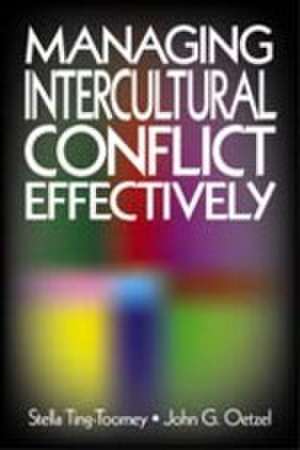
Managing Intercultural Conflict Effectively: Communicating Effectively in Multicultural Contexts, cartea 5
Autor Stella Ting-Toomey, John G. Oetzelen Limba Engleză Electronic book text – 2 iul 2012


Preț: 382.20 lei
Puncte Express: 573
Indisponibil temporar
Doresc să fiu notificat când acest titlu va fi disponibil:
Se trimite...
Specificații
ISBN-13: 9781452262802
ISBN-10: 1452262802
Pagini: 248
Dimensiuni: 152 x 229 mm
Ediția:1
Editura: SAGE Publications
Colecția Sage Publications, Inc
Seria Communicating Effectively in Multicultural Contexts
Locul publicării:Thousand Oaks, United States
ISBN-10: 1452262802
Pagini: 248
Dimensiuni: 152 x 229 mm
Ediția:1
Editura: SAGE Publications
Colecția Sage Publications, Inc
Seria Communicating Effectively in Multicultural Contexts
Locul publicării:Thousand Oaks, United States
V-ar putea interesa
-
 Hollywood Cartoons: American Animation in Its Golden AgeMichael Barrier-22%Preț: 167.42 lei215.87 lei
 -
 Information and Communication Technologies - Visions and RealitiesWilliam H. Dutton-35%Preț: 376.00 lei581.45 lei
 -
 Mastering CommunicationNicki Stanton-9%Preț: 260.17 lei287.09 lei
 -
 Visual Studies: A Skeptical IntroductionJames ElkinsPreț: 390.48 lei
 -
 The Handbook of Communication ScienceCharles R. Berger-27%Preț: 1056.20 lei1446.85 lei
 -
 Understanding Community MediaKevin Howley-23%Preț: 630.77 lei819.18 lei
 -
 Intercultural Communication & IdeologyAdrian Holliday-15%Preț: 614.56 lei723.01 lei
 -
 The Media and Political ProcessEric Louw-15%Preț: 427.83 lei503.33 lei
 -
 Why Voice MattersNick CouldryPreț: 396.87 lei
Recenzii
"The
authors
of
this
book
bring
intercultural
research
and
theory
together
and
develop
a
practical
framework
for
understanding
intercultural
conflict,
leading
to
some
very
specific
suggestions
for
how
we
can
deal
with
it
more
effectively.
Whereas
most
literature
in
this
area
focuses
on
a
specific
context,
e.g.
within
the
family,
within
business
organizations,
or
within
small
groups,
this
book
spans
all
these
contexts.
This
book
is
written
for
people
who
are
involved
in
intimate
relationships,
group-work,
and
manager-
employee
relationships
—in
other
words,
everyone
can
benefit."
Cuprins
About
the
Authors
List of Figures & Tables
Preface
1. Intercultural Conflict. An Introduction
Practical Reasons
Culture: A Learned Meaning System
Intercultural Conflict: Basic Assumptions
2. Intercultural Conflict. A Culture-Based Situational Model
A Culture-Based Situational Conflict Model: Primary Orientation Factors
Situational and Relationship Boundary Features
Intercultural Conflict Communication: Process Factors
Intercultural Conflict Competence: Four Criteria
Conclusion
3. Intercultural-Intimate Conflict in Personal Relationships
Intercultural -Intimate Conflict: Primary Factors
Intercultural -Intimate Conflict: Situational Features
Intercultural -Intimate Conflict: Process Factors
Intercultural -Intimate Conflict: Outcome Dimensions
Intercultural -Intimate Conflict: Practical Guidelines
4. Intercultural Conflict in Diverse Work Groups
What is a Group?
Sources of Conflict in a Culturally Diverse Group
Culture-Based Situational Features: Influence of Group Inputs on Conflict Process
Combined Situational and Process Factors: Influence of Conflict Process on Group Outputs
Intercultural Conflict in Diverse Work Groups: Practical Guidelines
5. Intercultural Conflict Between Managers and Employees in Organizations
Conflicts Between Managers and Employees
Primary Orientation Factors: A Model of Conflict Approaches
Conflicts in Multinational Organizations
Culturally Diverse Organizations in the United States
Intercultural Conflict Between Managers and Employees: Practical Guidelines
6. Managing Intercultural Conflict Competently
Knowledge Dimension
Mindfulness Dimension
Constructive Conflict Skills Dimension
Conclusions
Appendix: Measures of Face Concerns and Facework Behaviors in Four National Cultures
Data Collection Procedures
Results of Panculture Factor Analyses
References
Index
List of Figures & Tables
Preface
1. Intercultural Conflict. An Introduction
Practical Reasons
Culture: A Learned Meaning System
Intercultural Conflict: Basic Assumptions
2. Intercultural Conflict. A Culture-Based Situational Model
A Culture-Based Situational Conflict Model: Primary Orientation Factors
Situational and Relationship Boundary Features
Intercultural Conflict Communication: Process Factors
Intercultural Conflict Competence: Four Criteria
Conclusion
3. Intercultural-Intimate Conflict in Personal Relationships
Intercultural -Intimate Conflict: Primary Factors
Intercultural -Intimate Conflict: Situational Features
Intercultural -Intimate Conflict: Process Factors
Intercultural -Intimate Conflict: Outcome Dimensions
Intercultural -Intimate Conflict: Practical Guidelines
4. Intercultural Conflict in Diverse Work Groups
What is a Group?
Sources of Conflict in a Culturally Diverse Group
Culture-Based Situational Features: Influence of Group Inputs on Conflict Process
Combined Situational and Process Factors: Influence of Conflict Process on Group Outputs
Intercultural Conflict in Diverse Work Groups: Practical Guidelines
5. Intercultural Conflict Between Managers and Employees in Organizations
Conflicts Between Managers and Employees
Primary Orientation Factors: A Model of Conflict Approaches
Conflicts in Multinational Organizations
Culturally Diverse Organizations in the United States
Intercultural Conflict Between Managers and Employees: Practical Guidelines
6. Managing Intercultural Conflict Competently
Knowledge Dimension
Mindfulness Dimension
Constructive Conflict Skills Dimension
Conclusions
Appendix: Measures of Face Concerns and Facework Behaviors in Four National Cultures
Data Collection Procedures
Results of Panculture Factor Analyses
References
Index
Descriere
In
this
volume,
Ting-Toomey
and
Oetzel
accomplish
two
objectives:
to
explain
the
culture-based
situational
conflict
model,
including
the
relationship
among
conflict,
ethnicity,
and
culture;
and,
second,
integrate
theory
and
practice
in
the
discussion
of
interpersonal
conflict
in
culture,
ethnic,
and
gender
contexts.
While
the
book
is
theoretically
directed,
it
is
also
a
down-to-earth
practical
book
that
contains
ample
examples,
conflict
dialogues,
and
critical
incidents.
Managing
Intercultural
Conflict
Effectively
helps
to
illustrate
the
complexity
of
intercultural
conflict
interactions
and
readers
will
gain
a
broad
yet
integrative
perspective
in
assessing
intercultural
conflict
situations.
The
book
is
a
multidisciplinary
text
that
draws
from
the
research
work
of
a
variety
of
disciplines
such
as
cross-cultural
psychology,
social
psychology,
sociology,
marital
and
family
studies,
international
management,
and
communication.
Notă biografică
Stella Ting-Toomey (PhD, University of Washington) is a professor of human communication at California State University, Fullerton (CSUF). She has published numerous books and over more than 100 articles/chapters on the topics of intercultural conflict competence and ethnic identity negotiation process. A recent book title is Understanding Intercultural Communication, Second Edition (with Leeva Chung; Oxford University Press). Her publications have also appeared in the International Journal of Intercultural Relations, Communication Monographs, Human Communication Research, and The International Journal of Conflict Management, among others. Dr. Ting-Toomey¿s teaching passions include intercultural conflict theory and practice and intercultural communication training. She is the 2008 recipient of the 23-campus wide CSU Wang Family Excellence Award, and the 2007¿2008 recipient of the CSU-Fullerton Outstanding Professor Award. She has lectured widely throughout the United States, Asia, and Europe on the theme of mindful intercultural conflict competence.