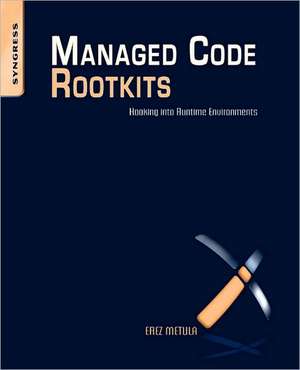
Managed Code Rootkits: Hooking into Runtime Environments
Autor Erez Metulaen Limba Engleză Paperback – 25 noi 2010
ABORDAREA PRACTICĂ: Managed Code Rootkits se distinge prin trecerea rapidă de la conceptele teoretice ale mediilor de execuție la implementarea efectivă a codului malițios. Spre deosebire de lucrările care analizează securitatea la nivel de sistem de operare, Erez Metula se concentrează pe mașina virtuală a aplicației, demonstrând cum un atacator poate altera implementarea runtime-ului. Remarcăm echilibrul dintre rigoarea tehnică și aplicabilitate; așa cum indică și recenziile de specialitate, sarcinile prezentate pot fi puse în lucru aproape imediat de către un specialist în securitate.
Abordarea diferă de Malware, Rootkits & Botnets A Beginner's Guide prin gradul ridicat de specializare — este mai puțin abstractă și mult mai aplicabilă pentru cei care lucrează direct cu limbaje intermediare. În timp ce alte titluri oferă o introducere generală în ecosistemul amenințărilor, această lucrare este un manual tehnic pentru nivel intermediar și avansat, axat pe manipularea mediilor Java, .NET și Android Dalvik.
Structura volumului reflectă o progresie logică, fiind organizată în patru părți esențiale. Primele capitole stabilesc bazele modelelor de mediu și scenariile de atac, în timp ce partea a doua intră în detaliile dezvoltării, acoperind instrumentele necesare și modificarea runtime-ului (Runtime Modification). Apreciem în mod deosebit secțiunea dedicată contramăsurilor, care nu se rezumă la teorie, ci oferă soluții tehnice de detecție și răspuns. Cele 20 de ilustrații incluse sunt vitale pentru înțelegerea fluxurilor complexe de date din interiorul mediilor gestionate. Este o resursă fundamentală pentru cercetătorii de malware și inginerii software care doresc să înțeleagă vulnerabilitățile profunde ale platformelor independente de procesor.
Preț: 249.29 lei
Preț vechi: 288.49 lei
-14%
Carte tipărită la comandă
Livrare economică 20 noiembrie-04 decembrie
Specificații
ISBN-10: 1597495743
Pagini: 336
Ilustrații: 20 illustrations
Dimensiuni: 191 x 235 x 23 mm
Greutate: 0.68 kg
Editura: ELSEVIER SCIENCE
V-ar putea interesa
-
 -20%Preț: 223.35 lei279.20 lei
 -
 CLR via CJeffrey Richter-20%Preț: 301.61 lei377.01 lei
 -
 ReversingEldad Eilam-20%Preț: 180.16 lei225.21 lei
 -
 -20%Preț: 255.72 lei319.65 lei
 -
 Python for CybersecurityHoward E Poston-20%Preț: 138.78 lei173.48 lei
 -
 -28%Preț: 295.73 lei411.52 lei
 -
 Hacking: The Art of Exploitation, 2nd EditionJon Erickson-35%Preț: 256.17 lei394.85 lei
 -
 -35%Preț: 325.22 lei496.70 lei
 -
 -35%Preț: 257.40 lei395.74 lei
 -
 -36%Preț: 223.02 lei349.15 lei
 -
 Metasploit, 2nd EditionDavid Kennedy-20%Preț: 295.28 lei369.11 lei
 -
 -36%Preț: 351.81 lei545.83 lei
 -
 -36%Preț: 253.24 lei392.66 lei
 -
 -20%Preț: 197.36 lei246.70 lei
 -
 -36%Preț: 283.89 lei440.71 lei
 -
 Heavy Wizardry 101: Shellcodes, Backdoors, Droppers and WormsDavid Martinez Oliveira-35%Preț: 288.14 lei443.89 lei
 -
 -35%Preț: 284.86 lei441.32 lei
 -
 Advanced Malware Analysis and IntelligenceMahadev Thukaram-20%Preț: 236.39 lei295.48 lei
 -
 .NET 10 RevealedKajetan Duszy¿ski-20%Preț: 240.60 lei300.75 lei
 -
 Mastering ASP.NET Core 10Mabrouk Mahdhi-20%Preț: 250.42 lei313.02 lei
Public țintă
Intermediate to advanced pen testers; hackers; malware researchers; software engineers; OS designers and developersDe ce să citești această carte
Recomandăm această carte profesioniștilor în penetration testing și cercetătorilor de malware care vor să treacă dincolo de atacurile clasice la nivel de sistem. Cititorul câștigă o înțelegere profundă a modului în care rootkit-urile pot fi ascunse în mediile runtime precum .NET sau Android. Este un ghid practic, premiat, care oferă instrumentele necesare atât pentru atacul, cât și pentru apărarea aplicațiilor moderne.
Descriere scurtă
The initial part of the book offers an overview of managed code rootkits. It explores environment models of managed code and the relationship of managed code to rootkits by studying how they use application VMs. It also discusses attackers of managed code rootkits and various attack scenarios. The second part of the book covers the development of managed code rootkits, starting with the tools used in producing managed code rootkits through their deployment.
The next part focuses on countermeasures that can possibly be used against managed code rootkits, including technical solutions, prevention, detection, and response tactics. The book concludes by presenting techniques that are somehow similar to managed code rootkits, which can be used in solving problems.
- Named a 2011 Best Hacking and Pen Testing Book by InfoSec Reviews
- Introduces the reader briefly to managed code environments and rootkits in general
- Completely details a new type of rootkit hiding in the application level and demonstrates how a hacker can change language runtime implementation
- Focuses on managed code including Java, .NET, Android Dalvik and reviews malware development scanarios
Cuprins
Chapter 1: Introduction
Chapter 2: Managed Code Rootkits
Part II: Malware Development
Chapter 3: Tools of the Trade
Chapter 4: Runtime Modification
Chapter 5: Manipulating the Runtime
Chapter 6: Extending the Language with a Malware API
Chapter 7: Automated Framework Modification
Chapter 8: Advanced Topics
Part III: Countermeasures
Chapter 9: Defending against MCRs
Part IV: Where Do We Go from Here?
Chapter 10: Other Uses of Runtime Modification
Recenzii
"As someone who has to deal with .NET security every day, I always look for new ideas and tools to make .NET applications more secure. This book provides both. It's especially valuable when you have to protect apps without having access to their original source code." -- Kyle C. Quest, GREM, GWAPT, GCIH, GCFA, GCIA, GCWN, GCUX, GCFW, GSNA, CISSP, CIPP, Director of Security Engineering, MetraTech
"Overall the book is very well structured and presented in a way that maintains the reader’s interest as the author delves ever deeper into why hackers use MCRs to target an organisation’s applications. Continuity of the content is maintained by helpful summaries at the end of each chapter… Mr Metula is a consummate and talented security practitioner who knows his subject thoroughly. I consider this book to be excellent value for money and would recommend it to any security professional. In today’s austere economic climate, modern IT solutions are being sought that are proven value for money. The use of virtual servers is rapidly increasing as they provide better utilisation and increased productivity of existing resources. This book highlights the risks of adopting such technology and provides valuable advice on countermeasures to mitigate those risks."--InfoSecReviews.com
"In today’s austere economic climate, modern IT solutions are being sought that are proven value for money. The use of virtual servers is rapidly increasing as they provide better utilisation and increased productivity of existing resources. This book highlights the risks of adopting such technology and provides valuable advice on countermeasures to mitigate those risks."--Best Hacking and Pen Testing Books in InfoSecReviews Book Awards