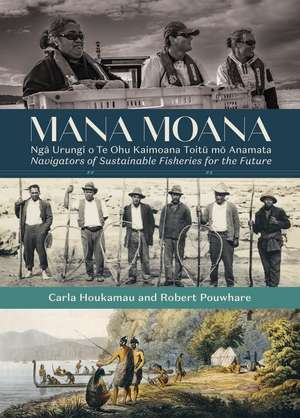
Mana Moana: Ngā Urungi o Te Ohu Kaimoana Toitū mō Anamata / Navigators of Sustainable Fisheries for the Future
Autor Carla Houkamau, Robert Pouwhareen Limba Engleză Paperback – 13 feb 2025
Mana Moana chronicles Māori fisheries in Aotearoa, linking ancient pūrākau of Polynesian navigators to contemporary issues of sustainability and economic development. It introduces readers to pre-colonial fishing methods, inter-tribal trade routes, and accounts from early European explorers who marvelled at Māori fishing prowess, and then moves on to detail the enduring struggle for Māori fishing rights, the 1992 Treaty of Waitangi Fisheries Settlement, and the creation of Aotearoa Fisheries Limited, now Moana New Zealand. Owned by fifty-eight iwi shareholders, Moana New Zealand is a unique business guided by te ao Māori values and committed to both commercial success and sustainability.
Weaving together history, mātauranga, business, and politics, Mana Moana offers readers deep insight into Māori fisheries and the realisation of mana Māori within a large-scale commercial enterprise.
Preț: 203.85 lei
Preț vechi: 261.88 lei
-22%
Puncte Express: 306
Carte disponibilă
Livrare economică 07-21 noiembrie
Livrare express 24-30 octombrie pentru 98.91 lei
Livrare prin curier în România Termenul estimat este afișat lângă disponibilitate.
Transport gratuit de la 400.00 lei Plată online sau ramburs, în funcție de opțiunile comenzii.
Retur gratuit în 14 zile Comandă securizată și suport în română.
Specificații
ISBN-13: 9781776711529
ISBN-10: 1776711521
Pagini: 304
Dimensiuni: 165 x 230 x 19 mm
Greutate: 0.63 kg
Editura: Auckland University Press
Colecția Auckland University Press
Locul publicării:Auckland, New Zealand
ISBN-10: 1776711521
Pagini: 304
Dimensiuni: 165 x 230 x 19 mm
Greutate: 0.63 kg
Editura: Auckland University Press
Colecția Auckland University Press
Locul publicării:Auckland, New Zealand
V-ar putea interesa
-
 -13%Preț: 218.87 lei252.97 lei
 -
 She-WolvesPaulina BrenPreț: 113.35 lei
 -
 The Caring CompanyIsaac GetzPreț: 183.45 lei
 -
 Preț: 137.61 lei
 -
 Friends That InvestSimran KaurPreț: 127.19 lei
 -
 The New Nature of BusinessAndre HoffmannPreț: 116.02 lei
 -
 Decolonizing EconomicsDevika DuttPreț: 142.79 lei
 -
 The Money ManualAbigail FosterPreț: 121.89 lei
 -
 -27%Preț: 1332.71 lei1814.36 lei
 -
 The ServiceberryRobin Wall KimmererPreț: 108.03 lei
 -
 Year of the RatHarry ShukmanPreț: 106.72 lei
 -
 Take Me to the RiverJackie KempPreț: 144.22 lei
 -
 Book of MoneyMonzoPreț: 85.58 lei
 -
 With the Law on Our SideLady HalePreț: 191.77 lei
 -
 The Pharaoh's PitchIvan Yong-11%Preț: 83.87 lei93.94 lei
 -
 LET It HappenMau Espinosa-11%Preț: 83.92 lei93.89 lei
 -
 Shadows At WorkSteven D'SouzaPreț: 112.53 lei
Recenzii
Mana Moana navigates the evolution of a vital Māori economic sector, spanning from pre-European contact to the present day. It is a fascinating story about the lattice of Indigenous spiritual traditions, ethical codes, and fisheries management systems that nurtured growth and innovation in the pre-colonial marine economy. The sweeping disruption and dispossession of colonisation unwound this lattice, leading in time to the near collapse of New Zealand’s fisheries. Yet, from this turmoil, a landmark court battle emerged, securing the recognition of rights and sparking the reformation of a new and flourishing Māori economic sector that draws upon its vibrant cultural traditions in its encounter with global markets. The book offers deep insights, illustrated through tangible examples, of how Indigenous economic institutions can be rebuilt to foster successful Indigenous enterprises, driven by Indigenous values, despite the constraints imposed by settler states.
Mana Moana makes a valuable contribution to the literature on Māori business, spanning from pre-European times, colonial settlement and treaty settlements, through to the post-treaty settlement era. The strengths of the book are its attention to history, tikanga and mātauranga, as well as the activity of fishing among Māori. The book is about the evolution of a Māori fishing enterprise within the context of the Māori political economy and how it has navigated challenges and opportunities in treaty settlements, industry, iwi, and Māori dynamics. A must-read for students, scholars, and practitioners of Indigenous business theory and practice.
Mana Moana makes a valuable contribution to the literature on Māori business, spanning from pre-European times, colonial settlement and treaty settlements, through to the post-treaty settlement era. The strengths of the book are its attention to history, tikanga and mātauranga, as well as the activity of fishing among Māori. The book is about the evolution of a Māori fishing enterprise within the context of the Māori political economy and how it has navigated challenges and opportunities in treaty settlements, industry, iwi, and Māori dynamics. A must-read for students, scholars, and practitioners of Indigenous business theory and practice.