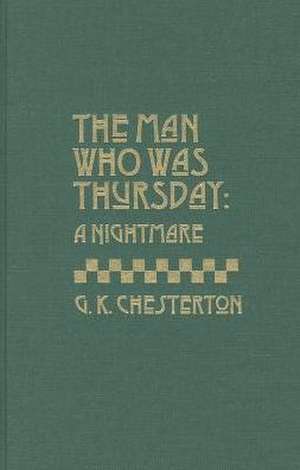
Man Who Was Thursday: A Nightmare
Autor G. K. Chestertonen Limba Engleză Hardback – 31 dec 1907
The Man Who Was Thursday
A Nightmare
by G. K. Chesterton
The Man Who Was Thursday: A Nightmare is a novel by G. K. Chesterton, first published in 1908. The book is sometimes referred to as a metaphysical thriller.
In Edwardian era London, Gabriel Syme is recruited at Scotland Yard to a secret anti-anarchist police corps. Lucian Gregory, an anarchistic poet, lives in the suburb of Saffron Park. Syme meets him at a party and they debate the meaning of poetry. Gregory argues that revolt is the basis of poetry. Syme demurs, insisting the essence of poetry is not revolution but law. He antagonizes Gregory by asserting that the most poetical of human creations is the timetable for the London Underground. He suggests Gregory isn't really serious about anarchism, which so irritates Gregory, that he takes Syme to an underground anarchist meeting place, revealing his public endorsement of anarchy is a ruse to make him seem harmless, when in fact he is an influential member of the local chapter of the European anarchist council.
The central council consists of seven men, each using the name of a day of the week as a cover name; the position of Thursday is about to be elected by Gregory's local chapter. Gregory expects to win the election but just before, Syme reveals to Gregory after an oath of secrecy, that he is a secret policeman. Fearful Syme may use his speech in evidence of a prosecution, Gregory's weakened words fail to convince the local chapter that he is sufficiently dangerous for the job. Syme makes a rousing anarchist speech and wins the vote. He is sent immediately as the chapter's delegate to the central council.
In his efforts to thwart the council, Syme eventually discovers that the other five members are also undercover detectives; each was employed just as mysteriously and assigned to defeat the Council. They soon find out they were fighting each other and not real anarchists; such was the mastermind plan of their president, Sunday. In a surreal conclusion, Sunday is unmasked as only seeming to be terrible; in fact, he is a force of good like the detectives. Sunday is unable to give an answer to the question of why he caused so much trouble and pain for the detectives. Gregory, the only real anarchist, seems to challenge the good council. His accusation is that they, as rulers, have never suffered like Gregory and their other subjects and so their power is illegitimate. Syme refutes the accusation immediately, because of the terrors inflicted by Sunday on the rest of the council.
Preț: 191.67 lei
Carte indisponibilă temporar
Specificații
ISBN-10: 0891905774
Pagini: 192
Dimensiuni: 145 x 216 x 18 mm
Greutate: 0.36 kg
Editura: Amereon Limited
V-ar putea interesa
-
 The Seven Dials Mystery. Special EditionAgatha ChristiePreț: 108.35 lei
 -
 Seven Dials. Netflix Tie-inAgatha ChristiePreț: 72.01 lei
 -
 The Secret AgentJoseph Conrad-27%Preț: 46.80 lei64.01 lei
 -
 The Secret Agent: A Simple TaleJoseph Conrad-19%Preț: 52.78 lei64.95 lei
 -
 Father Brown Selected StoriesG. K. Chesterton-18%Preț: 52.66 lei64.59 lei
 -
 The Picture of Dorian GrayOscar WildePreț: 35.72 lei
 -
 OrthodoxyG. K. Chesterton-18%Preț: 29.30 lei35.91 lei
 -
 The Hitchhiker's Guide To The GalaxyDouglas Adams-27%Preț: 76.76 lei105.82 lei
 -
 As If By MagicAnthony WynnePreț: 76.27 lei
 -
 Me Before YouJojo Moyes-24%Preț: 61.38 lei80.74 lei
 -
 Tales of Ordinary MadnessCharles Bukowski-31%Preț: 73.70 lei106.18 lei
 -
 Revenge of OdessaFrederick ForsythPreț: 109.20 lei
 -
 Collected Works of G.K. ChestertonG. K. ChestertonPreț: 124.34 lei
 -
 The Sugar ManNicolás ObregónPreț: 79.59 lei
 -
 The Man Who Was ThursdayG. K. ChestertonPreț: 88.99 lei
 -
 PhantastesGeorge MacDonaldPreț: 41.07 lei
 -
 The ProphetKahlil GibranPreț: 27.21 lei
 -
 -27%Preț: 77.56 lei106.86 lei
 -
 The Wisdom of Father BrownG. K. ChestertonPreț: 41.86 lei
 -
 HereticsG. K. ChestertonPreț: 46.29 lei
 -
 This is the Day They Dream OfRobert GoddardPreț: 151.19 lei
 -
 The Society of Unknowable ObjectsGareth BrownPreț: 123.96 lei
 -
 The Everyman ChestertonG. K. Chesterton-16%Preț: 123.15 lei147.20 lei
 -
 The Devil is a GentlemanPhil BakerPreț: 154.23 lei
 -
 The Time MachineH. G. WellsPreț: 33.23 lei
 -
 Draußen vor der TürWolfgang BorchertPreț: 67.17 lei
 -
 The Ball and the CrossG. K. ChestertonPreț: 44.87 lei
 -
 ManaliveG. K. ChestertonPreț: 38.39 lei
 -
 UtopiaThomas MorePreț: 33.19 lei
 -
 The Secret of Secrets. Large PrintDan BrownPreț: 257.25 lei
Notă biografică
Textul de pe ultima copertă
Descriere
A group of anarchists are under surveillance by Scotland Yard in Chesterton's hugely popular metaphysical thriller.
The Supreme Anarchists Council is dedicated to overthrowing the world order. To keep their identities a secret, each of them has been named a day of the week. Gabriel Syme, an eccentric poet, is recruited by Scotland Yard to infiltrate the group. He tracks down the six men and manages to win a place on the council. But in a bizarre and surreal twist of events, Syme realises that five of the six members are not at all what they seem . . .