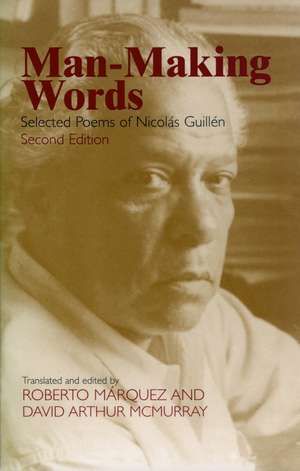
Man-Making Words: Selected Poems of Nicolas Guillen
Autor Nicolas Guillen Traducere de Roberto Marquez, David Arthur McMurrayen Limba Engleză Paperback – 7 oct 2003
Preț: 252.41 lei
Puncte Express: 379
Carte tipărită la comandă
Livrare economică 20 noiembrie-04 decembrie
Livrare prin curier în România Termenul estimat este afișat lângă disponibilitate.
Transport gratuit de la 400.00 lei Plată online sau ramburs, în funcție de opțiunile comenzii.
Retur gratuit în 14 zile Comandă securizată și suport în română.
Specificații
ISBN-13: 9781558494107
ISBN-10: 1558494103
Pagini: 256
Dimensiuni: 152 x 235 x 18 mm
Greutate: 0.4 kg
Ediția:Second Edition, Second Edition
Editura: University of Massachusetts Press
Colecția University of Massachusetts Press
ISBN-10: 1558494103
Pagini: 256
Dimensiuni: 152 x 235 x 18 mm
Greutate: 0.4 kg
Ediția:Second Edition, Second Edition
Editura: University of Massachusetts Press
Colecția University of Massachusetts Press
V-ar putea interesa
-
 The Canterbury TalesGeoffrey Chaucer-23%Preț: 62.05 lei80.96 lei
 -
 PoemsWang WeiPreț: 78.29 lei
 -
 Don''t Let Me Be LonelyClaudia Rankine-20%Preț: 61.73 lei77.17 lei
 -
 The Selected Poetry of Pier Paolo Pasolini: A Bilingual EditionPier Paolo PasoliniPreț: 211.67 lei
 -
 Book of HoursKevin YoungPreț: 115.97 lei
 -
 New Selected Poems 1988-2013Seamus HeaneyPreț: 105.99 lei
 -
 Tasker StreetMark HallidayPreț: 116.85 lei
 -
 Whiskey Words & a Shovel IIIR H Sin-41%Preț: 75.18 lei127.07 lei
 -
 -27%Preț: 66.57 lei91.73 lei
 -
 Things You Find in a Poet's BeardA. F. HarroldPreț: 71.44 lei
Notă biografică
ROBERTO MÁRQUEZis professor of Latin American studies at Mount Holyoke College. DAVID ARTHUR MCMURRAY, at the time of original publication, taught in the department of comparative literature at the University of Alberta.
Cuprins
Preface
Introduction
Notes on Sources
Introduction
- Exilio | Exile
- Rios | Rivers
- Bares | Bars
- Ciudades | Cities
- Cancíon carioca | Carioca Song
- Brazil—Copacabana | Brazil—Copacabana
- La pequeña balada de Plóvdiv | Little Ballad of Plovdiv
- En el invierno de París | Winter in Paris
- Casa de vecindad | Neighborhood House
- Unión Soviética | Soviet Union
- El Cosmonauta | The Cosmonaut
- Sputnik | Sputnok
- Canciones chinas | Chinese Songs
- Wu Sang-Kuei | Wu Sang-Kuei
- Paul Éluard | Paul Éluard
- Mi chiquita | My Little Women
- Piedra de horno | Ovenstone
- Ana María | Ana María
- Deportes | Sports
- Pequeña oda a un negro boxeador cubano | Small Ode to a Black Cuban Boxer
- ¿Qué color? | What Color?
- Gobernador | Governor
- Escolares | Schoolwork
- Little Rock | Little Rock
- Mau-Maus | Mau-Maus
- Calor | Heat
- Ancestros | Ancestry
- Un negro canta en Nueva York | A Black Man Sings in New York City
- Balada de los dos abuelos | Ballad of the two Grandfathers
- Un son para nińos antillanos | Son for Antillean Children
- El apellido | My Last Name
- Elegía Cubana | Cuban Elegy
- Elegía a Emmett Till | Elegy for Emmitt Till
- Elegìa a Jacques Roumain | Elegy for Jacques Roumain
- Elegía Camagüeyana | Elegy for Camagüey
- Elegía a Jesús Menéndez | Elegy for Jesús Menéndez
- Fusilamiento | Execution
- Palabras en el trópico | Words in the Tropics
- Llegada | Arrival
- Pequeña letanía grotesca en la muerte del senador McCarthy | Short Grotesque Litany on the Death of Senator McCarthy
- Canción puertorriqueña | Song for Puerto Rico
- Bonsal | Bonsal
- Allá lejos. . . | Far Off. . .
- Crecen altas las flores | the Flowers Grow High
- ¿Puedes? | Sell Me?
- Cualquier tiempo pasado fue peor | Whatever time is Past was Worse
- Tierra en la sierra y el llano | Land in the Sierra and the Plain
- Guitarra en duelo mayor | Guitar in Mourning Major
- Lectura de domingo | Sunday Reading
- Canta el sinsonte en el Turquino | Thus Sings a Mockingbird in el Turquino
- Vine en un barco negrero | I Came on a Slaveship
- Angela Davis | Angela Davis
Notes on Sources
Recenzii
“In a continent of poets, Nicolás Guillén stood out above the crowd. In Castro's Cuba he had no peer. He belonged to the great generation of Latin American writers—Pablo Neruda being the most famous—for whom politics and literature were inextricably linked. . . . Guillén was . . . a great actor, a wonderful declaimer of his own and others' poetry, and always a bit larger than life. But it was chiefly through his influence and support that the black element in Cuban culture, politics, and society was given official encouragement and support.”—(Manchester) Guardian
“One of Latin America's best-known writers and the man who introduced African and Latin musical rhythms into verse. . . . Guillén's work celebrated Cuba's multiracial and ethnic mix as well as the 1959 communist revolution. . . . Prensa Latina said word of his death sent a ‘shock wave’ through Cuba's people, many of whom knew his verses by heart.”—Boston Globe
“Guillén, the national poet of Cuba, was often described as one of the finest poets of the Spanish language. He was certainly outstanding among Latin American poets for his folk-poetry reflecting the speech rhythms of ordinary people and the rich ethnic lore of his island. His best-known contribution to the poetry of Latin America was the interaction of African rhythms and Latin music, well represented by his development of the 'son' as a poetic form—the son (or black sound) being in the 1930s an established Cuban dance.”—Independent
“Guillén . . . was one of the three or four major Latin American poets of this century, and the most important of all those of the Negroist or Afro-Cuban tendency. His work was also widely known in Spain, where he was held in very high esteem.”—(London) Times
“One of Latin America's best-known writers and the man who introduced African and Latin musical rhythms into verse. . . . Guillén's work celebrated Cuba's multiracial and ethnic mix as well as the 1959 communist revolution. . . . Prensa Latina said word of his death sent a ‘shock wave’ through Cuba's people, many of whom knew his verses by heart.”—Boston Globe
“Guillén, the national poet of Cuba, was often described as one of the finest poets of the Spanish language. He was certainly outstanding among Latin American poets for his folk-poetry reflecting the speech rhythms of ordinary people and the rich ethnic lore of his island. His best-known contribution to the poetry of Latin America was the interaction of African rhythms and Latin music, well represented by his development of the 'son' as a poetic form—the son (or black sound) being in the 1930s an established Cuban dance.”—Independent
“Guillén . . . was one of the three or four major Latin American poets of this century, and the most important of all those of the Negroist or Afro-Cuban tendency. His work was also widely known in Spain, where he was held in very high esteem.”—(London) Times