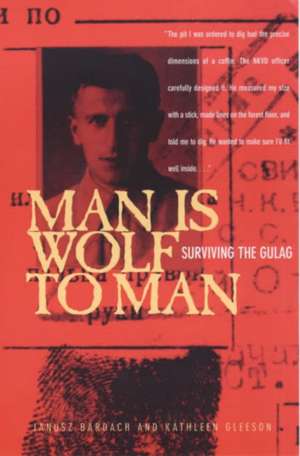
Man Is Wolf to Man: Surviving the Gulag
Autor Janusz Bardach, Kathleen Gleeson Adam Hochschilden Limba Engleză Paperback – 31 aug 1999
Ofițerul NKVD trasează linii precise pe pământul înghețat al pădurii, măsurând cu un băț înălțimea condamnatului pentru a se asigura că groapa pe care acesta este pus să o sape va avea dimensiunile exacte ale unui sicriu. Observăm în această scenă de o brutalitate matematică debutul transformării lui Janusz Bardach dintr-un soldat al Armatei Roșii, însuflețit de idealuri comuniste, într-un „dușman al poporului” condamnat la zece ani de muncă silnică. Man Is Wolf to Man nu este doar o cronică a supraviețuirii în Kolyma — cel mai necruțător punct al sistemului concentraționar stalinist — ci o analiză chirurgicală a condiției umane în fața anihilării.
Subliniem modul în care autorul, care ulterior a devenit un reputat chirurg plastician, reușește să redea cu o claritate senzorială copleșitoare realitatea foamei, a frigului extrem și a violenței arbitrare. Ca și Journey into the Land of the Zeks and Back de Julius Margolin, această biografie transformă documentele și amintirile traumatice într-o narațiune fluidă despre pierderea identității și lupta pentru a rămâne om într-un sistem conceput să te transforme în animal sau în cadavru. Merită menționat că, spre deosebire de alte mărturii, Bardach scrie din perspectiva cuiva care a crezut inițial în sistemul care l-a devorat, oferind o perspectivă rară asupra deziluziei ideologice.
Această lucrare este pilonul central al operei sale biografice, fiind completată ulterior de Surviving Freedom – After the Gulag, unde autorul explorează traumele post-eliberare. Dacă în lucrările ulterioare accentul cade pe reintegrare, aici structura narativă este dominată de ritmul sufocant al supraviețuirii zilnice. Această ediție revizuită de la University of California Press rămâne un document istoric vital, oferind o mărturie despre Gulag la fel de densă și necesară precum cele ale lui Soljenițîn sau Ginzburg.
Preț: 237.26 lei
Carte tipărită la comandă
Livrare economică 08-22 decembrie
Specificații
ISBN-10: 0520221524
Pagini: 408
Dimensiuni: 153 x 230 x 26 mm
Greutate: 0.61 kg
Ediția:Revised
Editura: University of California Press
V-ar putea interesa
-
 American JezebelEve LaplantePreț: 95.38 lei
 -
 The Diary of a Napoleonic Foot SoldierJakob WalterPreț: 144.83 lei
 -
 Eleanor Roosevelt, Volume 2Blanche Wiesen CookPreț: 222.72 lei
 -
 The Girl in the PictureDenise ChongPreț: 154.59 lei
 -
 In My Brother's ImageEugene L PoganyPreț: 157.73 lei
 -
 American DynastyKevin PhillipsPreț: 139.88 lei
 -
 Mao ZedongJonathan D. SpencePreț: 144.23 lei
 -
 Revolutionary CharactersGordon S. WoodPreț: 103.07 lei
 -
 Half the Way HomeAdam HochschildPreț: 113.50 lei
 -
 Mirror at MidnightAdam HochschildPreț: 122.20 lei
 -
 A More Perfect UnionMaurice A. HargravesPreț: 81.41 lei
 -
 More Frontier Justice in the Wild WestR. Michael WilsonPreț: 99.96 lei
 -
 Preț: 143.96 lei
 -
 Savage Jungle: An Epic Struggle for SurvivalIain FinlayPreț: 133.18 lei
 -
 Australia's 'war on terror' DiscourseKathleen Gleeson-15%Preț: 437.03 lei514.15 lei
 -
 Australia's 'war on terror' DiscourseKathleen Gleeson-18%Preț: 1256.55 lei1532.39 lei
 -
 I Am Too...Kenneth PattersonPreț: 105.58 lei
 -
 -7%Preț: 101.52 lei109.56 lei
 -
 Rolling CoffinsBrian Richard EsherPreț: 146.05 lei
 -
 My Redcoat Ancestor and Other StoriesVeronica PinckardPreț: 98.14 lei
 -
 Determined: The Story of Holocaust Survivor Avraham PerlmutterPh. D. A. Avraham PerlmutterPreț: 85.08 lei
 -
 Preț: 156.02 lei
 -
 Schatten über dem KongoAdam HochschildPreț: 237.84 lei
De ce să citești această carte
Recomandăm această carte cititorilor care doresc să înțeleagă mecanismele interne ale Gulagului prin ochii unui martor direct care a supraviețuit „Siberiei Siberiilor”. Janusz Bardach oferă mai mult decât o lecție de istorie; este o lecție de reziliență umană. Cititorul va câștiga o perspectivă onestă asupra modului în care demnitatea poate fi păstrată chiar și atunci când individul este redus la o simplă unitate de muncă în gerul de la Kolyma.
Despre autor
Janusz Bardach a fost un renumit chirurg plastician și reconstructiv, a cărui carieră medicală de succes în Iowa City a fost clădită pe fundamentele unei tinereți marcate de ororile totalitarismului. Evreu de origine poloneză, a trecut prin experiența limită a lagărelor de muncă din Siberia sub regimul stalinist, experiență care i-a definit înțelegerea asupra rezistenței fizice și psihice. Colaborarea sa cu Kathleen Gleeson, absolventă a programului de scriere non-ficțiune de la Universitatea din Iowa, și prefața semnată de Adam Hochschild conferă acestui volum o rigoare literară și istorică deosebită.
Descriere scurtă
In 1941 Janusz Bardach's death sentence was commuted to ten years' hard labor and he was sent to Kolyma--the harshest, coldest, and most deadly prison in Joseph Stalin's labor camp system--the Siberia of Siberias. The only English-language memoir since the fall of communism to chronicle the atrocities committed during the Stalinist regime, Bardach's gripping testimony explores the darkest corners of the human condition at the same time that it documents the tyranny of Stalin's reign, equal only to that of Hitler. With breathtaking immediacy, a riveting eye for detail, and a humanity that permeates the events and landscapes he describes, Bardach recounts the extraordinary story of this nearly inconceivable world.
The story begins with the Nazi occupation when Bardach, a young Polish Jew inspired by Soviet Communism, crosses the border of Poland to join the ranks of the Red Army. His ideals are quickly shattered when he is arrested, court-martialed, and sentenced to death. How Bardach survives an endless barrage of brutality--from a near-fatal beating to the harsh conditions and slow starvation of the gulag existence--is a testament to human endurance under the most oppressive circumstances. Besides being of great historical significance, Bardach's narrative is a celebration of life and a vital affirmation of what it means to be human. FROM THE BOOK:"The pit I was ordered to dig had the precise dimensions of a casket. The NKVD officer carefully designed it. He measured my size with a stick, made lines on the forest floor, and told me to dig. He wanted to make sure I'd fit well inside."
In 1941 Janusz Bardach's death sentence was commuted to ten years' hard labor and he was sent to Kolyma--the harshest, coldest, and most deadly prison in Joseph Stalin's labor camp system--the Siberia of Siberias. The only English-language memoir since the fall of communism to chronicle the atrocities committed during the Stalinist regime, Bardach's gripping testimony explores the darkest corners of the human condition at the same time that it documents the tyranny of Stalin's reign, equal only to that of Hitler. With breathtaking immediacy, a riveting eye for detail, and a humanity that permeates the events and landscapes he describes, Bardach recounts the extraordinary story of this nearly inconceivable world.
The story begins with the Nazi occupation when Bardach, a young Polish Jew inspired by Soviet Communism, crosses the border of Poland to join the ranks of the Red Army. His ideals are quickly shattered when he is arrested, court-martialed, and sentenced to death. How Bardach survives an endless barrage of brutality--from a near-fatal beating to the harsh conditions and slow starvation of the gulag existence--is a testament to human endurance under the most oppressive circumstances. Besides being of great historical significance, Bardach's narrative is a celebration of life and a vital affirmation of what it means to be human.
Textul de pe ultima copertă
"An extraordinary story of human brutality, human kindness, and human ability to survive under the most inhuman conditions imaginable. It should demonstrate to anyone who still entertains illusions about Soviet Communism how closely it resembled Nazism."--Richard Pipes
"Beneath the layers of history and the ideological divisions, "Man Is Wolf to Man is a glorious testimony to the resilience of the human spirit and a celebration of the tragic improvisations which are sometimes required to save a human life. After several generations, J. Bardach has opened another window into the tragic world first explored by A. Koestler in "Darkness at Noon. This is a worthy and affirmative book."--James A. McPherson
"Being spellbound by Dr. Bardach's vivid and richly detailed recollections, you become a fellow companion of a Jewish youth from Poland in his head-spinning odyssey across eight time-zones eastward with the Kolyma gold mines as the final destination. Through Bardach's experiences, one understands the feelings of countless other victims of history who found themselves between a rock and a hard place, as the relentless and senseless forces drove them from the Nazi gas chambers into the killing fields of Communism."--Vassily Aksyonov