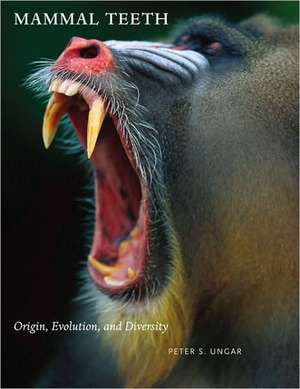
Mammal Teeth
Autor Peter S. Ungaren Limba Engleză Hardback – 30 sep 2010
Remarcăm în Mammal Teeth o sinteză riguroasă a istoriei evolutive, care pornește de la primele structuri vertebrate mineralizate de acum 500 de milioane de ani. Această ediție publicată de Johns Hopkins University Press se distinge prin modul în care Peter S. Ungar transformă studiul dentiției dintr-o analiză morfologică aridă într-o cronică a adaptării biologice. Autorul explică tranziția de la dinții conici simpli la structurile complexe ale molarilor și incisivilor, corelând direct forma acestora cu mecanica maxilarului și necesitățile nutriționale. Putem afirma că elementul de noutate cel mai valoros este includerea cercetărilor proprii ale lui Ungar privind analiza micro-uzurii, o metodă care a revoluționat înțelegerea dietelor speciilor dispărute. Structura volumului este echilibrată: prima parte urmărește firul cronologic al evoluției, în timp ce secțiunea finală oferă un inventar taxonomic exhaustiv al mamiferelor actuale, explorând inclusiv curiozități morfologice precum colții. Din punct de vedere vizual, cele 92 de desene liniare facilitează înțelegerea diferențelor subtile dintre familii. Comparabil cu The Teeth of Mammalian Vertebrates de Barry Berkovitz în rigurozitate, volumul de față este însă actualizat pentru a include corelații interdisciplinare între paleontology, mamalogie și antropologie, oferind o perspectivă mai largă asupra modului în care schimbările climatice și dietetice au modelat specia umană. Față de Teeth de Simon Hillson, care se concentrează pe contextul arheologic, lucrarea lui Ungar pune accentul pe biologia evoluționistă pură, fiind o resursă fundamentală pentru curriculumul universitar de biologie și paleontologie.
Preț: 592.40 lei
Preț vechi: 769.34 lei
-23%
Carte disponibilă
Livrare economică 28 octombrie-11 noiembrie
Livrare express 14-20 octombrie pentru 57.04 lei
Specificații
ISBN-10: 0801896681
Pagini: 320
Ilustrații: 6 b&w photos, 6 b&w illus., 92 line drawings
Dimensiuni: 228 x 287 x 29 mm
Greutate: 1.13 kg
Ediția:1
Editura: Johns Hopkins University Press
Locul publicării:Baltimore, United States
De ce să citești această carte
O resursă esențială pentru cercetători și studenți în biologie sau paleontologie. Cititorul câștigă o înțelegere profundă a modului în care dinții servesc drept „fosile vii” pentru a descifra evoluția mamiferelor. Cartea este recomandată pentru rigoarea premiată cu PROSE Award și pentru capacitatea de a conecta morfologia dentară de strategiile de supraviețuire și dietă ale speciilor, de la origini până în prezent.