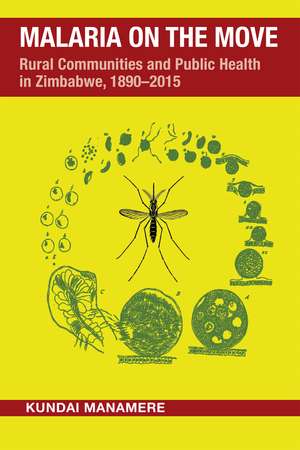
Malaria on the Move: Rural Communities and Public Health in Zimbabwe, 1890-2015: Perspectives on Global Health
Autor Kundai Manamereen Limba Engleză Paperback – apr 2025
Malaria on the Move explores the socioeconomic aspects of endemic malaria in the southeastern lowveld of Zimbabwe. The book provides a historical analysis of malaria control and eradication programs in Rhodesia and independent Zimbabwe from the late nineteenth century to 2015. Kundai Manamere draws connections between malaria epidemiology and human mobility relating to large- and small-scale farming, labor migration, colonial displacement, war, and rural-to-urban movements. She examines how circular labor migration and rural travel influence the risk of malaria for individuals and communities and shows how migration and travel have spread the disease and impeded control efforts. More important, the book demonstrates that the need to travel for work is an indicator of a local hierarchy of priorities. It reaffirms the urgent need for partners in malaria control to consider local socioeconomic factors in their design and implementation of intervention programs. The inclusion of local contexts, perspectives, and voices in the formulation of national and global public health policies and interventions is critical to addressing public noncooperation. To date, biomedical studies of malaria have outnumbered socioeconomic and political studies of the disease. Manamere advocates for a multipronged approach that goes beyond standard scientific research methods. Such an approach incorporates an understanding of how socioeconomic considerations of recipient communities influence malaria epidemiology, local perceptions of the disease, and responses to interventions. This context is particularly important for understanding why malaria has remained a global health challenge and why so many interventions have failed. Scientifically, malaria is a disease of the landscape, and its ecological complexity poses challenges to its eradication. Yet, biological and ecological landscapes are not exclusive factors in the spread of disease; as Manamere demonstrates, the socioeconomic environment is equally important.




Preț: 240.65 lei
Puncte Express: 361
Carte disponibilă
Livrare economică 02-16 noiembrie
Livrare express 16-22 octombrie pentru 26.70 lei
Livrare prin curier în România Termenul estimat este afișat lângă disponibilitate.
Transport gratuit de la 400.00 lei Plată online sau ramburs, în funcție de opțiunile comenzii.
Retur gratuit în 14 zile Comandă securizată și suport în română.
Specificații
ISBN-13: 9780821425862
ISBN-10: 0821425862
Pagini: 224
Dimensiuni: 150 x 225 x 18 mm
Greutate: 0.34 kg
Editura: Ohio University Press
Colecția Ohio University Press
Seria Perspectives on Global Health
ISBN-10: 0821425862
Pagini: 224
Dimensiuni: 150 x 225 x 18 mm
Greutate: 0.34 kg
Editura: Ohio University Press
Colecția Ohio University Press
Seria Perspectives on Global Health
Recenzii
"Malaria on the Move greatly enriches our understanding of the history of malaria in southern Africa. Kundai Manamere details how government policies and economic necessity drove Africans to move between malarial and non-malarial regions of southeast Africa over the past century. These movements shaped the changing epidemiology of malaria and undermined efforts to eliminate it. The book provides a richly documented case study that should be read by scholars and practitioners alike."—Randall M. Packard, author of The Making of a Tropical Disease: A Short History of Malaria
Notă biografică
Kundai Manamere is a research fellow at the University of the Free State's International Studies Group. Her research interests include global health, migration, women's histories, and the history of science and technology.
Cuprins
List of Illustrations
Acknowledgments
Abbreviations
Introduction
Mobility, Livelihoods, and Malaria Control
ONE Settler Colonialism and Malaria Control in Southern Rhodesia, 1890s–1930s
TWO Colonial Displacements and Barrier Spraying in the Southeastern Lowveld, 1940s–1950s
THREE Labor Migration and the WHO Preeradication Program, 1948–1965
FOUR Further Colonial Displacements, War, and the Development of Privatized Malaria Control at Triangle, 1966–1979
FIVE Circular Migration and the Threat of Imported Malaria, 1980–1999
SIX Resettlement and the RBM-Supported National Malaria Control Program, 2000–2015
Conclusion
Notes
Bibliography
Index
Acknowledgments
Abbreviations
Introduction
Mobility, Livelihoods, and Malaria Control
ONE Settler Colonialism and Malaria Control in Southern Rhodesia, 1890s–1930s
TWO Colonial Displacements and Barrier Spraying in the Southeastern Lowveld, 1940s–1950s
THREE Labor Migration and the WHO Preeradication Program, 1948–1965
FOUR Further Colonial Displacements, War, and the Development of Privatized Malaria Control at Triangle, 1966–1979
FIVE Circular Migration and the Threat of Imported Malaria, 1980–1999
SIX Resettlement and the RBM-Supported National Malaria Control Program, 2000–2015
Conclusion
Notes
Bibliography
Index
Descriere
Malaria on the Move provides a historical analysis of malaria control in Rhodesia and independent Zimbabwe from the late nineteenth century to 2015. The book examines how migration and travel influence the risk of malaria and reaffirms the need to take into consideration local socioeconomic factors in designing and implementing interventions.