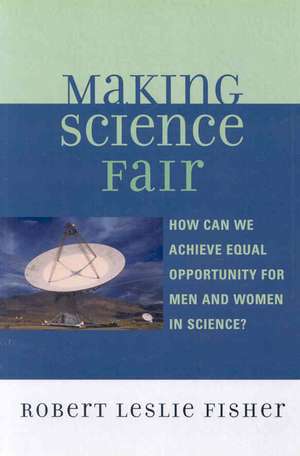
Making Science Fair: How Can We Achieve Equal Opportunity for Men and Women in Science?
Autor Robert Leslie Fisheren Limba Engleză Paperback – 11 iun 2007
First, we need to attract more women and minorities to pursue advanced degrees. Equally important are new tools to evaluate scientists throughout their careers to replace the unreliable simple count of publications. It merely measures the number of collaborators of a scientist, where men have an overwhelming advantage. Drawing primarily on the literature in program evaluation, the author presents two proposed metrics that would more accurately represent the research contributions of women scholars.
Preț: 279.38 lei
Preț vechi: 387.39 lei
-28%
Puncte Express: 419
Carte tipărită la comandă
Livrare economică 07-21 decembrie
Livrare prin curier în România Termenul estimat este afișat lângă disponibilitate.
Transport gratuit de la 400.00 lei Plată online sau ramburs, în funcție de opțiunile comenzii.
Retur gratuit în 14 zile Comandă securizată și suport în română.
Specificații
ISBN-13: 9780761837954
ISBN-10: 0761837957
Pagini: 114
Dimensiuni: 146 x 226 x 12 mm
Greutate: 0.2 kg
Editura: Bloomsbury Publishing
Colecția University Press of America
Locul publicării:New York, United States
ISBN-10: 0761837957
Pagini: 114
Dimensiuni: 146 x 226 x 12 mm
Greutate: 0.2 kg
Editura: Bloomsbury Publishing
Colecția University Press of America
Locul publicării:New York, United States
Cuprins
Part 1 Preface
Part 2 Introduction
Chapter 3 Why are so few women in the STEM fields?
Chapter 4 The mismeasure of scientific productivity
Chapter 5 New ways of conceptualizing scientific productivity
Chapter 6 Conclusions and policy recommendations
Part 7 Appendix One: Measuring research productivity in a gender neutral way
Part 8 Appendix Two: Data comparing countries in respect to women researchers
Part 9 Index
Part 10 About the Author
Part 2 Introduction
Chapter 3 Why are so few women in the STEM fields?
Chapter 4 The mismeasure of scientific productivity
Chapter 5 New ways of conceptualizing scientific productivity
Chapter 6 Conclusions and policy recommendations
Part 7 Appendix One: Measuring research productivity in a gender neutral way
Part 8 Appendix Two: Data comparing countries in respect to women researchers
Part 9 Index
Part 10 About the Author
Recenzii
Worth reading. Summing Up: Recommended.
Independent scholar Fisher has startling facts and figures and asserts that at least part of the problem in attracting and retaining new scientists is that women are openly discouraged in the classroom, in the lab, and in the boardroom. He finds that filling the "scientist gap" requires taking a hard look at universities that cater exclusively to white males and a "publish or perish" academic system in which having a female first name will guarantee you will perish.
Independent scholar Fisher has startling facts and figures and asserts that at least part of the problem in attracting and retaining new scientists is that women are openly discouraged in the classroom, in the lab, and in the boardroom. He finds that filling the "scientist gap" requires taking a hard look at universities that cater exclusively to white males and a "publish or perish" academic system in which having a female first name will guarantee you will perish.