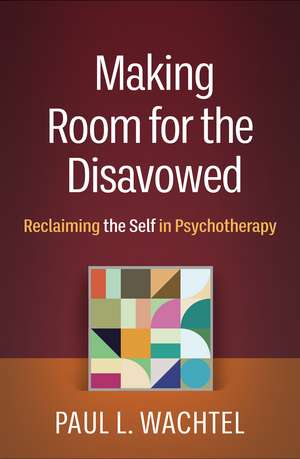
Making Room for the Disavowed: Reclaiming the Self in Psychotherapy
Autor Paul L. Wachtelen Limba Engleză Paperback – 18 dec 2023
See also Wachtel's Therapeutic Communication, Second Edition: Knowing What to Say When, as well as Mastering the Clinical Conversation: Language as Intervention, by Matthieu Villatte, Jennifer L. Villatte, and Steven C. Hayes.
Preț: 367.61 lei
Preț vechi: 386.96 lei
-5%
Puncte Express: 551
Carte disponibilă
Livrare economică 22 octombrie-05 noiembrie
Livrare express 07-13 octombrie pentru 39.12 lei
Livrare prin curier în România Termenul estimat este afișat lângă disponibilitate.
Transport gratuit de la 400.00 lei Plată online sau ramburs, în funcție de opțiunile comenzii.
Retur gratuit în 14 zile Comandă securizată și suport în română.
Specificații
ISBN-13: 9781462553174
ISBN-10: 1462553176
Pagini: 336
Dimensiuni: 152 x 229 x 31 mm
Greutate: 0.48 kg
Ediția:1
Editura: Guilford Publications
Colecția Guilford Press
ISBN-10: 1462553176
Pagini: 336
Dimensiuni: 152 x 229 x 31 mm
Greutate: 0.48 kg
Ediția:1
Editura: Guilford Publications
Colecția Guilford Press
V-ar putea interesa
-
 -26%Preț: 89.84 lei121.64 lei
 -
 Tailoring Treatment to Attachment PatternsDiana Fosha-5%Preț: 316.99 lei333.68 lei
 -
 Schema Therapy: Distinctive FeaturesEshkol Rafaeli-5%Preț: 178.32 lei187.71 lei
 -
 -5%Preț: 248.85 lei261.95 lei
 -
 Preț: 336.61 lei
 -
 -5%Preț: 573.35 lei603.53 lei
 -
 Healing Relational Trauma WorkbookDaniel A HughesPreț: 265.07 lei
 -
 The Handbook of Person-Centred Psychotherapy and CounsellingDr. Gina Di Malta-23%Preț: 286.45 lei370.91 lei
 -
 Preț: 343.31 lei
 -
 Treating Attachment Disorders, Second Edition: From Theory to TherapyKarl Heinz Brisch-5%Preț: 356.59 lei375.36 lei
 -
 Attachment in PsychotherapyDavid J. Wallin-5%Preț: 326.67 lei343.87 lei
 -
 -5%Preț: 317.58 lei334.30 lei
 -
 Emotional Schema TherapyRobert L. Leahy-5%Preț: 316.18 lei332.82 lei
 -
 Grounding Psychotherapy in Self-CompassionGalia Tyano Ronen-5%Preț: 364.78 lei383.98 lei
 -
 Facilitating Emotional Change: The Moment-by-Moment ProcessLeslie S. Greenberg-5%Preț: 347.12 lei365.39 lei
 -
 Working with Emotions in PsychotherapyLeslie S. Greenberg-5%Preț: 346.79 lei365.03 lei
 -
 Schema Therapy: A Practitioner's GuideJeffrey E. Young-5%Preț: 416.45 lei438.37 lei
 -
 -5%Preț: 405.90 lei427.27 lei
 -
 -28%Preț: 94.29 lei130.89 lei
 -
 It Didn't Start With You WorkbookMark WolynnPreț: 119.33 lei
Recenzii
"Wachtel eloquently presents a wonderful integrative approach in which making room is the pivotal process. Making room does not involve interpreting, modifying, or educating; it is about helping the person gain access to parts of self they have shied away from. This is the work on theoretical integration that the field has been waiting for."--Leslie S. Greenberg, PhD, Distinguished Research Professor Emeritus of Psychology, York University, Canada
"This is a groundbreaking volume from a giant of psychotherapy who has long sought ways to build bridges between psychodynamic thinking and other traditions. Wachtel's focus on making room challenges some aspects of traditional psychodynamic approaches; at the same time, it makes the psychodynamic methods described here immediately accessible and valuable to practitioners of humanistic approaches, third-wave cognitive-behavioral therapy, or many other varieties of modern psychotherapy. The book is brilliant and challenging--I highly recommend it."--Steven C. Hayes, PhD, Foundation Professor of Psychology Emeritus, University of Nevada, Reno; codeveloper of Acceptance and Commitment Therapy
"A necessary companion for practicing clinicians and students alike. Wachtel's book is like a microfiber cloth to clean our psychotherapist-lenses. It highlights the delicate and dynamic relationship between therapist and patient--and is a lesson on how to build a sturdy enough room to house it."--Esther Perel, MA, LMFT, private practice, New York City; podcast host, Where Should We Begin?
"This readable book embodies its own subject matter--expanding therapeutic conversations rather than forcing them into the narrow paradigms into which contemporary researchers and clinicians are socialized. Whether trained in DSM diagnoses, symptom-focused manuals, or authoritarian rules of interpretation, mental health professionals will find Wachtel’s book both incisive and liberating. Long admired for his deeply knowledgeable, respectful treatment of competing ideas, Wachtel breaks new ground in this integrative discourse on psychological healing. Beginning therapists will benefit from Wachtel's clarity, practicality, and humanity; seasoned clinicians will benefit from penetrating insights that support their best therapeutic instincts."--Nancy McWilliams, PhD, ABPP, Visiting Professor Emerita, Graduate School of Applied and Professional Psychology, Rutgers, The State University of New Jersey-
"This is a groundbreaking volume from a giant of psychotherapy who has long sought ways to build bridges between psychodynamic thinking and other traditions. Wachtel's focus on making room challenges some aspects of traditional psychodynamic approaches; at the same time, it makes the psychodynamic methods described here immediately accessible and valuable to practitioners of humanistic approaches, third-wave cognitive-behavioral therapy, or many other varieties of modern psychotherapy. The book is brilliant and challenging--I highly recommend it."--Steven C. Hayes, PhD, Foundation Professor of Psychology Emeritus, University of Nevada, Reno; codeveloper of Acceptance and Commitment Therapy
"A necessary companion for practicing clinicians and students alike. Wachtel's book is like a microfiber cloth to clean our psychotherapist-lenses. It highlights the delicate and dynamic relationship between therapist and patient--and is a lesson on how to build a sturdy enough room to house it."--Esther Perel, MA, LMFT, private practice, New York City; podcast host, Where Should We Begin?
"This readable book embodies its own subject matter--expanding therapeutic conversations rather than forcing them into the narrow paradigms into which contemporary researchers and clinicians are socialized. Whether trained in DSM diagnoses, symptom-focused manuals, or authoritarian rules of interpretation, mental health professionals will find Wachtel’s book both incisive and liberating. Long admired for his deeply knowledgeable, respectful treatment of competing ideas, Wachtel breaks new ground in this integrative discourse on psychological healing. Beginning therapists will benefit from Wachtel's clarity, practicality, and humanity; seasoned clinicians will benefit from penetrating insights that support their best therapeutic instincts."--Nancy McWilliams, PhD, ABPP, Visiting Professor Emerita, Graduate School of Applied and Professional Psychology, Rutgers, The State University of New Jersey-
Cuprins
I. Introduction
1. Making Room for Thoughts and Feelings: Attachment, Self-Acceptance, and Emotional Immediacy
2. Silos, Stereotypes, and the Evolutionary Links between Diverse and Competing Approaches
3. What Is the Appropriate Evidence Base for Responsible Clinical Practice?
II. Beyond Pathologizing: The Dialectics of Acceptance and Change
4. From Interpreting Wishes and Feelings to Making Room for Them: The Problem with Uncovering “the Truth”
5. The Roots of Pathologizing and Accusatory Interpretations
6. Anxiety, Exposure, and the Path to Self-Acceptance
7. Making Room in CBT: From Beck and Ellis to the Dialectics of Acceptance and Change
III. Attachment and the Lifelong Dynamics of Development
8. Self-Acceptance and Self-Rejection: The Critical Impact of Attachment
9. Working in the Present on the Consequences of the Past
IV. Living-in-the-World
10. Experiencing, Emotional Immediacy, and Self-in-Action
11. Living in Contexts: From the Relational Matrix to the Impact of Culture and Society
12. The Many Faces of Psychotherapy
References
Index
1. Making Room for Thoughts and Feelings: Attachment, Self-Acceptance, and Emotional Immediacy
2. Silos, Stereotypes, and the Evolutionary Links between Diverse and Competing Approaches
3. What Is the Appropriate Evidence Base for Responsible Clinical Practice?
II. Beyond Pathologizing: The Dialectics of Acceptance and Change
4. From Interpreting Wishes and Feelings to Making Room for Them: The Problem with Uncovering “the Truth”
5. The Roots of Pathologizing and Accusatory Interpretations
6. Anxiety, Exposure, and the Path to Self-Acceptance
7. Making Room in CBT: From Beck and Ellis to the Dialectics of Acceptance and Change
III. Attachment and the Lifelong Dynamics of Development
8. Self-Acceptance and Self-Rejection: The Critical Impact of Attachment
9. Working in the Present on the Consequences of the Past
IV. Living-in-the-World
10. Experiencing, Emotional Immediacy, and Self-in-Action
11. Living in Contexts: From the Relational Matrix to the Impact of Culture and Society
12. The Many Faces of Psychotherapy
References
Index
Notă biografică
Paul L. Wachtel, PhD, is Distinguished Professor in the Clinical Psychology Doctoral Program at The City College of New York. Dr. Wachtel has been a leading voice for integrative thinking in the human sciences and is a cofounder and past president of the Society for the Exploration of Psychotherapy Integration. He is a recipient of the Hans H. Strupp Memorial Award; the Distinguished Psychologist Award from Division 29 (Psychotherapy) of the American Psychological Association (APA); the Scholarship and Research Award from Division 39 (Psychoanalysis) of APA; and the Sidney J. Blatt Award for Outstanding Contributions to Psychotherapy, Scholarship, Education and Practice.
Descriere
In this uniquely integrative book, Paul L. Wachtel describes powerful clinical strategies to make roomfor aspects of the self that were sidetracked in the course of development.