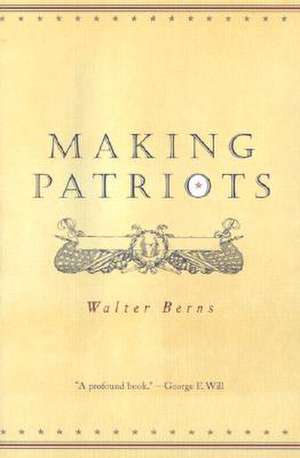
Making Patriots
Autor Walter Bernsen Limba Engleză Paperback – 15 oct 2002
David Brooks called Making Patriots "wise and penetrating," and in an era of polarization and anger, its bracing call for love of country is more important than ever
Although Samuel Johnson once remarked that "patriotism is the last refuge of scoundrels," over the course of the history of the United States we have seen our share of heroes: patriots who have willingly put their lives at risk for this country and, especially, its principles. And this is even more remarkable given that the United States is a country founded on the principles of equality and democracy that encourage individuality and autonomy far more readily than public spiritedness and self-sacrifice.
Walter Berns's Making Patriots is a pithy and provocative essay on precisely this paradox. How is patriotism inculcated in a system that, some argue, is founded on self-interest? Expertly and intelligibly guiding the reader through the history and philosophy of patriotism in a republic, from the ancient Greeks through contemporary life, Berns considers the unique nature of patriotism in the United States and its precarious state. And he argues that while both public education and the influence of religion once helped to foster a public-minded citizenry, the very idea of patriotism is currently under attack.
Berns finds the best answers to his questions in the thought and words of Abraham Lincoln, who understood perhaps better than anyone what the principles of democracy meant and what price adhering to them may exact. The graves at Arlington and Gettysburg and Omaha Beach in Normandy bear witness to the fact that self-interested individuals can become patriots, and Making Patriots is a compelling exploration of how this was done and how it might be again.
Although Samuel Johnson once remarked that "patriotism is the last refuge of scoundrels," over the course of the history of the United States we have seen our share of heroes: patriots who have willingly put their lives at risk for this country and, especially, its principles. And this is even more remarkable given that the United States is a country founded on the principles of equality and democracy that encourage individuality and autonomy far more readily than public spiritedness and self-sacrifice.
Walter Berns's Making Patriots is a pithy and provocative essay on precisely this paradox. How is patriotism inculcated in a system that, some argue, is founded on self-interest? Expertly and intelligibly guiding the reader through the history and philosophy of patriotism in a republic, from the ancient Greeks through contemporary life, Berns considers the unique nature of patriotism in the United States and its precarious state. And he argues that while both public education and the influence of religion once helped to foster a public-minded citizenry, the very idea of patriotism is currently under attack.
Berns finds the best answers to his questions in the thought and words of Abraham Lincoln, who understood perhaps better than anyone what the principles of democracy meant and what price adhering to them may exact. The graves at Arlington and Gettysburg and Omaha Beach in Normandy bear witness to the fact that self-interested individuals can become patriots, and Making Patriots is a compelling exploration of how this was done and how it might be again.
Preț: 170.05 lei
Puncte Express: 255
Preț estimativ în valută:
30.12€ • 35.17$ • 26.16£
30.12€ • 35.17$ • 26.16£
Carte tipărită la comandă
Livrare economică 21 februarie-07 martie
Preluare comenzi: 021 569.72.76
Specificații
ISBN-13: 9780226044385
ISBN-10: 0226044386
Pagini: 164
Dimensiuni: 133 x 203 x 13 mm
Greutate: 0.17 kg
Ediția:1
Editura: University of Chicago Press
Colecția University of Chicago Press
ISBN-10: 0226044386
Pagini: 164
Dimensiuni: 133 x 203 x 13 mm
Greutate: 0.17 kg
Ediția:1
Editura: University of Chicago Press
Colecția University of Chicago Press
V-ar putea interesa
-
 Preț: 302.66 lei
 -
 Democracy and Disenfranchisement: The Morality of Electoral ExclusionsClaudio López-Guerra-34%Preț: 642.96 lei973.69 lei
 -
 Inside Immigration DetentionMary Bosworth-23%Preț: 379.84 lei491.71 lei
 -
 Defending Politics: Why Democracy Matters in the 21st CenturyMatthew Flinders-20%Preț: 68.35 lei85.86 lei
 -
 Liberal Rights and Responsibilities: Essays on Citizenship and SovereigntyChristopher Heath Wellman-14%Preț: 535.72 lei622.93 lei
 -
 Preț: 254.86 lei
 -
 Preț: 378.43 lei
 -
 -40%Preț: 16.17 lei27.08 lei
 -
 -21%Preț: 59.73 lei75.31 lei
 -
 Human DignityGeorge KatebPreț: 194.62 lei
 -
 Preț: 233.09 lei
 -
 The Sociology of Human RightsMark FrezzoPreț: 181.82 lei
 -
 Preț: 404.40 lei
 -
 The Contradictions of Media PowerDr. Des Freedman-18%Preț: 182.55 lei223.49 lei
Notă biografică
Walter Berns is the John M. Olin University Professor Emeritus at Georgetown University and resident scholar at the American Enterprise Institute. His books include, In Defense of Liberal Democracy, The First Amendment and the Future of American Democracy, and Taking the Constitution Seriously.
Cuprins
Preface
Acknowledgments
Introduction
1. Classical Patriotism, Especially the Spartan
2. God before Country?
3. Commerce and Country
4. Educating Young Patriots
5. Lincoln, Patriotism's Poet
6. "What Country Have I?"
7. The Patriot's Flag
Epilogue
Index
Acknowledgments
Introduction
1. Classical Patriotism, Especially the Spartan
2. God before Country?
3. Commerce and Country
4. Educating Young Patriots
5. Lincoln, Patriotism's Poet
6. "What Country Have I?"
7. The Patriot's Flag
Epilogue
Index
Recenzii
"Wise and penetrating. . . . With Making Patriots, Walter Berns has done his part to help us make patriots, but there is still the larger challenge out there, to find a voice that can poetically express our love of country in the age of e-mail, irony, and the market."
"This brief, eloquent book is a beautiful tribute to patriotism, a besieged civic virtue. . . . The purpose of civics courses in the past was to instill respect for the principles that formed America. The question now, Mr. Berns notes, is whether the private realm can take up the slack. We are all beneficiaries of patriotism. Whether we are continuing the necessary task of making patriots is the challenge this profound book invites us to ponder."
"Berns understands, as so many political theorists do not, how demanding citizenship can be. 'No one is born loving his country,' he writes wisely; 'such love is not natural, but has to be taught or acquired.'"
"Thought-provoking and obviously heartfelt. . . . Berns's book is a brief but stirring hymn to America, not just as an idea but as a reality that moves the hearts of its citizens."
"Berns's argument shines best . . . when discussing how Americans, led by Abraham Lincoln, the poet of patriotism, and Frederick Douglass, the abolitionist patriot, enriched patriotism by destroying slavery and expanding citizenship and democracy. He engages readers, especially conservatives, to think critically about patriotism's core values."