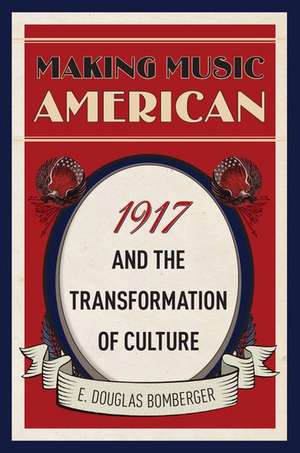
Making Music American: 1917 and the Transformation of Culture
Autor E. Douglas Bombergeren Limba Engleză Hardback – 31 ian 2019
Preț: 217.97 lei
Puncte Express: 327
Carte disponibilă
Livrare economică 13-18 noiembrie
Livrare prin curier în România Termenul estimat este afișat lângă disponibilitate.
Transport gratuit de la 400.00 lei Plată online sau ramburs, în funcție de opțiunile comenzii.
Retur gratuit în 14 zile Comandă securizată și suport în română.
Specificații
ISBN-13: 9780190872311
ISBN-10: 0190872314
Pagini: 288
Ilustrații: 30 halftone
Dimensiuni: 241 x 163 x 23 mm
Greutate: 0.54 kg
Editura: Oxford University Press
Colecția OUP USA
Locul publicării:New York, United States
ISBN-10: 0190872314
Pagini: 288
Ilustrații: 30 halftone
Dimensiuni: 241 x 163 x 23 mm
Greutate: 0.54 kg
Editura: Oxford University Press
Colecția OUP USA
Locul publicării:New York, United States
V-ar putea interesa
-
 Leipzig After Bach: Church and Concert Life in a German CityJeffrey S. Sposato-31%Preț: 540.79 lei781.28 lei
 -
 -24%Preț: 203.52 lei267.50 lei
 -
 -16%Preț: 157.62 lei188.59 lei
 -
 The Free Voice: A Guide to Natural SingingCornelius L. Reid-11%Preț: 321.06 lei362.76 lei
 -
 Claude Debussy's Clair de LuneGurminder Kaur Bhogal-17%Preț: 120.79 lei145.15 lei
 -
 Listening to Bach: The Mass in B Minor and the Christmas OratorioDaniel R. MelamedPreț: 291.92 lei
 -
 The Oxford Handbook of Social Justice in Music EducationCathy Benedict-18%Preț: 378.63 lei462.99 lei
 -
 What is Dance?Roger Copeland-23%Preț: 147.21 lei191.30 lei
 -
 -21%Preț: 219.25 lei277.60 lei
 -
 MacDowellE. Douglas Bomberger-20%Preț: 275.04 lei342.06 lei
 -
 A Tidal Wave of Encouragement: American Composers' Concerts in the Gilded AgeE. Douglas Bomberger-30%Preț: 472.33 lei674.30 lei
 -
 Brainard's Biographies of American MusiciansE. Douglas Bomberger-45%Preț: 311.95 lei568.64 lei
Recenzii
Following a diva, two conductors, two virtuoso soloists, and three bandleaders into, variously, military deployment, forced retirement, and the bottom of a bottle, Bomberger interrogates the national character of American art and artists.
Making Music American has a satisfying structure and natural propulsion.
The narrative propels you through 223 engaging pages as you bounce from character to character as if in a novel. Thought of as a picture of a moment rather than a case for the importance of 1917, the book is thoroughly enjoyable.
History, when done well, should look backwardand forward at the same time. Bomberger's Making Music American: 1917 and the Transformation of Culture is a rich look at a pivotal moment in American political and musical history. The study's interwoven narratives of musical lives encourage viewing America's present cultural landscape with one eye to how we got here and the other eye to what might come next, all the while with engaging stories of some of the artists who contributed most to shaping culture in America and around the world.
Making Music American is an important work of cultural history with an abundance of significant macro- and micro-historical implications.
A thoroughly researched and exciting history with all of the drama of a towering epic. Highly recommended for music lovers and history buffs alike.
compelling ... Highly recommended.
A fascinating and illuminating cultural history of America as experienced through the eyes and ears of her creative citizens living through one of the seminal years of our country's past. A story that defines so much of the world we live in today, kaleidoscopic in its approach and gripping in its account of sequential events of profound impact that often go unrecognized. This is the kind of history writing that I love; I couldnt put it down.
A hundred years ago almost everything changed in American music - and we are still living with the after effects today. This important book by E. Douglas Bomberger tells the fascinating story of how the United States found its own musical identity at a time of global crisis and war.
Making Music American has a satisfying structure and natural propulsion.
The narrative propels you through 223 engaging pages as you bounce from character to character as if in a novel. Thought of as a picture of a moment rather than a case for the importance of 1917, the book is thoroughly enjoyable.
History, when done well, should look backwardand forward at the same time. Bomberger's Making Music American: 1917 and the Transformation of Culture is a rich look at a pivotal moment in American political and musical history. The study's interwoven narratives of musical lives encourage viewing America's present cultural landscape with one eye to how we got here and the other eye to what might come next, all the while with engaging stories of some of the artists who contributed most to shaping culture in America and around the world.
Making Music American is an important work of cultural history with an abundance of significant macro- and micro-historical implications.
A thoroughly researched and exciting history with all of the drama of a towering epic. Highly recommended for music lovers and history buffs alike.
compelling ... Highly recommended.
A fascinating and illuminating cultural history of America as experienced through the eyes and ears of her creative citizens living through one of the seminal years of our country's past. A story that defines so much of the world we live in today, kaleidoscopic in its approach and gripping in its account of sequential events of profound impact that often go unrecognized. This is the kind of history writing that I love; I couldnt put it down.
A hundred years ago almost everything changed in American music - and we are still living with the after effects today. This important book by E. Douglas Bomberger tells the fascinating story of how the United States found its own musical identity at a time of global crisis and war.
Notă biografică
E. Douglas Bomberger teaches courses in popular and classical music at Elizabethtown College. He is the author of MacDowell (Oxford, 2013) and four other books.