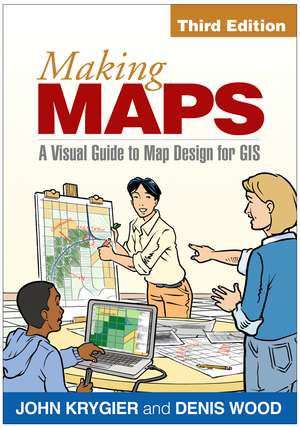
Making Maps, Third Edition: A Visual Guide to Map Design for GIS
Autor John Krygier, Denis Wooden Limba Engleză Paperback – 3 oct 2016
Evoluția cartografiei moderne a depășit granițele reprezentărilor statice, transformându-se într-o disciplină ce integrează fluxuri de date în timp real și tehnologii mobile. În Making Maps, Third Edition, observăm cum autorii John Krygier și Denis Wood adaptează designul de hărți la această realitate digitală, fără a sacrifica principiile fundamentale de estetică și claritate. Considerăm că această a treia ediție este esențială pentru înțelegerea modului în care cartografia GIS s-a mutat de pe desktop pe dispozitivele mobile.
Textul extinde cadrul propus de GIS Cartography cu date noi din sfera serviciilor de localizare și a eticii confidențialității, oferind în același timp un suport vizual mult mai bogat prin cele 74 de ilustrații color. Structura lucrării urmează o progresie logică, de la definirea scopului hărții (Capitolul 2) și organizarea datelor, până la aspecte tehnice de ierarhie vizuală, tipografie și simbolizare. Un element distinctiv este capitolul 10, dedicat exclusiv abstractizării simbolurilor, o componentă critică pentru designul eficient în GIS.
Descoperim aici o metodă pedagogică inedită: o nuvelă grafică ce traversează capitolele, oferind exemple de „așa da/așa nu” care facilitează învățarea activă. Spre deosebire de manualele tehnice rigide, acest volum de la Guilford Publications pune accent pe „de ce-ul” din spatele fiecărei alegeri de design, utilizând studii de caz relevante, precum distribuția bolilor tropicale sau rezultatele electorale, pentru a demonstra puterea narativă a unei hărți bine executate.
Preț: 423.22 lei
Carte disponibilă
Livrare economică 06-20 noiembrie
Livrare express 22-28 octombrie pentru 51.01 lei
Specificații
ISBN-10: 1462509983
Pagini: 293
Dimensiuni: 178 x 254 x 20 mm
Greutate: 0.85 kg
Ediția:3. Auflage
Editura: Guilford Publications
Colecția Guilford Press
V-ar putea interesa
-
 How to Lie with Maps, Third EditionMark MonmonierPreț: 209.43 lei
 -
 -13%Preț: 292.30 lei334.57 lei
 -
 -9%Preț: 559.55 lei614.90 lei
 -
 GIS Cartography: A Guide to Effective Map Design, Third EditionGretchen N. PetersonPreț: 374.63 lei
 -
 Thematic Cartography and GeovisualizationTerry A. Slocum-9%Preț: 1220.88 lei1341.62 lei
 -
 MapmaticsPaulina Rowinska-48%Preț: 49.02 lei93.56 lei
 -
 How to Make Maps: An Introduction to Theory and Practice of CartographyPeter AnthamattenPreț: 373.06 lei
 -
 GIS For DummiesJami DennisPreț: 166.20 lei
 -
 Data Design: Visualising Quantities, Locations, ConnectionsProfessor Per Mollerup-36%Preț: 200.30 lei312.82 lei
 -
 -8%Preț: 440.61 lei478.93 lei
 -
 Radical CartographyWilliam Rankin-44%Preț: 133.07 lei237.71 lei
 -
 Semiology of GraphicsJacques Bertin-15%Preț: 606.81 lei713.90 lei
 -
 Cartography.Kenneth Field-15%Preț: 506.32 lei595.67 lei
 -
 Designing Better Maps: A Guide for GIS UsersCynthia Brewer-15%Preț: 377.81 lei444.49 lei
 -
 Preț: 202.31 lei
 -
 Designing Better MapsCynthia A Brewer-15%Preț: 479.98 lei564.68 lei
 -
 Telling Stories with MapsAllen CarrollPreț: 270.17 lei
 -
 Maps: Their Untold Stories 2nd editionAndrew Janes-16%Preț: 188.89 lei225.86 lei
 -
 The Secret Language of MapsCarissa Carter-24%Preț: 77.33 lei101.22 lei
 -
 The Game Master's Guide to Fantasy MapmakingCody James KingPreț: 170.21 lei
De ce să citești această carte
Este ghidul vizual ideal pentru studenții și profesioniștii GIS care doresc să treacă de la hărți funcționale la hărți remarcabile. Cititorul câștigă competențe practice în designul pentru dispozitive mobile și înțelegerea ierarhiei vizuale. Recomandăm această ediție pentru echilibrul rar între rigoarea tehnică și prezentarea grafică excepțională, fiind un instrument de lucru care transformă datele brute în informație geografică ușor de asimilat.
Cuprins
2. What's Your Map For?
3. Mappable Data
4. Map Making Tools
5. Geographic Framework
6. The Big Picture of Map Design
7. The Inner Workings of Map Design
8. Map Generalization and Classification
9. Map Symbolization
10. Map Symbol Abstraction
11. Words on Maps
12. Color on Maps
Index
Recenzii
"A superb book for covering all the important topics for an introductory cartography class, with excellent examples, humor, and a personable style. It does not read like a classic (boring) textbook, and I really appreciate that. The visual examples are excellent, as is the ongoing Voyager example that ties all of the concepts together in small pieces that are more digestible for students. The 'More' recommendations at the end of each chapter will greatly benefit students who get really interested in a given topic and want more information."--Melinda Shimizu, PhD, Department of Earth and Physical Science, Western Oregon University
"Making Maps situates the art, science, and technology of cartography in the human decisions that maps can help (or hinder). The book introduces the fundamentals of map design in a framework that emphasizes the editorial power cartographers have to shape how people understand place and space. With an engaging, easy-to-read format that eschews tradition, the book has a punk rock spirit that no other works in this field really match. The authors recognize the importance of contemporary mapping technologies without becoming burdened by them, ensuring this will be an essential cartography resource for a long time to come."--Anthony C. Robinson, PhD, President, North American Cartographic Information Society; Department of Geography, The Pennsylvania State University
"This book describes the intersection of maps and art. Graphically, the book is beautifully put together. The descriptions of data classification are among the best in any textbook. Readers will come away with a newfound appreciation for well-designed maps."--Monica Stephens, PhD, Department of Geography, University at Buffalo, The State University of New York
"I really like the style of the book. The use of lists as opposed to lengthy comparisons of different techniques works very well. The concise descriptions and commentary accompanying a wide variety of maps illustrate the authors’ points effectively."--Dean Sinclair, PhD, Geography Program, Northwestern State University, Louisiana