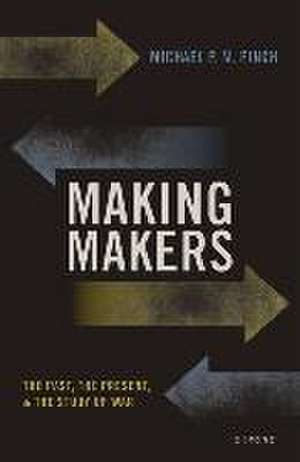
Making Makers: The Past, the Present, and the Study of War
Autor Michael P. M. Finchen Limba Engleză Hardback – 20 mai 2024
Preț: 631.10 lei
Preț vechi: 928.24 lei
-32%
Puncte Express: 947
Carte disponibilă
Livrare economică 19-25 noiembrie
Livrare prin curier în România Termenul estimat este afișat lângă disponibilitate.
Transport gratuit pentru acest produs Plată online sau ramburs, în funcție de opțiunile comenzii.
Retur gratuit în 14 zile Comandă securizată și suport în română.
Specificații
ISBN-13: 9780192867124
ISBN-10: 0192867121
Pagini: 272
Ilustrații: 13 black and white images/tables
Dimensiuni: 157 x 240 x 20 mm
Greutate: 0.59 kg
Editura: OUP OXFORD
Colecția OUP Oxford
Locul publicării:Oxford, United Kingdom
ISBN-10: 0192867121
Pagini: 272
Ilustrații: 13 black and white images/tables
Dimensiuni: 157 x 240 x 20 mm
Greutate: 0.59 kg
Editura: OUP OXFORD
Colecția OUP Oxford
Locul publicării:Oxford, United Kingdom
Recenzii
Finch deserves wide engagement from scholars and practitioners alike, offering constructive insights for anyone grappling withthe enduring complexities of strategy and conflict in our rapidly changing world.
Finch's careful examination of these shifts provides readers with a nuanced understanding of how the canon of strategic thought was shaped throughout the twentieth century. For scholars of International Relations, strategic studies and military history, Finch's book underscores the persistent tension between historical inquiry and contemporary relevance in strategic thought. Finch deserves wide engagement from scholars and practitioners alike, offering constructive insights for anyone grappling with the enduring complexities of strategy and conflict in our rapidly changing world.
Finch's Making Makers reveals how personalities, serendipity, and chance influence the world of ideas. Some of the most interesting passages in the book concern never-written essays, discarded drafts, and abandoned concepts. Scholars and grad students wishing to set their mark on the field may find these pages full of ideas for future exploration.
Making Makers is undoubtedly a significant contribution to military historiography. Finch's judicious unravelling of these various projects demonstrates 'how the scholars in question conceptualized and delineated the study of war and expressed this through their visions for the book'. Finch is to be congratulated on his elegant and fair-minded book.
Finch's book is also a valuable contribution to the historiography of strategic through in the twentieth century. Graduate students who seek a comprehensive overview of security and strategic studies after World War II will benefit from reading and including this book in their preparation for doctoral exams.
Michael P. M. Finch's study of the evolution of the project known to history as Makers of Modern Strategy is long overdue, and its topic is important. [...] What sets this work apart is that it is an intellectual biography not of a single book but of an anthology across several editions - an approach that distinguishes it from most historiography on military history.
Finch has done a masterful job of bringing to life the centrality of the intellectual impact and interconnectivity of Earle, Ropp, Schurman, along with Felix Gilbert, Gordon Craig and Peter Paret as the main driving forces for the three main volumes addressed.
Making Makers is an important contribution to the profession of arms and strategic art. [...] Making Makers is also the story of how those seeking to enhance the study of war must often overcome the military's desire to insert additional training, military science and or directed topics into military education curricula at the expense of military history and theory.
Finch's careful examination of these shifts provides readers with a nuanced understanding of how the canon of strategic thought was shaped throughout the twentieth century. For scholars of International Relations, strategic studies and military history, Finch's book underscores the persistent tension between historical inquiry and contemporary relevance in strategic thought. Finch deserves wide engagement from scholars and practitioners alike, offering constructive insights for anyone grappling with the enduring complexities of strategy and conflict in our rapidly changing world.
Finch's Making Makers reveals how personalities, serendipity, and chance influence the world of ideas. Some of the most interesting passages in the book concern never-written essays, discarded drafts, and abandoned concepts. Scholars and grad students wishing to set their mark on the field may find these pages full of ideas for future exploration.
Making Makers is undoubtedly a significant contribution to military historiography. Finch's judicious unravelling of these various projects demonstrates 'how the scholars in question conceptualized and delineated the study of war and expressed this through their visions for the book'. Finch is to be congratulated on his elegant and fair-minded book.
Finch's book is also a valuable contribution to the historiography of strategic through in the twentieth century. Graduate students who seek a comprehensive overview of security and strategic studies after World War II will benefit from reading and including this book in their preparation for doctoral exams.
Michael P. M. Finch's study of the evolution of the project known to history as Makers of Modern Strategy is long overdue, and its topic is important. [...] What sets this work apart is that it is an intellectual biography not of a single book but of an anthology across several editions - an approach that distinguishes it from most historiography on military history.
Finch has done a masterful job of bringing to life the centrality of the intellectual impact and interconnectivity of Earle, Ropp, Schurman, along with Felix Gilbert, Gordon Craig and Peter Paret as the main driving forces for the three main volumes addressed.
Making Makers is an important contribution to the profession of arms and strategic art. [...] Making Makers is also the story of how those seeking to enhance the study of war must often overcome the military's desire to insert additional training, military science and or directed topics into military education curricula at the expense of military history and theory.
Notă biografică
Michael P. M. Finch is a Senior Lecturer at the Centre for Future Defence and National Security, Deakin University. Prior to this he was a Senior Lecturer at the Strategic and Defence Studies Centre, Australian National University, a Lecturer in the Defence Studies Department at King's College London, and the Mellon Postdoctoral Fellow in the History of War at the University of Oxford. He is the author of A Progressive Occupation? The Gallieni-Lyautey Method and Colonial Pacification in Tonkin and Madagascar, 1885-1900 (OUP, 2013).