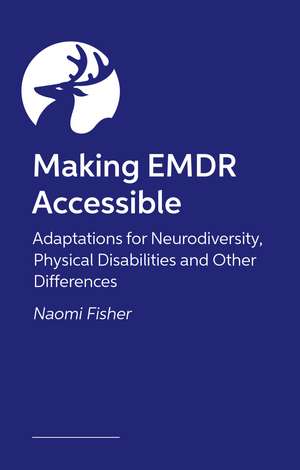
Making EMDR Accessible: Adaptations for Neurodiversity and Other Differences
Autor Naomi Fisheren Limba Engleză Paperback – 21 sep 2026
Drawing on two decades of clinical experience, Naomi Fisher guides readers step-by-step through every phase of EMDR, highlighting where challenges commonly arise and offering practical and containing adaptations grounded in clinical formulation, current understanding of trauma, and research. With clear explanations and compelling case examples, she demonstrates how EMDR therapists can flex to meet a wide range of sensory needs, cognitive styles, and communication preferences.
Clear, concise, and rooted in real-world practice, this book equips EMDR practitioners to deliver safer, more effective therapy to a wider range of clients.
Preț: 173.26 lei
Preț vechi: 244.04 lei
-29% Nou
Puncte Express: 260
Carte disponibilă
Livrare economică 10-24 noiembrie
Livrare express 24-30 octombrie pentru 82.13 lei
Livrare prin curier în România Termenul estimat este afișat lângă disponibilitate.
Transport gratuit de la 400.00 lei Plată online sau ramburs, în funcție de opțiunile comenzii.
Retur gratuit în 14 zile Comandă securizată și suport în română.
Specificații
ISBN-13: 9781399828888
ISBN-10: 1399828886
Pagini: 208
Ilustrații: 10 b/w illustrations
Dimensiuni: 136 x 212 x 16 mm
Greutate: 0.29 kg
Editura: JESSICA KINGSLEY PUBLISHERS
Colecția Jessica Kingsley Publishers
Locul publicării:London, United Kingdom
ISBN-10: 1399828886
Pagini: 208
Ilustrații: 10 b/w illustrations
Dimensiuni: 136 x 212 x 16 mm
Greutate: 0.29 kg
Editura: JESSICA KINGSLEY PUBLISHERS
Colecția Jessica Kingsley Publishers
Locul publicării:London, United Kingdom
Recenzii
This book addresses a crucial gap in the field by balancing respect for the core elements of the EMDR Standard Protocol with a strong appreciation of the creativity, flexibility, and clinical judgement needed in therapeutic work. Well organised, accessible, and enriched by clinical material, it is a warmly recommended read.
I am pleased to recommend Naomi Fisher's book on EMDR adaptations for neurodiversity to all psychotherapists who utilize EMDR. It shows with many examples how to address and target different types of pathogenic memories and how to work with discrimination especially - going through the 8 Phases of the EMDR standard protocol. In the present era, this book is exceedingly necessary. It improved my comprehension of what my patients are entitled to.
This book redefines EMDR by focusing on core principles rather than rigid protocols, helping therapists tailor treatment to individual clients - especially those with neurodiversity. Clear, practical, and example-rich, it equips therapists to adapt EMDR beyond typical PTSD cases, making it essential reading for practitioners working with both adults and children.
I so enjoyed reading this refreshing book and intend to keep several of the diagrams and summaries at hand for reference as an EMDR supervisor, particularly for child and adolescent work. The book helps simplify EMDR into key components and processes which enables the clinician to think more critically and work more flexibly and confidently with a range of common issues and challenges in real world therapy.
An indispensable, relational guide that clarifies the standard EMDR Protocol. More than a manual, it offers vivid clinical examples, reflective insights, and practical adaptations for neurodivergent clients. It reframes adaptation as clinical excellence, making lifechanging therapy accessible to all, and should be mandatory reading for every EMDR therapist worldwide today.
This book is an invaluable resource for EMDR clinicians working with neurodivergent clients. Blending theory, protocol refreshers, practical adaptations, and rich case studies, it offers thoughtful, accessible guidance to help therapists tailor EMDR effectively while honouring the uniqueness and needs of every individual client.
Whether you are new to EMDR or an experienced EMDR practitioner, if you work within the neurodiversity continuum then this book is essential reading. Dr Fisher - a therapist across the lifespan and an EMDR trainer - has a unique way of giving reassurance while providing fresh and practical strategies to help address frequently encountered challenges. The book harnesses five key principles for adaptations, with chapters covering each phase of the standard protocol, narrative EMDR, therapeutic dilemmas, and treatment accessibility. There is an emphasis on client individuality, flexibility, creativity, and knowledge and understanding of the standard protocol, that allows therapists to modify 'task demands' whilst simultaneously preserving the essential elements of EMDR. Dr Fisher presents these concepts in a manner that feels like personalized supervision, with invaluable chapter recaps and relatable case examples. Overall, I found Dr Fisher's book optimistic and encouraging, with a sense of limitless possibilities to assist clients who might otherwise miss out on the benefits of this powerful therapeutic intervention. If you are looking for guidance to help you think outside the box to enhance your EMDR practice within neurodiversity, then I highly recommend this publication.
I am pleased to recommend Naomi Fisher's book on EMDR adaptations for neurodiversity to all psychotherapists who utilize EMDR. It shows with many examples how to address and target different types of pathogenic memories and how to work with discrimination especially - going through the 8 Phases of the EMDR standard protocol. In the present era, this book is exceedingly necessary. It improved my comprehension of what my patients are entitled to.
This book redefines EMDR by focusing on core principles rather than rigid protocols, helping therapists tailor treatment to individual clients - especially those with neurodiversity. Clear, practical, and example-rich, it equips therapists to adapt EMDR beyond typical PTSD cases, making it essential reading for practitioners working with both adults and children.
I so enjoyed reading this refreshing book and intend to keep several of the diagrams and summaries at hand for reference as an EMDR supervisor, particularly for child and adolescent work. The book helps simplify EMDR into key components and processes which enables the clinician to think more critically and work more flexibly and confidently with a range of common issues and challenges in real world therapy.
An indispensable, relational guide that clarifies the standard EMDR Protocol. More than a manual, it offers vivid clinical examples, reflective insights, and practical adaptations for neurodivergent clients. It reframes adaptation as clinical excellence, making lifechanging therapy accessible to all, and should be mandatory reading for every EMDR therapist worldwide today.
This book is an invaluable resource for EMDR clinicians working with neurodivergent clients. Blending theory, protocol refreshers, practical adaptations, and rich case studies, it offers thoughtful, accessible guidance to help therapists tailor EMDR effectively while honouring the uniqueness and needs of every individual client.
Whether you are new to EMDR or an experienced EMDR practitioner, if you work within the neurodiversity continuum then this book is essential reading. Dr Fisher - a therapist across the lifespan and an EMDR trainer - has a unique way of giving reassurance while providing fresh and practical strategies to help address frequently encountered challenges. The book harnesses five key principles for adaptations, with chapters covering each phase of the standard protocol, narrative EMDR, therapeutic dilemmas, and treatment accessibility. There is an emphasis on client individuality, flexibility, creativity, and knowledge and understanding of the standard protocol, that allows therapists to modify 'task demands' whilst simultaneously preserving the essential elements of EMDR. Dr Fisher presents these concepts in a manner that feels like personalized supervision, with invaluable chapter recaps and relatable case examples. Overall, I found Dr Fisher's book optimistic and encouraging, with a sense of limitless possibilities to assist clients who might otherwise miss out on the benefits of this powerful therapeutic intervention. If you are looking for guidance to help you think outside the box to enhance your EMDR practice within neurodiversity, then I highly recommend this publication.