Cantitate/Preț
Produs

Making Domesday: Intelligent Power in Conquered England

Autor Stephen Baxter, Julia Crick, C. P. Lewis
en Limba Engleză Hardback – 8 mai 2025

La nivel de referință profesională și cercetare doctorală, Making Domesday reprezintă o reevaluare fundamentală a modului în care William Cuceritorul a sistematizat controlul asupra Angliei. Remarcăm faptul că acest volum de peste 1000 de pagini nu este doar o cronică istorică, ci un studiu riguros de istoriografie și paleografie, susținut de digitalizarea manuscrisului Exon Domesday. Credem că noutatea absolută rezidă în interpretarea acestui document nu ca pe un simplu registru static, ci ca pe o dovadă a „puterii inteligente” (intelligent power), un instrument de guvernare agresiv folosit pentru a transforma politica funciară a unei societăți recent cucerite.

Putem afirma că lucrarea propune o schimbare de paradigmă: birourile regionale nu doar colectau date, ci recalibrau descrierile funciare într-un proces de redactare accelerat, desfășurat pe parcursul a doar zece săptămâni. Acoperă aceeași arie tematică precum lucrarea Domesday de Sally Harvey, dar cu o abordare mult mai tehnică și interdisciplinară, punând accent pe procesul fizic de producție documentară și pe contextul colonial al colectării de informații statistice. În timp ce Surveying the Domesday Book se concentrează pe logistica și cronometrarea sondajului dintr-o perspectivă tehnică de evaluare, Making Domesday integrează aceste detalii într-o analiză politică și socială vastă.

Este interesant de observat poziția acestui volum în opera autorului Stephen Baxter. Deși cunoscut publicului larg pentru lucrări de ficțiune speculativă precum The Thousand Earths sau Galaxias, unde explorează riguros limitele matematicii și ingineriei în viitor, în Making Domesday acesta aplică aceeași precizie analitică asupra trecutului. Trecerea de la complexitatea sistemelor stelare la complexitatea birocratică a secolului al XI-lea demonstrează o preocupare constantă pentru structurile de putere și organizarea informației, indiferent de contextul temporal.

Citește tot Restrânge

Preț: 91263 lei

Preț vechi: 134513 lei
-32%

Puncte Express: 1369

Carte disponibilă

Livrare economică 07-13 mai


Specificații

ISBN-13: 9780198850120
ISBN-10: 0198850123
Pagini: 1072
Dimensiuni: 180 x 254 x 60 mm
Greutate: 2.32 kg
Editura: OUP OXFORD
Colecția OUP Oxford
Locul publicării:Oxford, United Kingdom

De ce să citești această carte

Această lucrare este esențială pentru istoricii medievaliști și specialiștii în administrație publică. Cititorul câștigă o înțelegere profundă a modului în care informația devine putere, descoperind cum un regim de cucerire a utilizat statistica pentru a-și legitima și securiza controlul teritorial. Este o resursă academică de vârf care transformă percepția asupra celui mai faimos document englez.


Despre autor

Stephen Baxter este un autor britanic recunoscut pentru rigoarea științifică a operelor sale, deținând diplome în matematică și inginerie. Deși cariera sa este marcată de succese remarcabile în literatura de factură hard science-fiction, Baxter demonstrează în această colaborare academică o capacitate excepțională de analiză istorică. Experiența sa în modelarea sistemelor complexe se reflectă în modul minuțios în care abordează structura administrativă a Angliei normande, aducând o perspectivă analitică proaspătă asupra documentelor medievale prin prisma teoriei informației și a exercițiului puterii guvernamentale.


Descriere

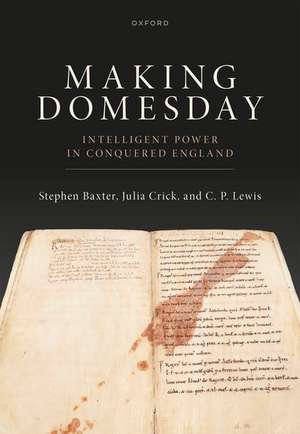
Making Domesday presents a fresh interpretation of William the Conqueror's survey of England, made possible by a major collaborative study and a new online edition of Exon Domesday, the earliest of the three original manuscripts to survive from the Domesday survey. The book addresses big questions about pre-modern government, written records, and the use of intelligence in both senses: the minds behind the planning and execution of Domesday, and the information about England that Domesday gathered. It characterizes Exon as the surviving part of the 'working papers' of one of the writing offices that over a period of ten weeks in summer 1086 dealt with all seven 'circuits' (regional groupings of shires) of the Domesday survey. The circuit offices had the task of recasting the manorial descriptions assembled in an earlier stage of the survey into an interim form intended for further redaction as Great Domesday Book by rearrangement, rewording, and abbreviation. A new deep understanding of the codicology and palaeography of Exon underpins every part of the analysis, and offers a model of documentary production for royal government at an exceptionally early period in western Europe. Part I describes and analyses each Exon text in unprecedented detail; Part II places Domesday in context and in broad comparative perspective, ranging across and beyond the Latin West. The dual approach provides a new interpretation of Domesday and a deeper understanding of both the Domesday survey and Domesday Book. It emerges that the survey was even more complex than we had dared to imagine, involving the production of different kinds of text intended to meet a range of fiscal and political needs. It is also clear that the survey was immediately effective, transforming the politics of land in a newly conquered society. Domesday has always been thought awesome, as its very name shows; Making Domesday contends that it was also a feat of intelligent government deployed by an aggressive and ambitious regime. As such it speaks to broader concerns with the colonial domination of conquered societies through the purposeful collection of systematic statistical information.

Recenzii

Overall, this is a very important book, which offers new interpretations about how Domesday was made, and about what it meant. It is highly original in its emphasis on andinterpretation of Exon Domesday, and in its contextualization and evaluation of what the Domesday project meant as a whole. It is based on and engages with the extensive historiography from the nineteenth century, evaluating the many theories made about the Domesday project, but includes so much new analysis that it surpasses that historiography, and must surely change the terms of debate around Domesday... This book should be a stimulus to future study, and ensure continuing debate over the process and meaning of the Domesday project.

Notă biografică

Stephen Baxter read History as an undergraduate at Wadham College, Oxford, and, following a short career in strategy consulting and investment banking, returned to Oxford to read for his doctorate at Christ Church. He was elected a Fellow by Examination at Magdalen College, Oxford, and then joined the History Department at King's College London as Lecturer and Senior Lecturer in Medieval History. He was appointed Clarendon Associate Professor and Barron Fellow in Medieval History at St Peter's College, Oxford, in 2014, and became Professor of Medieval History there in 2020. He has published widely on politics, government, and society in early medieval England.Julia Crick read Anglo-Saxon, Norse, and Celtic and History at Gonville and Caius College, Cambridge, completing her doctorate in the same institution. She held a JRF and Official Fellowship at Caius before moving to the University of Exeter to take up a Lectureship in Medieval History, becoming Senior Lecturer and Associate Professor. In 2012 she was appointed Professor of Palaeography and Manuscript Studies at King's College London. Between 2014 and 2017 she was Principal Investigator of the Exon Domesday research project (AHRC grant reference AH/L013975/1).C. P. Lewis read History and completed a DPhil at Merton College, Oxford. He joined the staff of the Victoria County History in 1982, working on Cambridgeshire, and later was county editor for Cheshire and then Sussex, taking early retirement in 2009. Since then he has been a research assistant on projects involving Domesday Book. He is a senior fellow at the Institute of Historical Research, University of London. His research interests and publications are on English and Welsh history in the central Middle Ages, English local and regional history, the historiography of English local history, and onomastics.