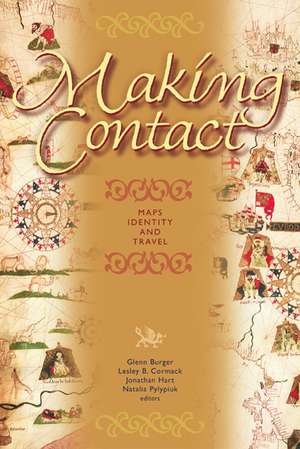
Making Contact: Maps, Identity, and Travel
Editat de Glenn Burger, Lesley B. Cormack, Jonathan Hart, Natalia Pylypiuken Limba Engleză Paperback – 26 feb 2003
Preț: 200.09 lei
Puncte Express: 300
Carte disponibilă
Livrare economică 10-24 noiembrie
Livrare prin curier în România Termenul estimat este afișat lângă disponibilitate.
Transport gratuit de la 400.00 lei Plată online sau ramburs, în funcție de opțiunile comenzii.
Retur gratuit în 14 zile Comandă securizată și suport în română.
Specificații
ISBN-13: 9780888643773
ISBN-10: 0888643772
Pagini: 264
Ilustrații: illustrations
Dimensiuni: 152 x 229 x 25 mm
Greutate: 0.45 kg
Editura: University of Alberta Press
Colecția University of Alberta Press
Locul publicării:Edmonton, Canada
ISBN-10: 0888643772
Pagini: 264
Ilustrații: illustrations
Dimensiuni: 152 x 229 x 25 mm
Greutate: 0.45 kg
Editura: University of Alberta Press
Colecția University of Alberta Press
Locul publicării:Edmonton, Canada
V-ar putea interesa
-
 The DictatorsRichard Overy-17%Preț: 133.61 lei161.17 lei
 -
 Heinemann Advanced History: Mussolini & ItalyEdward TownleyPreț: 338.71 lei
 -
 April BloodLauro Martines-37%Preț: 76.81 lei121.73 lei
 -
 The MapmakersJohn Noble WilfordPreț: 187.10 lei
 -
 Reviewing the Cold War: Approaches, Interpretations, TheoryOdd Arne Westad-15%Preț: 427.82 lei503.31 lei
 -
 1916: The Easter RisingTim Pat Coogan-27%Preț: 67.34 lei92.61 lei
 -
 J.B. Harkin: Father of Canada's National ParksE. J. (Ted) HartPreț: 206.04 lei
 -
 Canada's Constitutional RevolutionBarry L. Strayer-23%Preț: 201.15 lei260.18 lei
 -
 A Brief History of CircumnavigatorsMr Derek WilsonPreț: 97.30 lei
 -
 The Bus We LovedTravis ElboroughPreț: 92.47 lei
 -
 -21%Preț: 248.41 lei313.31 lei
Recenzii
When civilizations first encounter each other a cascade of change is triggered that both challenges and reinforces the identities of all parties. Making Contact revisits key encounters between cultures in the medieval and early modern world. Contributors cross disciplinary boundaries to explore the implications of contact. Scott D. Westrem examines the imagined Africa depicted in the Bell Mappamundi. Day-to-day accommodations between the religious identities of Vilnius, in the Polish-Lithuanian Commonwealth, are explored by David Frick. Steven F. Kruger argues that medieval Christian identity was destabilized by the living Talmudic tradition. Individual Jesuits who were critical to the success of contact in Japan are evaluated by Nakai Ayako. Linda Woodbridge argues that Elizabethan attitudes towards aboriginals paralleled their attitudes towards English vagrants. Despite a nod to Arcadian conventions, travel narratives of Virginia were preoccupied with finding wealth, according to Paul W. DePasquale's research. Rick H. Lee examines the conflicting loyalties of Pierre Raddisson in the New World. Richard A. Young demonstrates that the Florida shipwreck narratives of Cabeza de Vaca were groomed for intended audiences, past and present. This rich interdisciplinary collaboration contributes to the debate on boundaries between disciplines, as well as boundaries between the Middle Ages and the early modern period, and also between historical and theoretical perspectives. Making Contact draws our attention to the important ways in which historic encounters with contrasting 'others' have shaped the identities of both individual and corporate 'selves' over a span of five centuries.
"Making Contact: Maps, Identity, and Travel offers the reader a[n] informed and erudite selection of multi-disciplinary essays about the repercussions of cultural interaction, ranging from the exploits of the Cabeza de Vaca, to the Jesuit Missionaries' influence upon European and Japanese ways of life. Highly recommended for personal and academic World History collections, Making Contact is a superbly presented scholarly study of extensive detail." Wisconsin Bookwatch, The Midwest Book Review
"The aim of this book is to present the reader with an overview of a number of instances when two cultures have come together, made contact and coexisted with each other...Another fascinating aspect of this book is that the writers always include passages on how both cultures viewed each other. This lets the reader see just how much the differences between two races, colours or even beliefs could be exaggerated and accentuated by both first-hand accounts and their subsequent retelling." M2 Best Books
"Cognitive and cultural maps shape all the texts here; even though many of the writers never travelled far, others who did activated their fears and desires. Identity is the book's true theme: when Europeans ecountered pople whom they considered utterly alien, both within and beyond the scraggy isthmus, they had to reflect on who they really were. ...this is an informative, entertaining, and provocative collection of articles, valuable for all historians interested in cross-cultural encounters in many times and places."Peter C. Perdue, The International History Review
"Through an imaginative reconsideration of the fundamentals of identity and otherness, the best pieces in the volume bring renewed creative energy to the study of medieval and early modern European identities. With its bold forays across disciplines and fields, Making Contact provides sufficient variety to hold the interest of a casual reader, while its freshness of interpretation will satisfy the specialist. Finally, it would be remiss not to observe the excellent graphic design of this book. ... Making Contact is a book that should make all invovled, scholars and pressmen alike, proud of their creation." Greg Bak, Histoire sociale / Social History
"[T]he volume is a valuable contribution to the study of identity and contact. There are some particularly strong papers in the collection..The essays of Making Contact will be useful to scholars investigating individual issues of European contact in the [medieval and early modern] period..In the end, Making Contact marks a valuable contribution to a vast field of study, especially on the strength of its better papers." University of Toronto Quarterly, Vol. 74, No. 1, Winter 2004/5
"Making Contact is derived from a highly successful conference of the same name at the University of Alberta in 1998. Indeed, if the papers in this collection are any indication, the conference was clearly an energizing one for both the presenters and the participants....The result is an engaging collection whose arguments and wider meaning are still being debated. In fact, the essay that was originally prepared for the introduction has been turned into an article and bookended with another new introduction. This kind of healthy tension, which is normally missing from published conference proceedings, only adds to the value of this work." William A. Waiser, Canadian Book Review Annual, 2004
"Making Contact: Maps, Identity, and Travel offers the reader a[n] informed and erudite selection of multi-disciplinary essays about the repercussions of cultural interaction, ranging from the exploits of the Cabeza de Vaca, to the Jesuit Missionaries' influence upon European and Japanese ways of life. Highly recommended for personal and academic World History collections, Making Contact is a superbly presented scholarly study of extensive detail." Wisconsin Bookwatch, The Midwest Book Review
"The aim of this book is to present the reader with an overview of a number of instances when two cultures have come together, made contact and coexisted with each other...Another fascinating aspect of this book is that the writers always include passages on how both cultures viewed each other. This lets the reader see just how much the differences between two races, colours or even beliefs could be exaggerated and accentuated by both first-hand accounts and their subsequent retelling." M2 Best Books
"Cognitive and cultural maps shape all the texts here; even though many of the writers never travelled far, others who did activated their fears and desires. Identity is the book's true theme: when Europeans ecountered pople whom they considered utterly alien, both within and beyond the scraggy isthmus, they had to reflect on who they really were. ...this is an informative, entertaining, and provocative collection of articles, valuable for all historians interested in cross-cultural encounters in many times and places."Peter C. Perdue, The International History Review
"Through an imaginative reconsideration of the fundamentals of identity and otherness, the best pieces in the volume bring renewed creative energy to the study of medieval and early modern European identities. With its bold forays across disciplines and fields, Making Contact provides sufficient variety to hold the interest of a casual reader, while its freshness of interpretation will satisfy the specialist. Finally, it would be remiss not to observe the excellent graphic design of this book. ... Making Contact is a book that should make all invovled, scholars and pressmen alike, proud of their creation." Greg Bak, Histoire sociale / Social History
"[T]he volume is a valuable contribution to the study of identity and contact. There are some particularly strong papers in the collection..The essays of Making Contact will be useful to scholars investigating individual issues of European contact in the [medieval and early modern] period..In the end, Making Contact marks a valuable contribution to a vast field of study, especially on the strength of its better papers." University of Toronto Quarterly, Vol. 74, No. 1, Winter 2004/5
"Making Contact is derived from a highly successful conference of the same name at the University of Alberta in 1998. Indeed, if the papers in this collection are any indication, the conference was clearly an energizing one for both the presenters and the participants....The result is an engaging collection whose arguments and wider meaning are still being debated. In fact, the essay that was originally prepared for the introduction has been turned into an article and bookended with another new introduction. This kind of healthy tension, which is normally missing from published conference proceedings, only adds to the value of this work." William A. Waiser, Canadian Book Review Annual, 2004