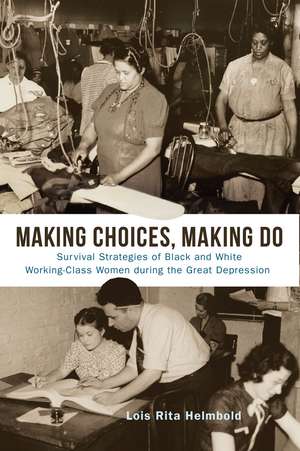
Making Choices, Making Do: Survival Strategies of Black and White Working-Class Women during the Great Depression
Autor Lois Rita Helmbolden Limba Engleză Paperback – 14 oct 2022 – vârsta ani
Preț: 374.59 lei
Puncte Express: 562
Preț estimativ în valută:
66.30€ • 77.30$ • 57.44£
66.30€ • 77.30$ • 57.44£
Carte indisponibilă temporar
Doresc să fiu notificat când acest titlu va fi disponibil:
Se trimite...
Preluare comenzi: 021 569.72.76
Specificații
ISBN-13: 9781978826434
ISBN-10: 1978826435
Pagini: 282
Ilustrații: 33 b&w images, 8 tables
Dimensiuni: 156 x 235 x 18 mm
Greutate: 0.45 kg
Editura: Rutgers University Press
Colecția Rutgers University Press
ISBN-10: 1978826435
Pagini: 282
Ilustrații: 33 b&w images, 8 tables
Dimensiuni: 156 x 235 x 18 mm
Greutate: 0.45 kg
Editura: Rutgers University Press
Colecția Rutgers University Press
Notă biografică
Lois Rita Helmbold is an independent American historian and women's studies scholar. She was a professor and chair of the women's studies department at the University of Nevada, Las Vegas until she retired. She is now an anti-racism social activist in Oakland, California.
Cuprins
Preface: My History and Positionality
Abbreviation in Text and Notes
Citation Conventions
Introduction
1. Urban Working-Class Daily Lives and Work in the 1920s
2. Job Deterioration and Unemployment: "You just can't depend on a steady job at all."
3. Employment Strategies and their Consequences
4. The Family Economy: Daily Survival and Management of Resources
5. Interrupted Expectations: Loyalty and Conflict in the Family Economy
6. Outside the Family Economy: “Most times I’d go to a friend.”
7. Relief: "I never thought I would come to this. I am so willing and anxious to work."
Conclusion: Working-Class Women’s Class and Race Consciousness
Acknowledgements
Appendix 1: Interview Sources
Appendix 2: Women’s Bureau Social Scientists
Appendix 3: The Census
Tables
End notes
Abbreviation in Text and Notes
Citation Conventions
Introduction
1. Urban Working-Class Daily Lives and Work in the 1920s
2. Job Deterioration and Unemployment: "You just can't depend on a steady job at all."
3. Employment Strategies and their Consequences
4. The Family Economy: Daily Survival and Management of Resources
5. Interrupted Expectations: Loyalty and Conflict in the Family Economy
6. Outside the Family Economy: “Most times I’d go to a friend.”
7. Relief: "I never thought I would come to this. I am so willing and anxious to work."
Conclusion: Working-Class Women’s Class and Race Consciousness
Acknowledgements
Appendix 1: Interview Sources
Appendix 2: Women’s Bureau Social Scientists
Appendix 3: The Census
Tables
End notes
Recenzii
"Making Choices, Making Do is a remarkable study that recasts the 1930s working class through the lens of black and white women's experiences during the Great Depression. Analyzing how race, immigration, and gender shaped women's survival strategies, Helmbold opens up fresh interpretive possibilities and an intersectional, comparative, and feminist methodological approach to defining class."
"Deeply researched in remarkably rich sources, this fine study takes us into the lives of working class women—their budgets, jobs, struggles, interactions with authorities, worries, and dreams. Full of insights regarding gender, immigration, and family, the book especially succeeds in its careful comparisons of women’s lives across the color line dividing African American and white women, capturing both common oppression and critical differences."
"We've been waiting for this book since Helmbold finished her path-breaking 1983 dissertation. Making Choices, Making Do shows its origins in the heyday of social history through its focus on the life stories of individuals, but also through its use of quantitative methods through sampling, name matching in local records, and forays into the US census."
"The sources of data used by Lois Helmbold deserve special mention. The author sifts through the relatively unknown interviews conducted by the Women's Bureau of the US Department of Labor to unearth the employment histories, financial struggles, household roles and survival strategies adopted by working-class women during the Great Depression."
Descriere
Working-class white and black women practiced the same Depression survival strategies across race. Archived 1930s interviews with 1,340 Chicago, Cleveland, Philadelphia, and South Bend women, and letters from domestic workers articulate common resourcefulness in employment, housework, and acquisition of relief. Institutionalized racism in employment, housing, and relief, however, assured that Black women worked harder, but fared worse.