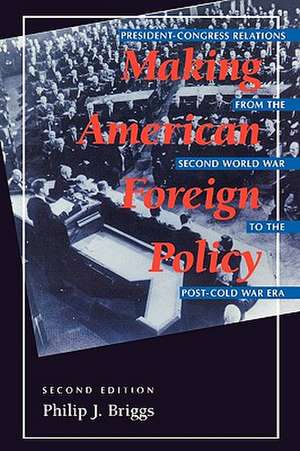
Making American Foreign Policy: President--Congress Relations from the Second World War to the Post--Cold War Era
Autor Philip J. Briggsen Limba Engleză Paperback – 28 feb 1995
Preț: 349.44 lei
Preț vechi: 462.76 lei
-24%
Puncte Express: 524
Carte tipărită la comandă
Livrare economică 09-23 noiembrie
Livrare prin curier în România Termenul estimat este afișat lângă disponibilitate.
Transport gratuit de la 400.00 lei Plată online sau ramburs, în funcție de opțiunile comenzii.
Retur gratuit în 14 zile Comandă securizată și suport în română.
Specificații
ISBN-13: 9780847679461
ISBN-10: 0847679462
Pagini: 352
Dimensiuni: 153 x 233 x 20 mm
Greutate: 0.41 kg
Ediția:2. Auflage.
Editura: Bloomsbury Publishing
Colecția Rowman & Littlefield
Locul publicării:New York, United States
ISBN-10: 0847679462
Pagini: 352
Dimensiuni: 153 x 233 x 20 mm
Greutate: 0.41 kg
Ediția:2. Auflage.
Editura: Bloomsbury Publishing
Colecția Rowman & Littlefield
Locul publicării:New York, United States
Cuprins
Chapter 1 Introduction
Chapter 2 Congress and Collective Security: The Resolutions of 1943
Chapter 3 Congress and Bipartisanship: The Formation of NATO, 1949
Chapter 4 Congress and Franco Spain: The Pact of Madrid, 1953
Chapter 5 Congress and the Cold War: U.S.-China Policy, 1955
Chapter 6 Congress and the Middle East: The Eisenhower Doctrine, 1957
Chapter 7 Kennedy and the Congress: The Nuclear Test Ban Treaty, 1963
Chapter 8 Nixon Versus the Congress: The War Powers Resolution, 1973
Chapter 9 Reagan and the Congress: The Grenada Intervention, 1983
Chapter 10 Congress and the Gulf War: From Desert Shield to Desert Storm, 1991
Chapter 11 Common Themes and a Look at Clinton's Congressional Relations
Chapter 12 Appendices
Chapter 13 Bibliography
Chapter 2 Congress and Collective Security: The Resolutions of 1943
Chapter 3 Congress and Bipartisanship: The Formation of NATO, 1949
Chapter 4 Congress and Franco Spain: The Pact of Madrid, 1953
Chapter 5 Congress and the Cold War: U.S.-China Policy, 1955
Chapter 6 Congress and the Middle East: The Eisenhower Doctrine, 1957
Chapter 7 Kennedy and the Congress: The Nuclear Test Ban Treaty, 1963
Chapter 8 Nixon Versus the Congress: The War Powers Resolution, 1973
Chapter 9 Reagan and the Congress: The Grenada Intervention, 1983
Chapter 10 Congress and the Gulf War: From Desert Shield to Desert Storm, 1991
Chapter 11 Common Themes and a Look at Clinton's Congressional Relations
Chapter 12 Appendices
Chapter 13 Bibliography
Recenzii
Well-researched, well-reasoned, and well-argued . . . an extremely useful casebook for classroom use.
The perpetual competition for control over America's foreign policy that takes place between the President and the Congress comes to life in Professor Brigg's insightful case studies. He conveys Washington's power game with accuracy and verve.
The case studies themselves are quite useful. Each provides a fairly detailed account of the setting and major developments in the policy process.
A timely contribution to a recurring problem-sorting out the respective roles of the president and the Congress in the conduct of American foreign policy. His case studies are well chosen.
The author goes beyond the tugs of power between the White House and Capitol Hill. He examines the threads in that rope of tension: constitutional issues, key actors, communication links and the historical precedent that together fashion contemporary American foreign policy.
The perpetual competition for control over America's foreign policy that takes place between the President and the Congress comes to life in Professor Brigg's insightful case studies. He conveys Washington's power game with accuracy and verve.
The case studies themselves are quite useful. Each provides a fairly detailed account of the setting and major developments in the policy process.
A timely contribution to a recurring problem-sorting out the respective roles of the president and the Congress in the conduct of American foreign policy. His case studies are well chosen.
The author goes beyond the tugs of power between the White House and Capitol Hill. He examines the threads in that rope of tension: constitutional issues, key actors, communication links and the historical precedent that together fashion contemporary American foreign policy.