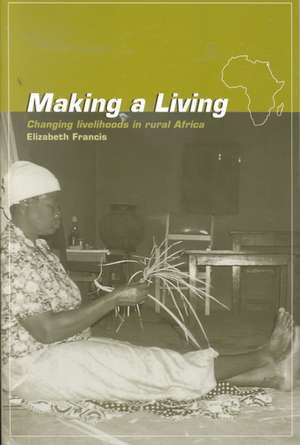
Making a Living: Changing Livelihoods in Rural Africa
Autor Elizabeth Francisen Limba Engleză Paperback – 8 iun 2000
Preț: 603.22 lei
Preț vechi: 709.67 lei
-15%
Puncte Express: 905
Carte tipărită la comandă
Livrare economică 30 noiembrie-14 decembrie
Livrare prin curier în România Termenul estimat este afișat lângă disponibilitate.
Transport gratuit pentru acest produs Plată online sau ramburs, în funcție de opțiunile comenzii.
Retur gratuit în 14 zile Comandă securizată și suport în română.
Specificații
ISBN-13: 9780415144964
ISBN-10: 0415144965
Pagini: 232
Ilustrații: 10 tables
Dimensiuni: 156 x 234 x 14 mm
Greutate: 0.43 kg
Ediția:New.
Editura: Taylor & Francis
Colecția Routledge
Locul publicării:Oxford, United Kingdom
ISBN-10: 0415144965
Pagini: 232
Ilustrații: 10 tables
Dimensiuni: 156 x 234 x 14 mm
Greutate: 0.43 kg
Ediția:New.
Editura: Taylor & Francis
Colecția Routledge
Locul publicării:Oxford, United Kingdom
Public țintă
Postgraduate, Professional, and UndergraduateCuprins
PART 1 Changing livelihoods in Eastern and Southern Africa, 1 Making a living: commercial farming, 2 Farming and rural livelihoods in South Africa: a case study, 3 Making a living: migrancy and multiple livelihoods, 4 Rural livelihoods and gender, PART 2 Poverty and livelihoods in Western Kenya, 5 Koguta and Western Kenya, 6 Migration, accumulation and poverty, 7 Poverty and livelihoods, 8 Gender and livelihoods in Koguta, Conclusion
Recenzii
'It is a thoughtful and concise book. A sophisticated and comprehensive analysis of rural livelihoods, the household, gender relations and general poverty.' - Journal of Development Studies
'This book can be recommended to serious students of livelihood diversification. It is also useful for Women in Development Studies, as it makes good use of life histories and discusses the impacts on interfamily relationships, undogmatically.' - Progress in Development Studies
'This book can be recommended to serious students of livelihood diversification. It is also useful for Women in Development Studies, as it makes good use of life histories and discusses the impacts on interfamily relationships, undogmatically.' - Progress in Development Studies
Descriere
Livelihoods in rural Africa are changing to respond to disappearing job prospects, falling agricultural output and collapsing infrastructure. The responses to these challenges vary in different parts of Africa. This book explains why.