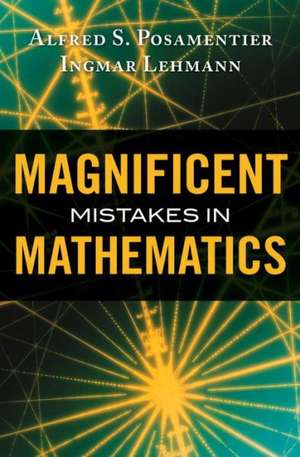
Magnificent Mistakes in Mathematics
Autor Alfred S Posamentier, Ingmar Lehmannen Limba Engleză Hardback – 13 aug 2013
Preț: 198.88 lei
Puncte Express: 298
Carte tipărită la comandă
Livrare economică 30 noiembrie-14 decembrie
Livrare express 24-30 octombrie pentru 39.79 lei
Livrare prin curier în România Termenul estimat este afișat lângă disponibilitate.
Transport gratuit de la 400.00 lei Plată online sau ramburs, în funcție de opțiunile comenzii.
Retur gratuit în 14 zile Comandă securizată și suport în română.
Specificații
ISBN-13: 9781616147471
ISBN-10: 1616147474
Pagini: 308
Dimensiuni: 156 x 236 x 27 mm
Greutate: 0.55 kg
Ediția:New.
Editura: Globe Pequot Publishing
ISBN-10: 1616147474
Pagini: 308
Dimensiuni: 156 x 236 x 27 mm
Greutate: 0.55 kg
Ediția:New.
Editura: Globe Pequot Publishing
V-ar putea interesa
-
 Matrix HandbookSeber-9%Preț: 1007.66 lei1107.31 lei
 -
 Math Wonders to Inspire Teachers and StudentsAlfred S. PosamentierPreț: 254.89 lei
 -
 Effective Techniques to Motivate Mathematics InstructionAlfred PosamentierPreț: 387.71 lei
 -
 Statistical MechanicsEdward Mayer JosephPreț: 269.57 lei
 -
 The Theory of Linear OperatorsHarold T. DavisPreț: 312.03 lei
 -
 Preț: 224.65 lei
 -
 Mathematical Amazements and SurprisesAlfred S. PosamentierPreț: 170.67 lei
 -
 NumbersAlfred S PosamentierPreț: 115.86 lei
 -
 CircleAlfred S PosamentierPreț: 149.74 lei
 -
 The Joy of GeometryAlfred S. PosamentierPreț: 110.46 lei
 -
 Math TricksAlfred S PosamentierPreț: 144.14 lei
 -
 PiAlfred S. PosamentierPreț: 140.24 lei
 -
 Preț: 231.79 lei
 -
 Preț: 254.56 lei
 -
 Preț: 231.62 lei
 -
 Preț: 239.01 lei
 -
 Preț: 214.86 lei
 -
 Oeuvres de Lagrange. T. 14 (Éd.1867-1892)Joseph-Louis LagrangePreț: 190.94 lei
 -
 Preț: 191.65 lei
 -
 Preț: 143.62 lei
 -
 Théorie des fonctions de variables imaginaires. T. 1 (Éd.1874-1876)Maximilien MariePreț: 161.01 lei
 -
 Traité d'algèbre. Partie 1 (Éd.1846)E. GentilPreț: 123.65 lei
 -
 Preț: 354.49 lei
 -
 Category Theory and Computer ScienceDavid H. PittPreț: 392.26 lei
 -
 Mengen - Relationen - FunktionenIngmar LehmannPreț: 281.54 lei
Notă biografică
Alfred S. Posamentier is dean of the School of Education and professor of mathematics education at Mercy College in Dobbs Ferry, New York. Previously, he had the same positions at the City College of the City University of New York for forty years. He has published over fifty-five books in the area of mathematics and mathematics education, including The Fabulous Fibonacci Numbers (with Ingmar Lehmann).
Ingmar Lehmann is retired from the mathematics faculty at Humboldt University in Berlin. For many years he led the Berlin Mathematics Student Society for gifted secondary-school students, with which he is still closely engaged today. He is the coauthor with Alfred S. Posamentier of The Secrets of Triangles, The Glorious Golden Ratio, and three other books.
Ingmar Lehmann is retired from the mathematics faculty at Humboldt University in Berlin. For many years he led the Berlin Mathematics Student Society for gifted secondary-school students, with which he is still closely engaged today. He is the coauthor with Alfred S. Posamentier of The Secrets of Triangles, The Glorious Golden Ratio, and three other books.
Recenzii
“People who like math, as well as those who struggled with it for years, will be captivated by this book. The authors ask readers to follow them into mathematical areas such as the number pi, the Pythagorean theorem, or other concepts and look for ‘magnificent mistakes,’ and they show most interestingly that ‘even using correct procedures can sometimes lead to absurd—but enlightening—results.’ It’s a brilliant and entertaining technique for understanding math and the development of theorems. Following [Posamentier and Lehmann's] popular books on the Fibonacci numbers and pi, this is another fascinating and enjoyable read.”
—Dr. Gerhard Ackermann, professor and retired president, Beuth University of Applied Sciences, Berlin
"A fascinating journey through the history of mathematics, highlighting the great thinkers of all time, from Pythagoras, Aristotle, and Archimedes, through the inventors of calculus, Newton and Leibniz. The authors identify the mistakes of these and other notable mathematicians, and, in a gentle and lighthearted way, lead the reader through an easy-to-follow explanation of the error and the appropriate correction. This book is both informative and entertaining and should make every mathematician, both novice and professional, feel secure with the knowledge that their errors put them in the company of the greatest mathematicians of all time.... A treasure for educators, mathematicians, and those with an interest in mathematics and its history.”
—Daniel Jaye, chief academic officer and director of Academic Affairs, Solomon Schechter Day School of Bergen County
—Dr. Gerhard Ackermann, professor and retired president, Beuth University of Applied Sciences, Berlin
"A fascinating journey through the history of mathematics, highlighting the great thinkers of all time, from Pythagoras, Aristotle, and Archimedes, through the inventors of calculus, Newton and Leibniz. The authors identify the mistakes of these and other notable mathematicians, and, in a gentle and lighthearted way, lead the reader through an easy-to-follow explanation of the error and the appropriate correction. This book is both informative and entertaining and should make every mathematician, both novice and professional, feel secure with the knowledge that their errors put them in the company of the greatest mathematicians of all time.... A treasure for educators, mathematicians, and those with an interest in mathematics and its history.”
—Daniel Jaye, chief academic officer and director of Academic Affairs, Solomon Schechter Day School of Bergen County