Cantitate/Preț
Produs

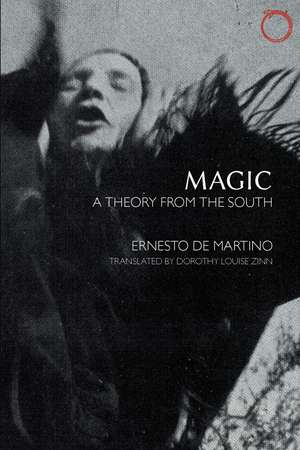
Magic: A Theory from the South

Autor Ernesto de Martino Traducere de Dorothy Louise Zinn
en Limba Engleză Paperback – 15 iun 2015

Până recent, literatura academică de limbă engleză a suferit de o lacună semnificativă în ceea ce privește accesul la opera lui Ernesto de Martino, unul dintre cei mai originali antropologi ai secolului XX. Volumul Magic: A Theory from the South, publicat de HAU, vine să corecteze această absență, oferind o traducere precisă a studiului fundamental din 1959, „Sud e Magia”. Suntem de părere că această ediție nu este doar o recuperare istorică, ci o contribuție vitală la dezbaterile contemporane despre modernitate și gândirea magică.

Spre deosebire de abordările care tratează magia ca pe o simplă curiozitate irațională, Ernesto de Martino investighează de ce magia a fost percepută ca o problemă de cunoaștere în primul rând. Analizând ritualurile din sudul Italiei și Napoli în epoca Iluminismului, autorul propune o teorie a „sudului” care prefigurează analizele post-coloniale moderne. Cititorii familiarizați cu Magical Thinking de Stuart McWilliams vor aprecia modul în care acest volum ancorează crizele epistemologice în realități etnografice concrete, oferind o perspectivă istoricistă asupra modului în care subalternii negociază raportul cu știința oficială.

Putem afirma că Magic reprezintă o piesă esențială pentru înțelegerea întregii opere a lui De Martino, completând viziunea apocaliptică din The End of the World. Dacă în lucrările anterioare se concentra pe prăbușirea prezenței umane în fața istoriei, aici analizează mecanismele prin care ritualul și magia servesc drept instrumente de protecție a „prezenței” în fața precarității existențiale. Este un text dens, teoretic, dar esențial pentru orice curriculum de antropologia religiei sau studii culturale.

Citește tot Restrânge

Preț: 22020 lei

Puncte Express: 330

Carte disponibilă

Livrare economică 30 aprilie-14 mai
Livrare express 16-22 aprilie pentru 2414 lei


Specificații

ISBN-13: 9780990505099
ISBN-10: 099050509X
Pagini: 224
Ilustrații: 14 halftones
Dimensiuni: 152 x 229 x 20 mm
Greutate: 0.34 kg
Editura: HAU
Colecția HAU

De ce să citești această carte

Această lucrare este indispensabilă pentru cercetătorii și studenții din antropologie și istoria religiilor care doresc să înțeleagă rădăcinile teoretice ale studiilor despre subalternitate. Cititorul câștigă o perspectivă sofisticată asupra magiei nu ca superstiție, ci ca mecanism cultural de apărare. Este o oportunitate rară de a accesa în limba engleză gândirea unui filosof-antropolog care a revoluționat studiul folclorului european prin prisma marxismului și fenomenologiei.


Despre autor

Ernesto de Martino (1908–1965) a fost un filosof, istoric al religiilor și antropolog italian de prim rang, a cărui operă a transformat radical studiul culturii populare în Italia postbelică. Format sub influența lui Benedetto Croce și influențat ulterior de gândirea lui Gramsci, de Martino a dezvoltat concepte inovatoare precum „criza prezenței”. Deși a fost mult timp cunoscut în afara Italiei doar prin lucrări precum „The Land of Remorse”, el este astăzi recunoscut la nivel global ca un precursor al antropologiei politice și al studiilor despre modernitate, opera sa rămânând un punct de referință pentru înțelegerea relației dintre ritual și istorie.


Notă biografică

Ernesto de Martino (1908-65) was a prominent anthropologist and historian of religions in Italy. Dorothy Louise Zinn is associate professor of cultural anthropology at the Free University of Bozen-Bolzano, Italy. 


Recenzii

“A classic in the field of ethnographic theory and the study of magic’s role within culture. This English translation by Dorothy Louise Zinn now makes it available for a wider audience.”

“Had an enduring influence on Italian ethnology, and de Martino’s line of argument, unusual in folklore studies, and developed without reference to mainstream anthropology, may still be of some broader interest.”

“Ernesto de Martino’s study of magic, ritual, lament, possession, the evil eye, fascination, and tarantism in southern Italy draws innovatively from a range of intellectual sources. Although ethnology, philosophy, and psychology, as well as literary theory and sources, make for an original and engaging framework, de Martino’s work is little known outside his native Italy. This is a shame because his thought has much to offer. However, this new translation of his 1959 Sud e magia might be a step towards greater recognition of his work in the Anglophone world.”
 

“A thought-provoking work that questions the shifting boundaries between south and north, naïve and learned, magic and religion. Originally published in 1959 in Italian and now available in Dorothy Zinn’s precise translation, the book is part of the trilogy that makes de Martino (1908–1965) a seminal figure at the intersection of folklore, ethnology, and the historical and philosophical study of religion.”
 

"This translation is an important contribution to increasing the international visibility of this prominent historian of religions and ethnologist, whose work had been mainly restricted to the Italian language. The translation allows the English-speaking scholarly world to become acquainted with a classic relatively unknown outside of Italy until now."

"There are three key attributes that the book possesses that to my thinking make it stand out as especially significant for contemporary anthropologists that study human relationships with the sacred. The first is that de Martino very strongly underscores the cosmological significance of magical ritual, seeing it not simply as a means to an end but also as signalling broader parameters of the world enshrined in myths… A second point of significance is de Martino’s characterisation of Lucanian magic as not a historical ‘detritus’ or expression of an ancient past (despite his use of the term ‘survival’) but rather as something that is thoroughly conditioned by contemporary circumstances…A final and broader point is that, as a book focused on the intersection of magic and Christianity, it forces those of us working in the Anthropology of Christianity to reconsider the received historical narrative that typically attributes the emergence of such studies as having occurred in the 1980s and 1990s. Although de Martino does not explicitly frame his work as an anthropological study of Christianity… his book fully deserves to be seen as a rich ethnographic study of Southern Catholicism and its intermingling with local occult practices."

"The importance of Ernesto de Martino’s work for Italian ethnography can hardly be over-estimated. Trained as a philosopher, de Martino revolutionised the study of folklore by challenging the compilative and ‘naturalist’ approach of the 1940s and 1950s…Zinn’s precise translation and annotations infuse new life into a text published more than half a century ago, but which still surprises with its modern flavour. Her translation of the book’s original title as Magic: a theory from the South seems to allude to postcolonial theory: the word ‘Sud’ for de Martino referred only to Southern Italy, in the context of the questione meridionale; here it hints at the multiple ‘Souths’ to which anthropology directs its scrutiny, and to the gap between mainstream and alternative interpretations of social facts."

Descriere

Though his work was little known outside Italian intellectual circles for most of the twentieth century, anthropologist and historian of religions Ernesto de Martino is now recognized as one of the most original thinkers in the field. This book is testament to de Martino’s innovation and engagement with Hegelian historicism and phenomenology—a work of ethnographic theory way ahead of its time.

This new translation of Sud e Magia, his 1959 study of ceremonial magic and witchcraft in southern Italy, shows how De Martino is not interested in the question of whether magic is rational or irrational but rather in why it came to be perceived as a problem of knowledge in the first place. Setting his exploration within his wider, pathbreaking theorization of ritual, as well as in the context of his politically sensitive analysis of the global south’s historical encounters with Western science, he presents the development of magic and ritual in Enlightenment Naples as a paradigmatic example of the complex dynamics between dominant and subaltern cultures. Far ahead of its time, Magic is still relevant as anthropologists continue to wrestle with modernity’s relationship with magical thinking.