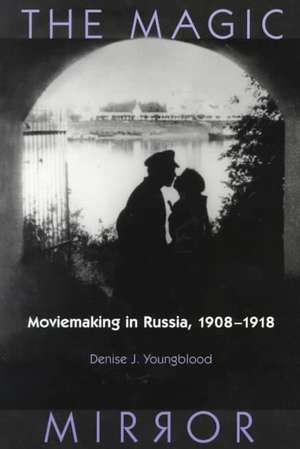
Magic Mirror: Moviemaking In Russia, 1908-1918: Wisconsin Studies in Film
Autor Denise J. Youngblooden Limba Engleză Paperback – 7 apr 1999
Amid the instability and violence of turn-of-the-century industrialization and urbanization Russians embraced a revolutionary art form to reflect the aspirations and motivations of a new class. In The Magic Mirror Denise Youngblood portrays a newly urbanized entrepreneurial middle class—not the revolutionaries or imperialists of historians—and the movies they made and paid to see. Upon those screens they saw their lives depicted in all their variety and uncertainty.
Youngblood provides a cultural angle into an era most often viewed through a revolutionary lens. Film and the film industry illuminates and reflects the popular attitudes of the time.
The Magic Mirror is a study of the ten years of native film production through the Revolutions of 1917, based almost exclusively on Russian language primary sources. Topics examined include the organization and evolution of the industry followed by description and analysis of genres, motifs, and themes as exemplified in 65 of the most important surviving films.
Youngblood provides a cultural angle into an era most often viewed through a revolutionary lens. Film and the film industry illuminates and reflects the popular attitudes of the time.
The Magic Mirror is a study of the ten years of native film production through the Revolutions of 1917, based almost exclusively on Russian language primary sources. Topics examined include the organization and evolution of the industry followed by description and analysis of genres, motifs, and themes as exemplified in 65 of the most important surviving films.
Preț: 137.11 lei
Puncte Express: 206
Carte tipărită la comandă
Livrare economică 03-17 decembrie
Livrare prin curier în România Termenul estimat este afișat lângă disponibilitate.
Transport gratuit de la 400.00 lei Plată online sau ramburs, în funcție de opțiunile comenzii.
Retur gratuit în 14 zile Comandă securizată și suport în română.
Specificații
ISBN-13: 9780299162344
ISBN-10: 0299162346
Pagini: 216
Ilustrații: 18 b-w photos
Dimensiuni: 152 x 229 x 13 mm
Greutate: 0.34 kg
Ediția:1
Editura: University of Wisconsin Press
Colecția University of Wisconsin Press
Seria Wisconsin Studies in Film
ISBN-10: 0299162346
Pagini: 216
Ilustrații: 18 b-w photos
Dimensiuni: 152 x 229 x 13 mm
Greutate: 0.34 kg
Ediția:1
Editura: University of Wisconsin Press
Colecția University of Wisconsin Press
Seria Wisconsin Studies in Film
V-ar putea interesa
-
 -25%Preț: 208.80 lei280.21 lei
 -
 The Oxford Handbook of Dance and the Popular ScreenMelissa Blanco Borelli-14%Preț: 1049.52 lei1220.37 lei
 -
 Lady in the Dark – Iris Barry and the Art of FilmRobert SittonPreț: 374.20 lei
 -
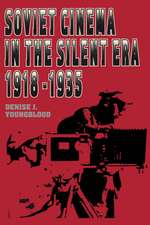 Soviet Cinema in the Silent Era, 1918–1935Denise J. YoungbloodPreț: 266.28 lei
 -
 Preț: 166.42 lei
 -
 Preț: 158.19 lei
 -
 Preț: 164.22 lei
 -
 Preț: 160.72 lei
 -
 Movies for MassesDenise J. YoungbloodPreț: 339.92 lei
 -
 Russian War FilmsDenise J YoungbloodPreț: 305.17 lei
 -
 Bondarchuk's War and Peace: Literary Classic to Soviet Cinematic EpicDenise J. YoungbloodPreț: 430.56 lei
 -
 Cinematic Cold WarTony ShawPreț: 244.28 lei
 -
 Preț: 128.88 lei
 -
 Picture ThisMolly Bang-13%Preț: 121.41 lei139.76 lei
 -
 Repentance: The Film CompanionProfessor Emerita Denise J. Youngblood-21%Preț: 165.63 lei208.51 lei
Recenzii
“A compelling account of the social basis of the development of Russian cinema.”—Vance Kepley, University of Wisconsin–Madison
Notă biografică
Denise Youngblood is associate professor of history at the University of Vermont and the author of Movies for the Masses and Soviet Cinema in the Soviet Era.
Descriere
Amid the instability and violence of turn-of-the-century industrialization and urbanization Russians embraced a revolutionary art form to reflect the aspirations and motivations of a new class. In The Magic Mirror Denise Youngblood portrays a newly urbanized entrepreneurial middle class—not the revolutionaries or imperialists of historians—and the movies they made and paid to see. Upon those screens they saw their lives depicted in all their variety and uncertainty.
Youngblood provides a cultural angle into an era most often viewed through a revolutionary lens. Film and the film industry illuminates and reflects the popular attitudes of the time.
The Magic Mirror is a study of the ten years of native film production through the Revolutions of 1917, based almost exclusively on Russian language primary sources. Topics examined include the organization and evolution of the industry followed by description and analysis of genres, motifs, and themes as exemplified in 65 of the most important surviving films.
Youngblood provides a cultural angle into an era most often viewed through a revolutionary lens. Film and the film industry illuminates and reflects the popular attitudes of the time.
The Magic Mirror is a study of the ten years of native film production through the Revolutions of 1917, based almost exclusively on Russian language primary sources. Topics examined include the organization and evolution of the industry followed by description and analysis of genres, motifs, and themes as exemplified in 65 of the most important surviving films.