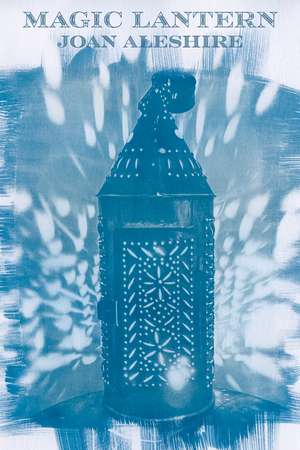
Magic Lantern
Autor Joan Aleshireen Limba Engleză Paperback – 15 sep 2026
Preț: 100.04 lei
Nou
Puncte Express: 150
Carte disponibilă
Livrare economică 16-30 noiembrie
Livrare prin curier în România Termenul estimat este afișat lângă disponibilitate.
Transport gratuit de la 400.00 lei Plată online sau ramburs, în funcție de opțiunile comenzii.
Retur gratuit în 14 zile Comandă securizată și suport în română.
Specificații
ISBN-13: 9781961897908
ISBN-10: 1961897903
Pagini: 104
Dimensiuni: 152 x 229 x 10 mm
Greutate: 0.25 kg
Editura: FOUR WAY BOOKS
Colecția Four Way Books
ISBN-10: 1961897903
Pagini: 104
Dimensiuni: 152 x 229 x 10 mm
Greutate: 0.25 kg
Editura: FOUR WAY BOOKS
Colecția Four Way Books
Recenzii
The poems in Joan Aleshire's Magic Lantern describe and illuminate a late-in-life love affair and its shocking betrayal, while at the same time depicting the background of the lovers: a rural New England setting with all the consequences, happenstances, and pitfalls of small-town life.
The genius of Aleshire's seventh book of poems lies in her ability to convey a seamless narrative while powerfully incorporating the lyrical qualities of music and precision. Each poem stands on its own as the collection relates a story that becomes a page-turner of a tender love betrayed.
The speaker of these poems comes across as unscathed but not unmarked—one who has not only survived, but thrives, due to the support of her closely-knit community and because of her all-feeling compassion for every living thing, from those who have treated her badly, to fellow townspeople, flowers, pets, and birds at the feeder.
Magic Lantern is a stunning collection centered on age, affection, duplicity, disappointment, and human desire.
—John Skoyles
The genius of Aleshire's seventh book of poems lies in her ability to convey a seamless narrative while powerfully incorporating the lyrical qualities of music and precision. Each poem stands on its own as the collection relates a story that becomes a page-turner of a tender love betrayed.
The speaker of these poems comes across as unscathed but not unmarked—one who has not only survived, but thrives, due to the support of her closely-knit community and because of her all-feeling compassion for every living thing, from those who have treated her badly, to fellow townspeople, flowers, pets, and birds at the feeder.
Magic Lantern is a stunning collection centered on age, affection, duplicity, disappointment, and human desire.
—John Skoyles
Notă biografică
Joan Aleshire graduated from Harvard/Radcliffe in 1960, and from the MFA Program for Writers at Goddard College in 1980. She worked as Interim Director and was a member of the poetry faculty in the MFA Program at Warren Wilson College from 1982-2013. She has published seven books of poetry and a novel, as well as essays and translations from Russian. She lives in Shrewsbury, Vermont.
Extras
"Ordinary Heartbreak"
What we wouldn't have given
for ordinary heartbreak? the widow
wrote of the poet's life under Stalin,
and I thought every poet I knew
would !nd in that de!ance
their articles of faith, a way to live,
so when one poet friend said,
She's so arrogant, and another
added, and condescending,
I sat confounded, not knowing
how to explain a country crueler
than any lover: betrayal as common
currency, night without sleep
waiting for !sts at the door,
Mandelstam's earphones, earphones,
who turned me in? no metaphor.
When my heart broke, hard,
as if it had never been broken
before, ordinary was this:
the friends unafraid to listen,
to ease my way; the postal clerk
adding the extra stamp I'd forgotten
to my letter; the colleague, that worst
of days, taking my library shift
without being asked; the town plow
sweeping a foam of snow before it,
!rst thing, scattering saving grains
of sand like cinnamon in its wake.
What we wouldn't have given
for ordinary heartbreak? the widow
wrote of the poet's life under Stalin,
and I thought every poet I knew
would !nd in that de!ance
their articles of faith, a way to live,
so when one poet friend said,
She's so arrogant, and another
added, and condescending,
I sat confounded, not knowing
how to explain a country crueler
than any lover: betrayal as common
currency, night without sleep
waiting for !sts at the door,
Mandelstam's earphones, earphones,
who turned me in? no metaphor.
When my heart broke, hard,
as if it had never been broken
before, ordinary was this:
the friends unafraid to listen,
to ease my way; the postal clerk
adding the extra stamp I'd forgotten
to my letter; the colleague, that worst
of days, taking my library shift
without being asked; the town plow
sweeping a foam of snow before it,
!rst thing, scattering saving grains
of sand like cinnamon in its wake.