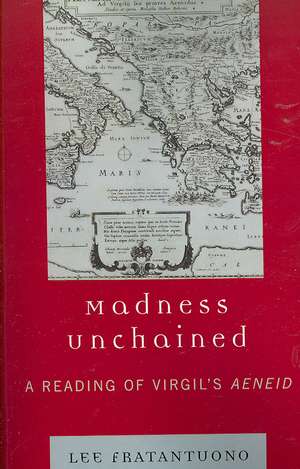
Madness Unchained: A Reading of Virgil's Aeneid
Autor Lee Fratantuonoen Limba Engleză Paperback – 30 mai 2007
There have been other books that have attempted to present a complete guide to the Aeneid, but this is the first to address every episode in the poem, omitting nothing, and aiming itself at an audience that ranges from the Advanced Placement Virgil student in secondary school to the professional Virgilian and everyone in-between, both Latinists and the Latin-less. Individual chapters correspond to the books of the poem; unlike some volumes that prejudice the reader's interpretation of the work by rearranging the order of episodes in order to influence their impact on the audience, this book moves in the order Virgil intended, and also gives rather fuller exposition to the second half of the poem, Virgil's self-proclaimed "greater work" (maius opus).
The notes to each chapter, as well as the "Selected Bibliography," are meant to provide a guide to the dense forest that is Virgilian scholarship. The notes aim at familiarizing the interested reader with the better and lesser known byways of Virgilian criticism, both English/American and continental, and at introducing the reader to some of the perennial problems of Virgilian literary criticism.
It is hoped that Madness Unchained will become the standard introductory guide to the poem, useful in college and university courses in mythology, Roman literature, epic poetry, and Virgil (in Latin or translation), as well as offering a reappraisal of the poem to the many readers and scholars in other disciplines who know they should "like" the Aeneid, but who have always been perplexed by the seemingly stra
Preț: 365.07 lei
Preț vechi: 534.40 lei
-32%
Puncte Express: 548
Carte tipărită la comandă
Livrare economică 01-15 decembrie
Livrare prin curier în România Termenul estimat este afișat lângă disponibilitate.
Transport gratuit de la 400.00 lei Plată online sau ramburs, în funcție de opțiunile comenzii.
Retur gratuit în 14 zile Comandă securizată și suport în română.
Specificații
ISBN-13: 9780739122426
ISBN-10: 0739122428
Pagini: 427
Dimensiuni: 148 x 224 x 28 mm
Greutate: 0.69 kg
Editura: Bloomsbury Publishing
Colecția Lexington Books
Locul publicării:New York, United States
ISBN-10: 0739122428
Pagini: 427
Dimensiuni: 148 x 224 x 28 mm
Greutate: 0.69 kg
Editura: Bloomsbury Publishing
Colecția Lexington Books
Locul publicării:New York, United States
V-ar putea interesa
-
 -28%Preț: 471.75 lei659.23 lei
 -
 De Rerum Natura VLucretius-13%Preț: 284.03 lei328.02 lei
 -
 Homeric Soundings: The Shaping of the IliadOliver Taplin-33%Preț: 638.73 lei948.43 lei
 -
 -31%Preț: 561.11 lei809.92 lei
 -
 De Generatione et CorruptioneAristotle-29%Preț: 396.44 lei557.41 lei
 -
 An Introduction to HomerW. a. Camps-21%Preț: 282.93 lei359.41 lei
 -
 Horace: Odes II: Vatis AmiciHorace-29%Preț: 493.61 lei693.74 lei
 -
 Oxford Readings in Greek ReligionRichard Buxton-28%Preț: 412.80 lei575.78 lei
 -
 -29%Preț: 467.85 lei656.90 lei
 -
 Aristophanes: PeaceS. Douglas Olson-33%Preț: 569.54 lei844.43 lei
 -
 A Companion to Homer's OdysseyJames Morrison-43%Preț: 275.67 lei485.57 lei
 -
 The Cambridge Companion to HomerRobert FowlerPreț: 338.74 lei
 -
 Camb Companion to Greek TragedyP. E. EasterlingPreț: 337.75 lei
 -
 EuripidesBen ShawPreț: 105.13 lei
 -
 Sophocles: ElectraMichael LloydPreț: 180.69 lei
Cuprins
Chapter 1 Arms and the Man . . .
Chapter 2 All Fell Silent . . .
Chapter 3 After It Seemed Best . . .
Chapter 4 But the Queen . . .
Chapter 5 Meanwhile Sure Aeneas . . .
Chapter 6 So He Spoke, Weeping . . .
Chapter 7 You Also, Dying . . .
Chapter 8 As Turnus Raised . . .
Chapter 9 And While These Things . . .
Chapter 10 The House of Olympus . . .
Chapter 11 Dawn Left the Ocean . . .
Chapter 12 As Turnus Sees . . .
Chapter 2 All Fell Silent . . .
Chapter 3 After It Seemed Best . . .
Chapter 4 But the Queen . . .
Chapter 5 Meanwhile Sure Aeneas . . .
Chapter 6 So He Spoke, Weeping . . .
Chapter 7 You Also, Dying . . .
Chapter 8 As Turnus Raised . . .
Chapter 9 And While These Things . . .
Chapter 10 The House of Olympus . . .
Chapter 11 Dawn Left the Ocean . . .
Chapter 12 As Turnus Sees . . .
Recenzii
At last, a commentary on the Aeneid that doesn't need more decoding devices than Virgil's poem! Dr. Fratantuono's book stands apart for its adherence to a sensible, and yet profound, analysis of a poem that too often in the last several decades hasbeen the testing ground for any number of new approaches to literary criticism. F begins with a heartfelt lament on the way Books VII-XII have been practically ignored in the curricula of American Classical education at all levels. His commentary attemptsto correct this by paying due attention to what V himself considered to be the greater part of his poem. One of my favorite features of F's book is the way the author weaves into his commentary the relevant passages from the poem, and, in so doing, keeps the commentary focused strictly on the passages. The translations, which by F's own admission, do not aspire to any 'literary greatness,' are still some of the best I have ever read. (Perhaps F's description of all translations of the Aeneid as 'betrayals' of the original Latin poem is in fact a tad too harsh.) Like V, who did not compose his opus in a 'linear fashion' but who worked on individual sections as the spirit moved him, F chose to write a commentary which, while remarkably coherent, ca
Madness Unchained is truly a stunning achievement! Fratantuono's engaging commentary on Virgil's Aeneid, written in lucid and economical prose, has something to offer everyone, from novice readers of the epic to seasoned, veteran scholars. There is much to glean from these pages, whether one dips in to read the author's comments on individual scenes or uses the commentary to accompany a reading of Virgil's epic in its entirety. One of Fratantuono's primary contributions to Virgilian scholarship is the way in which he treats the epic as a whole, illustrating brilliantly that the poem is more than merely a sum of its individual parts. The reader will appreciate Fratantuono's close and perceptive reading of the epic together with his masterful and authoritative survey of existing scholarship. This commentary will prove itself as a worthy sourcebook for generations of Virgil readers to come.
a wonderful book, because with its well-versed learning in all aspects of Vergilian scholarship it inspires its readers to think independently.
Summing Up: Recommended. Lower-/upper-division undergraduates.
Fratantuono's detailed, image-by-image and often even line-by-line examination is the most thorough analysis of The Aeneid to appear in decades. It has the great virtue of not shying away from the most difficult cruces in the long interpretative history of the work, and it offers fresh insights into many of them. The readings he offers of individual passages are frequently not only provocative but also suggestive of further possibilities for extended exploration. In short, this is a book that will challenge many of us to rethink our presuppositions about many an aspect of Virgil's epic.
At last, a commentary on the Aeneid that doesn't need more decoding devices than Virgil's poem! Dr. Fratantuono's book stands apart for its adherence to a sensible, and yet profound, analysis of a poem that too often in the last several decades has been the testing ground for any number of new approaches to literary criticism. F begins with a heartfelt lament on the way Books VII-XII have been practically ignored in the curricula of American Classical education at all levels. His commentary attempts to correct this by paying due attention to what V himself considered to be the "greater part" of his poem. One of my favorite features of F's book is the way the author weaves into his commentary the relevant passages from the poem, and, in so doing, keeps the commentary focused strictly on the passages. The translations, which by F's own admission, do not aspire to any 'literary greatness,' are still some of the best I have ever read. (Perhaps F's description of all translations of the Aeneid as 'betrayals' of the original Latin poem is in fact a tad too harsh.) Like V, who did not compose his opus in a 'linear fashion' but who worked on individual sections as the spirit moved him, F chose to write a commentary which, while remarkably coherent, can nevertheless be read with profit in installments and in whatever order the reader selects. One thing is for sure: whatever part of the commentary a person reads, it soon becomes clear that these are the musings of a scholar who, through assiduous study and reflection, has an ear for Virgil and who can, at all times, see a passage within the larger themes of the poem. While not new, F's view, that the Aeneid embodies a 'profound reflection on the nature of the Augustan regime in Rome,' is presented in ways that are fresh and not at all hackneyed. Readers of all ages will profit from F's book. It will doubtless be welcomed by secondary school instructors, who will find in the commentary a perfect complement to their work in the classroom with the La
Madness Unchained is truly a stunning achievement! Fratantuono's engaging commentary on Virgil's Aeneid, written in lucid and economical prose, has something to offer everyone, from novice readers of the epic to seasoned, veteran scholars. There is much to glean from these pages, whether one dips in to read the author's comments on individual scenes or uses the commentary to accompany a reading of Virgil's epic in its entirety. One of Fratantuono's primary contributions to Virgilian scholarship is the way in which he treats the epic as a whole, illustrating brilliantly that the poem is more than merely a sum of its individual parts. The reader will appreciate Fratantuono's close and perceptive reading of the epic together with his masterful and authoritative survey of existing scholarship. This commentary will prove itself as a worthy sourcebook for generations of Virgil readers to come.
a wonderful book, because with its well-versed learning in all aspects of Vergilian scholarship it inspires its readers to think independently.
Summing Up: Recommended. Lower-/upper-division undergraduates.
Fratantuono's detailed, image-by-image and often even line-by-line examination is the most thorough analysis of The Aeneid to appear in decades. It has the great virtue of not shying away from the most difficult cruces in the long interpretative history of the work, and it offers fresh insights into many of them. The readings he offers of individual passages are frequently not only provocative but also suggestive of further possibilities for extended exploration. In short, this is a book that will challenge many of us to rethink our presuppositions about many an aspect of Virgil's epic.
At last, a commentary on the Aeneid that doesn't need more decoding devices than Virgil's poem! Dr. Fratantuono's book stands apart for its adherence to a sensible, and yet profound, analysis of a poem that too often in the last several decades has been the testing ground for any number of new approaches to literary criticism. F begins with a heartfelt lament on the way Books VII-XII have been practically ignored in the curricula of American Classical education at all levels. His commentary attempts to correct this by paying due attention to what V himself considered to be the "greater part" of his poem. One of my favorite features of F's book is the way the author weaves into his commentary the relevant passages from the poem, and, in so doing, keeps the commentary focused strictly on the passages. The translations, which by F's own admission, do not aspire to any 'literary greatness,' are still some of the best I have ever read. (Perhaps F's description of all translations of the Aeneid as 'betrayals' of the original Latin poem is in fact a tad too harsh.) Like V, who did not compose his opus in a 'linear fashion' but who worked on individual sections as the spirit moved him, F chose to write a commentary which, while remarkably coherent, can nevertheless be read with profit in installments and in whatever order the reader selects. One thing is for sure: whatever part of the commentary a person reads, it soon becomes clear that these are the musings of a scholar who, through assiduous study and reflection, has an ear for Virgil and who can, at all times, see a passage within the larger themes of the poem. While not new, F's view, that the Aeneid embodies a 'profound reflection on the nature of the Augustan regime in Rome,' is presented in ways that are fresh and not at all hackneyed. Readers of all ages will profit from F's book. It will doubtless be welcomed by secondary school instructors, who will find in the commentary a perfect complement to their work in the classroom with the La