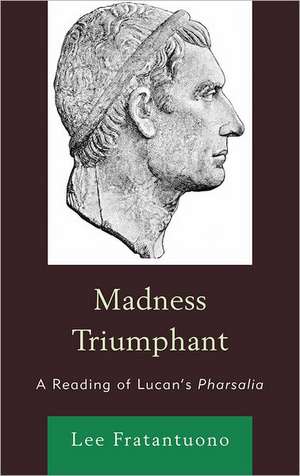
Madness Triumphant: A Reading of Lucan's Pharsalia
Autor Lee Fratantuonoen Limba Engleză Hardback – 28 iun 2012
Preț: 885.58 lei
Preț vechi: 1340.89 lei
-34%
Puncte Express: 1328
Carte tipărită la comandă
Livrare economică 30 noiembrie-14 decembrie
Livrare prin curier în România Termenul estimat este afișat lângă disponibilitate.
Transport gratuit pentru acest produs Plată online sau ramburs, în funcție de opțiunile comenzii.
Retur gratuit în 14 zile Comandă securizată și suport în română.
Specificații
ISBN-13: 9780739173145
ISBN-10: 0739173146
Pagini: 465
Dimensiuni: 160 x 237 x 34 mm
Greutate: 0.86 kg
Editura: Bloomsbury Publishing
Colecția Lexington Books
Locul publicării:New York, United States
ISBN-10: 0739173146
Pagini: 465
Dimensiuni: 160 x 237 x 34 mm
Greutate: 0.86 kg
Editura: Bloomsbury Publishing
Colecția Lexington Books
Locul publicării:New York, United States
Cuprins
Introduction
Chapter I: Wars Worse Than Civil
Chapter II: And Now the Wraths of the Gods
Chapter III: As the South Wind Drove the Fleet
Chapter IV: But at the Very Edge of the Earth
Chapter V: Thus Did Fortune Preserve
Chapter VI: After the Leaders Pitched Camps
Chapter VII: Slower Than the Eternal Law
Chapter VIII: And Now, Beyond the Gorges of Hercules
Chapter IX: But Not in Pharian Ash
Chapter X: As Soon As Caesar Trampled
Select Bibliography
Chapter I: Wars Worse Than Civil
Chapter II: And Now the Wraths of the Gods
Chapter III: As the South Wind Drove the Fleet
Chapter IV: But at the Very Edge of the Earth
Chapter V: Thus Did Fortune Preserve
Chapter VI: After the Leaders Pitched Camps
Chapter VII: Slower Than the Eternal Law
Chapter VIII: And Now, Beyond the Gorges of Hercules
Chapter IX: But Not in Pharian Ash
Chapter X: As Soon As Caesar Trampled
Select Bibliography
Recenzii
Though immensely popular in late Antiquity, the Middle Ages, and the Renaissance, Lucan's Pharsalia has languished in semi-obscurity for centuries. With the availability of Fratantuono's excellent commentary, this grand Silver Age epic, with its stories of witches, ghosts, a headless Pompey, wild animals feasting on fallen soldiers, and a Rome poised to lose its cherished libertas, stands a good chance of making a long overdue comeback. It is the third in a series of commentaries Fratantuono has written in the last five years, and it may well be his best, which is saying a lot, since his earlier commentaries on the Aeneid and Ovid's Metamorphoses get more use than most other books in my personal Latin library. Lucan's intent in the Pharsalia was clearly to fashion an epic that would elicit comparanda with the works of his predecessors, and Fratantuono is the perfect guide to help us understand these many points of comparison. As in his books on Vergil and Ovid, Fratantuono shows an amazingly comprehensive knowledge of his poem and comes up with insights that are born of many years of a productive engagement with it. Madness Triumphant is surely a victrix causa for both the young Neronian poet and his 21st century interpreter.
Fratantuono gives a masterful reading of Lucan through close textual analysis. With great sensitivity to the poetics of tradition he leads the reader step by step through the minefields of Lucan's poetry, uncovering a whole (and dark) philosophy of Roman imperial government. To experienced and non-experienced readers of Lucan alike this book is an interpretive gift; an erudite but friendly companion on the perilous journey Lucan enjoins.
Every turn of the page of Madness Triumphant fills the reader with anticipation and delight as Lee Fratantuono masterfully demystifies Lucan's enigmatic allusions to his poetic predecessors and illuminates the Pharsalia's haunting yet beautifully dark vision of Rome.
Fratantuono gives a masterful reading of Lucan through close textual analysis. With great sensitivity to the poetics of tradition he leads the reader step by step through the minefields of Lucan's poetry, uncovering a whole (and dark) philosophy of Roman imperial government. To experienced and non-experienced readers of Lucan alike this book is an interpretive gift; an erudite but friendly companion on the perilous journey Lucan enjoins.
Every turn of the page of Madness Triumphant fills the reader with anticipation and delight as Lee Fratantuono masterfully demystifies Lucan's enigmatic allusions to his poetic predecessors and illuminates the Pharsalia's haunting yet beautifully dark vision of Rome.