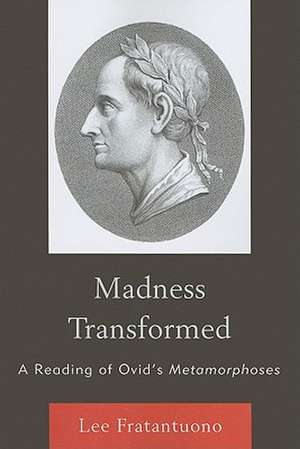
Madness Transformed: A Reading of Ovid's Metamorphoses
Autor Lee Fratantuonoen Limba Engleză Paperback – 12 mai 2011
Preț: 406.74 lei
Preț vechi: 583.21 lei
-30%
Puncte Express: 610
Carte tipărită la comandă
Livrare economică 30 noiembrie-14 decembrie
Livrare prin curier în România Termenul estimat este afișat lângă disponibilitate.
Transport gratuit pentru acest produs Plată online sau ramburs, în funcție de opțiunile comenzii.
Retur gratuit în 14 zile Comandă securizată și suport în română.
Specificații
ISBN-13: 9780739129449
ISBN-10: 0739129449
Pagini: 487
Dimensiuni: 155 x 231 x 31 mm
Greutate: 0.84 kg
Editura: Bloomsbury Publishing
Colecția Lexington Books
Locul publicării:New York, United States
ISBN-10: 0739129449
Pagini: 487
Dimensiuni: 155 x 231 x 31 mm
Greutate: 0.84 kg
Editura: Bloomsbury Publishing
Colecția Lexington Books
Locul publicării:New York, United States
Cuprins
Chapter 1 Ad Lectorem
Chapter 2 Introduction
Chapter 3 I: Into New Bodies
Chapter 4 II: The Palace of the Sun
Chapter 5 III: And Now the God Confessed
Chapter 6 IV: But Not the Daughter of Minyas
Chapter 7 V: While the Danaean Hero . . .
Chapter 8 VI: Tritonia Had Listened
Chapter 9 VII: And Now the Minyans
Chapter 10 VIII: Now the East Wind Fell
Chapter 11 IX: The Neptunian Hero . . .
Chapter 12 X: And Then, Veiled in Saffron . . .
Chapter 13 XI: While with Such a Song . . .
Chapter 14 XII: Priam, Unknowing . . .
Chapter 15 XIII: The Leaders Sat
Chapter 16 XIV: And Now Etna . . .
Chapter 17 XV: Meanwhile There is Sought . . .
Chapter 18 Select Bibliography
Chapter 2 Introduction
Chapter 3 I: Into New Bodies
Chapter 4 II: The Palace of the Sun
Chapter 5 III: And Now the God Confessed
Chapter 6 IV: But Not the Daughter of Minyas
Chapter 7 V: While the Danaean Hero . . .
Chapter 8 VI: Tritonia Had Listened
Chapter 9 VII: And Now the Minyans
Chapter 10 VIII: Now the East Wind Fell
Chapter 11 IX: The Neptunian Hero . . .
Chapter 12 X: And Then, Veiled in Saffron . . .
Chapter 13 XI: While with Such a Song . . .
Chapter 14 XII: Priam, Unknowing . . .
Chapter 15 XIII: The Leaders Sat
Chapter 16 XIV: And Now Etna . . .
Chapter 17 XV: Meanwhile There is Sought . . .
Chapter 18 Select Bibliography
Recenzii
There is much to recommend this book, especially the many cross references to Vergil, coming as they do from the pen of a first rate Vergilian scholar. Fratantuono's commentary reminds us of the immense richness of Ovid's poem and shows us intertextual relations that only a very close reading can reveal. The narrative flows nicely, so much so that it becomes difficult to set the book aside. Indeed, Fratantuono's prose seems to have captured some of the charm and even humor of Ovid. All in all, this is a wonderful, transformative book.
Lee Fratantuono applies his detailed, subtle, and often original analyses of Virgil's Aeneid to Ovid's Metamorphoses, demonstrating along the way their close intertextual relationship. In so doing he offers a fresh perspective on one of the most influential works of Roman literature. Ovid's vision is at once emulation, rival, and extension of his master Virgil's, and his epic of the whole universe rounds out the image of Augustan Rome as the divinely directed plan of a chosen people destined to bring order out of chaos in the cosmic, political, and poetic realms.
Fratantuono's careful and sensitive reading of the Metamorphoses is full of illuminating insights into Ovid's 'tissue of allusions' and his reflections on the Augustan era. This study offers the most comprehensive commentary yet on the epic's structure, its relationship to Vergil's Aeneid, and Ovid's play with his literary inheritance.
Fratantuono (Ohio Wesleyan Univ.) derives his title from Virgil's Aeneid--words spoken by Jupiter proclaiming an era of peace and prophesying that the "impious rage" and frenzy of war will cease--all gainsaid by the last lines of the poem. Offering a coherent sequel to his Madness Unchained: A Reading of Virgil's Aeneid (CH, Feb'08, 45-3052), the author explicates, scene by scene, Ovid's "perpetual song." Close study reveals the Augustan-era epic as a rich, bold answer to both the Aeneid and the Odes of Horace, one that includes subtle cross-referencing bows to Lucretius and Lucan. It is a work of rivalry, but writ large on a cosmic stage. In Ovid's world of imminent chaos, "madness is the possession of everyone," with no foreseeable redemption. Fratantuono looks at each tale of wondrous transformation and ironic Ovidian commentary in light of the several momentous turning points in the reign of Caesar Augustus. Ovid's lengthy poem of dactylic hexameters (i.e., not elegiac) here enjoys a fresh perspective, rounding out both the Roman Republic and the Roman Empire as the divinely prescribed plan destined to create a "new world order." Dense, challenging, scholarly, the volume is graced with an annotated bibliography and a detailed index.
Fratauntuono has many original ideas. He mostly points out parallels between the texts and comments on Ovid's attempts to surpass his predecessor. Several connections between characters in Virgil and Ovid are particularly convincing. The discussion of Virgil's Camilla and Ovid's Atalanta, for instance, is quite compelling....Madness Transformed is a unique book, a hybrid commentary and monograph.
Lee Fratantuono applies his detailed, subtle, and often original analyses of Virgil's Aeneid to Ovid's Metamorphoses, demonstrating along the way their close intertextual relationship. In so doing he offers a fresh perspective on one of the most influential works of Roman literature. Ovid's vision is at once emulation, rival, and extension of his master Virgil's, and his epic of the whole universe rounds out the image of Augustan Rome as the divinely directed plan of a chosen people destined to bring order out of chaos in the cosmic, political, and poetic realms.
Fratantuono's careful and sensitive reading of the Metamorphoses is full of illuminating insights into Ovid's 'tissue of allusions' and his reflections on the Augustan era. This study offers the most comprehensive commentary yet on the epic's structure, its relationship to Vergil's Aeneid, and Ovid's play with his literary inheritance.
Fratantuono (Ohio Wesleyan Univ.) derives his title from Virgil's Aeneid--words spoken by Jupiter proclaiming an era of peace and prophesying that the "impious rage" and frenzy of war will cease--all gainsaid by the last lines of the poem. Offering a coherent sequel to his Madness Unchained: A Reading of Virgil's Aeneid (CH, Feb'08, 45-3052), the author explicates, scene by scene, Ovid's "perpetual song." Close study reveals the Augustan-era epic as a rich, bold answer to both the Aeneid and the Odes of Horace, one that includes subtle cross-referencing bows to Lucretius and Lucan. It is a work of rivalry, but writ large on a cosmic stage. In Ovid's world of imminent chaos, "madness is the possession of everyone," with no foreseeable redemption. Fratantuono looks at each tale of wondrous transformation and ironic Ovidian commentary in light of the several momentous turning points in the reign of Caesar Augustus. Ovid's lengthy poem of dactylic hexameters (i.e., not elegiac) here enjoys a fresh perspective, rounding out both the Roman Republic and the Roman Empire as the divinely prescribed plan destined to create a "new world order." Dense, challenging, scholarly, the volume is graced with an annotated bibliography and a detailed index.
Fratauntuono has many original ideas. He mostly points out parallels between the texts and comments on Ovid's attempts to surpass his predecessor. Several connections between characters in Virgil and Ovid are particularly convincing. The discussion of Virgil's Camilla and Ovid's Atalanta, for instance, is quite compelling....Madness Transformed is a unique book, a hybrid commentary and monograph.