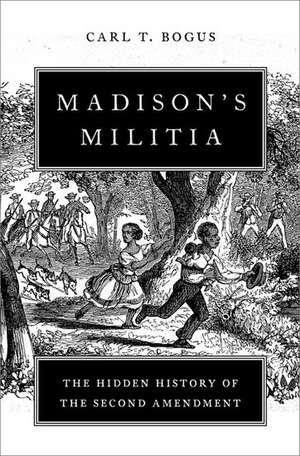
Madison's Militia: The Hidden History of the Second Amendment
Autor Carl T. Bogusen Limba Engleză Hardback – 5 mai 2023
Nivel de studiu: Licență și Master în istorie americană, științe politice sau drept constituțional. Observăm în această lucrare publicată de Oxford University Press o reevaluare radicală a unuia dintre cele mai dezbătute texte din istoria juridică: al Doilea Amendament al Constituției SUA. Departe de a fi un simbol al libertății cetățenești împotriva tiraniei, Madison's Militia demonstrează că dreptul de a purta arme a fost articulat de James Madison pentru a asigura sprijinul statelor sclavagiste din Sud. Analizând tensiunile dintre James Madison și Patrick Henry, autorul Carl T. Bogus expune o realitate incomodă: milițiile nu erau doar forțe de apărare națională, ci instrumente esențiale pentru menținerea ordinii în sistemul sclavagist. Cititorii familiarizați cu A Well-Regulated Militia de Saul Cornell vor aprecia modul în care Bogus merge dincolo de dezbaterea dintre dreptul individual și cel colectiv, ancorând interpretarea juridică într-un context social și rasial specific. Dacă lucrările anterioare ale autorului, precum Why Lawsuits are Good for America – Disciplined Democracy, Big Business, and the Common Law, explorau rolul sistemului juridic în democrația modernă, acest volum aplică aceeași rigoare analitică asupra originilor istorice ale legislației americane. Stilul este alert, integrând episoade dramatice despre insurecțiile sclavilor cu analizele proceselor-verbale ale Primului Congres, oferind o perspectivă istorică ce destabilizează mitul muschetarului de pe Lexington Green.
Preț: 179.03 lei
Preț vechi: 214.59 lei
-17%
Carte disponibilă
Livrare economică 15-20 mai
Specificații
ISBN-10: 019763222X
Pagini: 336
Dimensiuni: 274 x 123 x 30 mm
Greutate: 0.59 kg
Editura: Oxford University Press
Colecția OUP USA
Locul publicării:New York, United States
De ce să citești această carte
Această carte este esențială pentru cei care doresc să înțeleagă rădăcinile sistemice ale culturii armelor în SUA. Cititorul câștigă o perspectivă istorică documentată care depășește retorica politică actuală, descoperind legătura directă dintre al Doilea Amendament și controlul sclaviei. Este o recomandare obligatorie pentru studenții la drept și istorie care caută o analiză critică a miturilor fondatoare americane.
Despre autor
Carl T. Bogus este profesor asociat la Școala de Drept a Universității Roger Williams din Rhode Island. Expert recunoscut în drept constituțional și istorie juridică, Bogus s-a remarcat prin analizele sale critice asupra sistemului legal american. Lucrările sale explorează intersecția dintre politică, dreptul comun și interesele corporatiste, oferind perspective provocatoare asupra modului în care legislația modelează societatea. În Madison's Militia, el își folosește expertiza academică pentru a deconstrui originile Amendamentului al Doilea, consolidându-și reputația de cercetător care nu evită subiectele controversate ale istoriei americane.
Descriere
Recenzii
Readers interested in the Second Amendment's origins or in assessing arguments about its meaning will likely and deeply appreciate this comprehensive history.
At a time when the Supreme Court is increasingly looking at the original meaning in interpreting the Constitution, Professor Carl Bogus has written a riveting account of how the Second Amendment actually came to be added to the Constitution. Contrary to the conventional wisdom, Professor Bogus shows that the Second Amendment was meant to protect the slave system and keep Congress from disarming slave patrols. This is an essential history for all lawyers, judges, students, and individuals who are researching the original understanding of the Second Amendment and gun rights.
A surprisingly fast-paced account of the events leading up to the Second Amendment. Bogus persuasively suggests that, while Madison and other Founders paid lip-service to the dedication of militias and the threat of standing armies, their primary concern was to suppress insurrections by the people they enslaved. Madison's Militia undermines any claim by the Roberts Court/the Supreme Court to locate the individual right to bear arms in an originalist reading of the Constitution.
Bogus offers a fresh and fearless investigation into why Madison and his contemporaries added the right to keep and bear arms to the Constitution. Uncluttered by myth or hagiography, this book will likely become the definitive account of the darker side of the Second Amendment's drafting and ratification.
Carl Bogus makes an important contribution to efforts to discern the meaning of the 27 words that make up the Second Amendment to the United States Constitution. Bogus' work provides a rich context to understand what those who drafted and debated the amendment faced, as well as what they hoped to accomplish. Bogus invites readers to reconsider the racially neutral right to bear arms that the amendment protects in light of the immediate racialized threat of uprisings and rebellions by enslaved people against their enslavers. His book offers a radically different way to read and understand the amendment which aligns with, rather than revises, the history surrounding its ratification.
Slavery was the main event—not a sideshow—as the U.S. was founded. In this insightful, crisply written book Carl Bogus tells us that what impelled the now infamous Second Amendment was precisely the rampant fear of slave insurrections, necessitating the formation of a well-armed militia.
Madison's Militia offers an illuminating overview of the tangled history of the Second Amendment and its 'right to bear arms.' Whatever the limitations of citizen militias in actually fighting wars, they were indispensable in Virginia and other states worried about suppressing any slave rebellions and about the possibility that the new national government would prove insufficiently protective of slavery. American historians are increasingly studying the intersections of slavery and a desire to maintain white supremacy, and Bogus provides a valuable, extremely well-written, demonstration of those intersections.