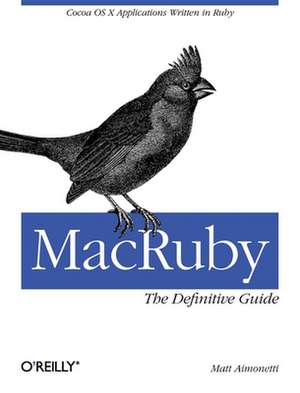
MacRuby: The Definitive Guide
Autor Matt Aimonettien Limba Engleză Paperback – 6 dec 2011
Perfect for programmers at any level, this book is packed with code samples and complete project examples. If you use Ruby, you can tap your skills to take advantage of Interface Builder, Cocoa libraries, the Objective-C runtime, and more. If you're a Cocoa developer, you'll learn how to improve your productivity with MacRuby.
- Get up to speed on MacRuby basics, including classes and methods
- Learn how to use MacRuby with Apple's Xcode developer suite
- Delve into the primitive object classes and data types in Foundation Kit
- Build event-driven user interfaces with the AppKit framework
- Handle relational object persistence with the Core Data framework
- Use advanced MacRuby techniques, including concurrency and sandboxing
- Get examples for applications using Twitter and a location web service
- Embed MacRuby into existing Objective-C applications
Preț: 195.35 lei
Preț vechi: 244.19 lei
-20%
Puncte Express: 293
Carte disponibilă
Livrare economică 16-30 noiembrie
Livrare prin curier în România Termenul estimat este afișat lângă disponibilitate.
Transport gratuit de la 400.00 lei Plată online sau ramburs, în funcție de opțiunile comenzii.
Retur gratuit în 14 zile Comandă securizată și suport în română.
Specificații
ISBN-13: 9781449380373
ISBN-10: 1449380379
Pagini: 242
Ilustrații: Illustrations
Dimensiuni: 180 x 233 x 18 mm
Greutate: 0.4 kg
Editura: O'Reilly
ISBN-10: 1449380379
Pagini: 242
Ilustrații: Illustrations
Dimensiuni: 180 x 233 x 18 mm
Greutate: 0.4 kg
Editura: O'Reilly
V-ar putea interesa
-
 Beginning XcodeMatthew Knott-20%Preț: 247.95 lei309.93 lei
 -
 Writing Game Center Apps in IOSVandad Nahavandipoor-20%Preț: 112.71 lei140.89 lei
 -
 Graphics and Animation on IOSVandad Nahavandipoor-20%Preț: 113.45 lei141.81 lei
 -
 iOS 5 Programming CookbookVandad Nahavandipoor-20%Preț: 263.81 lei329.77 lei
 -
 Learning iOS ProgrammingAllan-20%Preț: 181.64 lei227.05 lei
 -
 Pro iOS Table Views and Collection ViewsTim Duckett-20%Preț: 344.57 lei430.71 lei
 -
 Get Fit with Apple WatchAllen Taylor-20%Preț: 110.69 lei138.36 lei
 -
 iOS eCommerce App Development with ParseLiangjun Jiang-20%Preț: 266.36 lei332.94 lei
 -
 Designing for iOS with SketchSian Morson-20%Preț: 347.36 lei434.21 lei
 -
 Learn Swift 2 on the MacWaqar Malik-20%Preț: 259.76 lei324.71 lei
 -
 Migrating to Swift from Flash and ActionScriptRadoslava Leseva Adams-20%Preț: 314.35 lei392.94 lei
 -
 Enterprise Mac Administrators GuideCharles Edge-20%Preț: 533.19 lei666.49 lei
 -
 Enterprise Mac Security: Mac OS XCharles Edge-20%Preț: 451.51 lei564.39 lei
 -
 Developing for Apple TV using tvOS and SwiftGary Bennett-20%Preț: 177.49 lei221.87 lei
 -
 App Development Recipes for IOS and WatchosMolly K Maskrey-20%Preț: 261.34 lei326.67 lei
 -
 OS X App Development with CloudKit and SwiftBruce Wade-20%Preț: 175.85 lei219.81 lei
 -
 Agile SwiftGodfrey Nolan-20%Preț: 191.46 lei239.33 lei
 -
 Beginning CareKit DevelopmentChristopher Baxter-20%Preț: 232.92 lei291.15 lei
 -
 Build iOS Database Apps with Swift and SQLiteKevin Languedoc-20%Preț: 232.56 lei290.70 lei
 -
 Practical SwiftEric Downey-20%Preț: 213.71 lei267.13 lei
 -
 Beginning Swift Games Development for iOSJames Goodwill-20%Preț: 183.57 lei229.47 lei
 -
 iOS Penetration TestingKunal Relan-20%Preț: 342.70 lei428.38 lei
 -
 iOS 7 Programming FundamentalsMatt Neuburg-20%Preț: 235.23 lei294.04 lei
 -
 Learning SwiftJon Manning-20%Preț: 264.07 lei330.08 lei
 -
 iOS 11 Programming Fundamentals with SwiftMatt Neuberg-20%Preț: 63.08 lei78.85 lei
 -
 Core Data in SwiftMarcus Zarra-20%Preț: 226.53 lei283.16 lei
Notă biografică
Matt Aimonetti is a Senior Engineer at Sony Playstation in San Diego, CA where he works on video games. Prior to that, Matt worked with startups, fortune 100 companies and traditional companies, where he had the opportunity to be involved with really captivating projects in different domain spaces from Biotech to comics without forgetting advertising, social networks e-learning and more.
Matt joined the MacRuby team in 2008 and has been active in the Ruby community for many years prior to that. Matt developed or contributed to a lot OSS libraries and frameworks (Merb, Rails and many more), spoke at users groups and conferences in the U.S. and abroad. Matt blogs at http://merbist.com.
Matt joined the MacRuby team in 2008 and has been active in the Ruby community for many years prior to that. Matt developed or contributed to a lot OSS libraries and frameworks (Merb, Rails and many more), spoke at users groups and conferences in the U.S. and abroad. Matt blogs at http://merbist.com.
Cuprins
Dedication; Preface; The Purpose of This Book; Prerequisites; Conventions Used in This Book; Using Code Examples; Safari® Books Online; How to Contact Us; Acknowledgments; MacRuby Overview; Chapter 1: Introduction; 1.1 Introducing MacRuby; 1.2 Installation; 1.3 Code Example; 1.4 Loading a Framework; 1.5 Using Classes; 1.6 Methods; Chapter 2: Fundamentals; 2.1 Run Loops; 2.2 Callbacks/Delegation; 2.3 User Inputs; 2.4 Outlets; 2.5 Display; 2.6 Example; Chapter 3: The Cocoa Environment; 3.1 History; 3.2 Main Frameworks in the Cocoa API; 3.3 Reference Library; 3.4 Mutability; Chapter 4: Foundation; 4.1 Compatibility Table; 4.2 Strings and Attributed Strings; 4.3 Arrays; 4.4 Hashes/Dictionaries; 4.5 Sets; 4.6 Enumerators; 4.7 Date, Time, and Calendars; 4.8 Data; 4.9 Locales; 4.10 Time Zones; 4.11 Exceptions; 4.12 I/O; 4.13 URLs/Requests/Connections; 4.14 Pipes; 4.15 File Handles; 4.16 Bundles; 4.17 Scheduling; 4.18 Notifications; 4.19 Archiving and Serialization; 4.20 Miscellaneous Classes; Chapter 5: Application Kit; 5.1 Cocoa Key Principles; 5.2 User Interface; Chapter 6: Xcode; 6.1 Xcode IDE; Chapter 7: Core Data; 7.1 Data Model; 7.2 User Interface; 7.3 Persistence; Chapter 8: One Step Deeper; 8.1 Selectors; 8.2 Blocks; 8.3 Concurrency; 8.4 Sandboxing; 8.5 Using Objective-C or C Code; 8.6 Scriptable Applications; 8.7 Method Missing; 8.8 Pointers; 8.9 Compilation; 8.10 Compilation Within Xcode; MacRuby in Practice; Chapter 9: Address Book Example; 9.1 User Interface; 9.2 Address Book; 9.3 Web API Call; 9.4 Cleaning Up: Better Management of Widgets; 9.5 The Extra Mile: Displaying More Information Through Notifications; Chapter 10: Geolocation; 10.1 User Interface; 10.2 Table View; 10.3 Core Location; 10.4 Web API; Chapter 11: MacRuby in Objective-C Projects; 11.1 API; 11.2 Usage; 11.3 Example in an Xcode Project; Chapter 12: Objective-C Code in MacRuby Apps; 12.1 Dynamic Library; 12.2 Framework; Chapter 13: Using Ruby Third-Party Libraries; 13.1 RubyGems; 13.2 MacRuby Deploy; Index; Colophon;