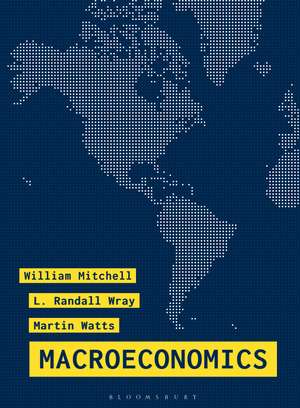
Macroeconomics
Autor Professor William Mitchell, Professor L. Randall Wray, Professor Martin Wattsen Limba Engleză Paperback – 25 feb 2019
The book is suitable for both introductory and intermediate courses, offering a thorough overview of the basics and valuable historical context, while covering everything needed for more advanced courses. Issues are explained conceptually, with the more technical, mathematical material in chapter appendices, offering greater flexibility of use.
Accompanying online resources for this title can be found at bloomsburyonlineresources.com/mitchell-macroeconomics. These resources are designed to support teaching and learning when using this textbook and are available at no extra cost.
Preț: 424.92 lei
Preț vechi: 536.34 lei
-21%
Puncte Express: 637
Carte disponibilă
Livrare economică 06-20 noiembrie
Livrare express 23-29 octombrie pentru 97.67 lei
Livrare prin curier în România Termenul estimat este afișat lângă disponibilitate.
Transport gratuit pentru acest produs Plată online sau ramburs, în funcție de opțiunile comenzii.
Retur gratuit în 14 zile Comandă securizată și suport în română.
Specificații
ISBN-13: 9781137610669
ISBN-10: 1137610662
Pagini: 604
Ilustrații: 5 bw illus
Dimensiuni: 192 x 260 x 30 mm
Greutate: 1.23 kg
Ediția:1st ed. 2019
Editura: Bloomsbury Publishing
Colecția Bloomsbury Academic
Locul publicării:London, United Kingdom
ISBN-10: 1137610662
Pagini: 604
Ilustrații: 5 bw illus
Dimensiuni: 192 x 260 x 30 mm
Greutate: 1.23 kg
Ediția:1st ed. 2019
Editura: Bloomsbury Publishing
Colecția Bloomsbury Academic
Locul publicării:London, United Kingdom
V-ar putea interesa
-
 The Eurodollar Futures and Options HandbookGalen Burghardt-18%Preț: 548.05 lei672.09 lei
 -
 Preț: 464.26 lei
 -
 Preț: 242.22 lei
 -
 Central Banking in Developing CountriesA. Chandavarkar-18%Preț: 955.08 lei1164.73 lei
 -
 -18%Preț: 952.86 lei1162.03 lei
 -
 The Alchemy of FinanceGeorge SorosPreț: 153.87 lei
 -
 Option Market MakingAllen Jan Baird-8%Preț: 604.67 lei657.25 lei
 -
 Preț: 256.58 lei
 -
 WatermillsMartin Watts-33%Preț: 45.64 lei68.04 lei
 -
 Oil 101Morgan Patrick DowneyPreț: 266.83 lei
 -
 Trades, Quotes and PricesJean-Philippe Bouchaud-8%Preț: 622.79 lei676.94 lei
 -
 Advances in Financial Machine LearningMarcos Lopez de PradoPreț: 327.22 lei
 -
 VolatilityAdam S. IqbalPreț: 393.18 lei
 -
 Commodity Option PricingIain J Clark-8%Preț: 640.27 lei695.95 lei
 -
 -18%Preț: 750.37 lei915.08 lei
 -
 Smile Pricing ExplainedP. AustingPreț: 366.86 lei
 -
 Modern Money TheoryL. Randall Wray-17%Preț: 585.17 lei705.03 lei
 -
 BenedictionsWilliam MitchellPreț: 160.36 lei
 -
 Energy Price RiskT. James-18%Preț: 1280.77 lei1561.93 lei
 -
 Preț: 64.20 lei
 -
 The Prize: The Epic Quest for Oil, Money & PowerDaniel Yergin-12%Preț: 116.99 lei133.02 lei
 -
 -20%Preț: 845.84 lei1057.30 lei
Cuprins
PART A: INTRODUCTION & MEASUREMENT
1 Introduction
2 How to Think and Do Macroeconomics
3 A Brief Overview of the Economic History and the Rise of Capitalism
4 The System of National Income and Product Accounts
5 Labour Market Concepts and Measurement
6 Sectoral Accounting and the Flow of Funds
7 Methods, Tools and Techniques
8 Framing and Language in Macroeconomics
PART B: CURRENCY, MONEY & BANKING
9 Introduction to Sovereign Currency: The Government and its Money
10 Money and Banking
PART C: NATIONAL INCOME, OUTPUT AND EMPLOYMENT DETERMINATION
11 The Classical System
12 Mr Keynes and the 'Classics'
13 The Theory of Effective Demand
14 The Macroeconomic Demand for Labour
15 The Aggregate Expenditure Model
16 Aggregate Supply
PART D UNEMPLOYMENT AND INFLATION: THEORY AND POLICY
17 Unemployment and Inflation
18 The Phillips Curve and Beyond
19 Full Employment Policy
PART E ECONOMIC POLICY IN AN OPEN ECONOMY
20 Introduction to Monetary and Fiscal Policy Operations
21 Fiscal Policy in Sovereign Nations
22 Fiscal Space and Fiscal Sustainability
23 Monetary Policy in Sovereign Nations
24 Policy in an Open Economy: Exchange Rates, Balance of Payments and Competitiveness
PART F ECONOMIC INSTABILITY
25 The Role of Investment in Profit Generation
26 Stabilising the Unstable Economy
PART G HISTORY OF MACROECONOMIC THOUGHT
27 Overview of the History of Economic Thought
28 The IS-LM Framework
29 Modern Schools of Economic Thought
30 The New Monetary Consensus in Macroeconomics
PART H CONTEMPORARY DEBATES
31 Recent Policy Debates
32 Macroeconomics in the Light of the Global Financial Crisis
33 Macroeconomics for the Future.
1 Introduction
2 How to Think and Do Macroeconomics
3 A Brief Overview of the Economic History and the Rise of Capitalism
4 The System of National Income and Product Accounts
5 Labour Market Concepts and Measurement
6 Sectoral Accounting and the Flow of Funds
7 Methods, Tools and Techniques
8 Framing and Language in Macroeconomics
PART B: CURRENCY, MONEY & BANKING
9 Introduction to Sovereign Currency: The Government and its Money
10 Money and Banking
PART C: NATIONAL INCOME, OUTPUT AND EMPLOYMENT DETERMINATION
11 The Classical System
12 Mr Keynes and the 'Classics'
13 The Theory of Effective Demand
14 The Macroeconomic Demand for Labour
15 The Aggregate Expenditure Model
16 Aggregate Supply
PART D UNEMPLOYMENT AND INFLATION: THEORY AND POLICY
17 Unemployment and Inflation
18 The Phillips Curve and Beyond
19 Full Employment Policy
PART E ECONOMIC POLICY IN AN OPEN ECONOMY
20 Introduction to Monetary and Fiscal Policy Operations
21 Fiscal Policy in Sovereign Nations
22 Fiscal Space and Fiscal Sustainability
23 Monetary Policy in Sovereign Nations
24 Policy in an Open Economy: Exchange Rates, Balance of Payments and Competitiveness
PART F ECONOMIC INSTABILITY
25 The Role of Investment in Profit Generation
26 Stabilising the Unstable Economy
PART G HISTORY OF MACROECONOMIC THOUGHT
27 Overview of the History of Economic Thought
28 The IS-LM Framework
29 Modern Schools of Economic Thought
30 The New Monetary Consensus in Macroeconomics
PART H CONTEMPORARY DEBATES
31 Recent Policy Debates
32 Macroeconomics in the Light of the Global Financial Crisis
33 Macroeconomics for the Future.
Recenzii
Even some mainstream economists now acknowledge that the macroeconomics of the past thirty years represents a big step back. But they do not recognize that this is because it lacks a pluralist perspective, and in the meantime they have ignored the revolutionary potential of heterodox economics for reconstructing macroeconomics. This new book points out the right direction for the coming macroeconomics revolution.
Finally, a macroeconomics text that takes a modern-monetary approach to the macroeconomy. Finally, an alternative to the mainstream vision of the macro economy and what it says and, more importantly, fails to say, about the real world. The presentation of Keynes closely approximates his vision, a much-needed change from texts that present a "bastardized" view of Keynes' theory. The book is highly readable, the assumptions underlying the different models are presented clearly, the logic easy to follow, and the historical context serves to add relevance.
A complete, up-to-date and excellent account of macroeconomic theory. An excellent critique of the mainstream economic paradigm, it calls for more realistic approaches to human behaviour, and for heterodox ideas in economics. It presents macroeconomic methodology in the light of the 2007-08 crisis, and outlines how economics should proceed in the post-crash world. One of the most interesting and remarkable macroeconomics textbooks of the past few years.
Finally, a macro textbook that rejects neoclassical microfoundations as a basis for understanding how capitalism works. The authors replace maximizing individuals with social classes where capitalist firms exercising differential power largely determine economic outcomes.
The most progressive macroeconomics textbook on the market. Organized around a balance sheet view, the authors carefully examine the most important issues of our time: Why government as the sovereign issuer of currency is not financially constrained, how banks create deposits by making loans and how the central bank influences the economy by shifting interest rates. The authors are outstanding scholars of macroeconomics, and this textbook should enlighten the next generation of students. I recommend it wholeheartedly.
A uniquely well-structured, clear discussion of macroeconomics for the 21st century, contrasting a useful and realistic analysis of a modern monetary production economy with the flawed, unrealistic and outdated narrowly neoclassical approach which has failed so comprehensively in recent years. Quite simply the best economics textbook I have ever read, and one which should become a standard text in many universities and colleges in the years to come.
Supremely accessible . Unlike most other textbooks, it explains schools of thought, relates them to the history of economic ideas and provides historical and institutional detail. Students are invited to reflect on why economists disagree, what macroeconomics means, and the role of language and framing. One can only wish that all textbooks nurtured sensitivity to these topics in future economists. All in all, an exceptionally clear text for students new to macroeconomics and a good grounding in the current policy debates shown in the final part of the book ... It marries pluralism of ideas with a clear exposition of Modern Monetary Theory, all with institutional realism and analytical rigor - a major feat. Highly recommended!
This is a long awaited first-year university textbook where heterodox and mainstream approaches run side by side within a critical framework which avoids the pedagogical pitfall of forcing students to learn economics through mainstream lenses. Students and experienced economists alike can learn from this wonderful book.
Finally, a macroeconomics text that takes a modern-monetary approach to the macroeconomy. Finally, an alternative to the mainstream vision of the macro economy and what it says and, more importantly, fails to say, about the real world. The presentation of Keynes closely approximates his vision, a much-needed change from texts that present a "bastardized" view of Keynes' theory. The book is highly readable, the assumptions underlying the different models are presented clearly, the logic easy to follow, and the historical context serves to add relevance.
A complete, up-to-date and excellent account of macroeconomic theory. An excellent critique of the mainstream economic paradigm, it calls for more realistic approaches to human behaviour, and for heterodox ideas in economics. It presents macroeconomic methodology in the light of the 2007-08 crisis, and outlines how economics should proceed in the post-crash world. One of the most interesting and remarkable macroeconomics textbooks of the past few years.
Finally, a macro textbook that rejects neoclassical microfoundations as a basis for understanding how capitalism works. The authors replace maximizing individuals with social classes where capitalist firms exercising differential power largely determine economic outcomes.
The most progressive macroeconomics textbook on the market. Organized around a balance sheet view, the authors carefully examine the most important issues of our time: Why government as the sovereign issuer of currency is not financially constrained, how banks create deposits by making loans and how the central bank influences the economy by shifting interest rates. The authors are outstanding scholars of macroeconomics, and this textbook should enlighten the next generation of students. I recommend it wholeheartedly.
A uniquely well-structured, clear discussion of macroeconomics for the 21st century, contrasting a useful and realistic analysis of a modern monetary production economy with the flawed, unrealistic and outdated narrowly neoclassical approach which has failed so comprehensively in recent years. Quite simply the best economics textbook I have ever read, and one which should become a standard text in many universities and colleges in the years to come.
Supremely accessible . Unlike most other textbooks, it explains schools of thought, relates them to the history of economic ideas and provides historical and institutional detail. Students are invited to reflect on why economists disagree, what macroeconomics means, and the role of language and framing. One can only wish that all textbooks nurtured sensitivity to these topics in future economists. All in all, an exceptionally clear text for students new to macroeconomics and a good grounding in the current policy debates shown in the final part of the book ... It marries pluralism of ideas with a clear exposition of Modern Monetary Theory, all with institutional realism and analytical rigor - a major feat. Highly recommended!
This is a long awaited first-year university textbook where heterodox and mainstream approaches run side by side within a critical framework which avoids the pedagogical pitfall of forcing students to learn economics through mainstream lenses. Students and experienced economists alike can learn from this wonderful book.