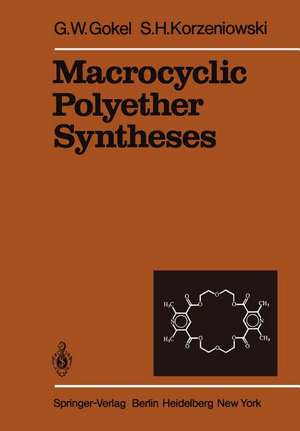
Macrocyclic Polyether Syntheses
Autor G. W. Gokel, S. H. Korzeniowskien Limba Engleză Paperback – 10 dec 2011
Preț: 654.89 lei
Preț vechi: 770.45 lei
-15%
Puncte Express: 982
Carte tipărită la comandă
Livrare economică 23 noiembrie-07 decembrie
Livrare prin curier în România Termenul estimat este afișat lângă disponibilitate.
Transport gratuit pentru acest produs Plată online sau ramburs, în funcție de opțiunile comenzii.
Retur gratuit în 14 zile Comandă securizată și suport în română.
Specificații
ISBN-13: 9783642684531
ISBN-10: 364268453X
Pagini: 436
Ilustrații: XVIII, 412 p.
Dimensiuni: 170 x 244 x 24 mm
Greutate: 0.75 kg
Ediția:Softcover reprint of the original 1st ed. 1982
Editura: Springer
Locul publicării:Berlin, Heidelberg, Germany
ISBN-10: 364268453X
Pagini: 436
Ilustrații: XVIII, 412 p.
Dimensiuni: 170 x 244 x 24 mm
Greutate: 0.75 kg
Ediția:Softcover reprint of the original 1st ed. 1982
Editura: Springer
Locul publicării:Berlin, Heidelberg, Germany
V-ar putea interesa
-
 -15%Preț: 538.69 lei633.75 lei
 -
 Intermediate Organic Chemistry 3eAM Fabirkiewicz-23%Preț: 651.68 lei846.34 lei
 -
 Arene ChemistryMortier-9%Preț: 1202.39 lei1321.30 lei
 -
 Compendium of Organic Synthetic MethodsMichael B Smith-9%Preț: 1283.76 lei1410.72 lei
 -
 Organic Redox SystemsNishinaga-9%Preț: 1235.94 lei1358.17 lei
 -
 -23%Preț: 1054.68 lei1369.72 lei
 -
 Preț: 392.60 lei
 -
 Polymer Synthesis: Theory and PracticeDietrich Braun-15%Preț: 618.51 lei727.66 lei
Public țintă
ResearchCuprins
1. Introduction and General Principles.- 1.1 Background.- 1.2 Pedersen’s Discovery of Crown Compounds.- 1.3 Nomenclature and Jargon.- 1.3.1 Crown Ether.- 1.3.2 Azacrown.- 1.3.3 In-Out Bicyclic Amines.- 1.3.4 Cryptands and Cryptate Complexes.- 1.3.5 Lariat Ethers.- 1.3.6 Crown Esters.- 1.3.7 Spherands.- 1.3.8 Cascades.- 1.3.9 Polypodes and Octopus Molecules.- 1.3.10 Host-Guest-Chemistry.- 1.3.11 Conventions.- 1.4 The Cyclooligomerization of Ethylene Oxide.- 1.5 Polyazamacrocycles as Complexing Agents for Transition Metals.- 1.6 References.- 2. The Template Effect.- 2.1 Introduction.- 2.2 Operation of the Template Effect.- 2.3 Evidence for the Template Effect.- 2.4 Complexation Constants and the Template Effect.- 2.5 References.- 3. Syntheses of Oxygen Macrocycles.- 3.1 Pedersen’s First Crowns.- 3.2 Syntheses of 18-Crown-6.- 3.3 Syntheses of Dibenzo and Dicyclohexano-18-Crown-6.- 3.4 Synthesis of Substituted Benzocrowns.- 3.5 Crowns Incorporating the Xylylene Unit.- 3.6 Furan-containing Macrocycles.- 3.7 Crowns Containing the Paracyclophanyl Unit.- 3.8 Bis-Crowns.- 3.9 Lariat Ethers.- 3.10 Miscellaneous Crown Systems.- 3.11 Ne wkome’s Pyridine-containing Macrocycles.- 3.12 Okahara’s One-pot Approach.- 3.13 Chiral Crowns.- 3.13.1 Cram’s Chiral Binaphthyl Systems.- 3.13.2 Crowns Incorporating the Tartaric or Lactic Acid Subunit.- 3.13.3 Crowns Incorporating Sugar Subunits.- 3.14. Organometallic Derivatives of Crowns.- 3.15 Cesium Salts in Crown Synthesis.- 3.16 Listings of Tables.- 3.17 Tables 3.1–3.29.- 3.18 References.- 4. Syntheses of Azacrowns.- 4.1 Introduction.- 4.2 Monoazacrowns.- 4.3 Bridged Monoazacrowns.- 4.4 Diazacrowns.- 4.5 Cyclams.- 4.6 Cyclic Oximes.- 4.7 Macrocyclic Imines.- 4.8 Thioazamacrocycles.- 4.9 Biologically Active Azacrowns.- 4.10 CrownEther Based Dyes.- 4.11 Newkome’s Pyridine-containing Macrocycles.- 4.12 Listing of Tables.- 4.13 Tables 4.1–4.21.- 4.14 References.- 5. Crown Esters and Macrocyclic Polyether Lactones.- 5.1 Introduction.- 5.2 General Ester Synthesis.- 5.3 Macrocyclic Ester Properties.- 5.4 One-pot Macrocyclic Lactone Synthesis.- 5.5 The Hantzsch Condensation.- 5.6 Antibiotic Models.- 5.7 Stannoxanes as Covalent Templates.- 5.8 Macrocyclic Esters by Ozonolysis.- 5.9 Photochemical Macrocyclization.- 5.10 Listing of Tables.- 5.11 Tables 5.1–5.14.- 5.12 References.- 6. Miscellaneous Macrocycles.- 6.1 Macrocyclic Polyether Acetals.- 6.2 Macrocyclic Thioethers.- 6.2.1 Simple Sulfur Macrocycles.- 6.2.2 Macrocycles with Sulfur-containing Subunits.- 6.2.3 Macrocyclic Polysulfides.- 6.3 Mixed Sulfur-Nitrogen Macrocycles.- 6.4 Phosphorus and Arsenic-containing Macrocycles.- 6.5 Silicon-containing Macrocycles.- 6.6 Polymer-bound Macrocycles.- 6.6.1 Pendant Crown Polymers.- 6.6.2 Crown Ether Copolymers.- 6.6.3 Polycrowns.- 6.6.4 Pseudocrowns.- 6.7 Listing of Tables.- 6.8 Tables 6.1–6.4.- 6.9 References.- 7. Open-chained Equivalents of Crown Ethers.- 7.1 Introduction.- 7.2 Uses of Open-chained Equivalents in PTC.- 7.3 Octopus Molecules.- 7.4 Substituted Podands.- 7.5 Synthetic Ionophores.- 7.6 Listing of Tables.- 7.7 Tables 7.1–7.13.- 7.8 References.- 8. Cryptands and Related Poly cyclic Systems.- 8.1 Inception and General Syntheses.- 8.2 Cryptands Containing Sulfur and Nitrogen in the Bridges.- 8.3 Lipophilic Cryptands.- 8.4 Cryptands Containing a Carbon Bridgehead.- 8.5 Chiral Cryptands.- 8.6 Miscellaneous Cryptands.- 8.7 Macropolycyclic Cryptands.- 8.8 Polymer-bound Cryptands.- 8.9 listing of Tables.- 8.10 Tables 8.1–8.5.- 8.11 References.- Author Index.