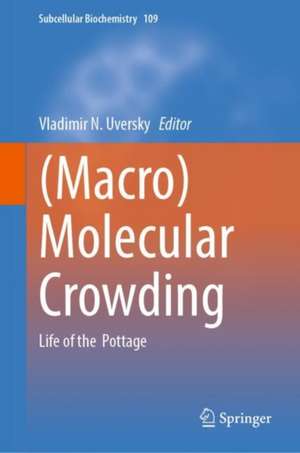
(Macro)Molecular Crowding: Subcellular Biochemistry, cartea 109
Editat de Vladimir N. Uverskyen Limba Engleză Hardback – 27 sep 2025
Din seria Subcellular Biochemistry
- 18%
 Preț: 1275.46 lei
- 5%
 Preț: 1339.98 lei
- 18%
 Preț: 1455.52 lei
- 18%
 Preț: 1283.96 lei
- 18%
 Preț: 1269.37 lei
- 18%
 Preț: 1039.94 lei
- 18%
 Preț: 1421.89 lei
- 18%
 Preț: 1349.39 lei
- 18%
 Preț: 1077.55 lei
- 18%
 Preț: 998.90 lei
- 18%
 Preț: 1194.50 lei
- 18%
 Preț: 1271.07 lei
- 24%
 Preț: 1320.74 lei
- 24%
 Preț: 1040.56 lei
- 5%
 Preț: 1488.53 lei
- 5%
 Preț: 1466.23 lei
- 18%
 Preț: 1274.34 lei
- 18%
 Preț: 1273.15 lei
- 5%
 Preț: 1463.35 lei
- 18%
 Preț: 1269.85 lei
- 18%
 Preț: 1270.31 lei
- 5%
 Preț: 2048.53 lei
- 5%
 Preț: 1061.54 lei
- 18%
 Preț: 1281.91 lei
- 5%
 Preț: 1364.89 lei
- 18%
 Preț: 1192.81 lei
- 5%
 Preț: 1362.82 lei
- 5%
 Preț: 1369.44 lei
- 5%
 Preț: 1057.44 lei
- 5%
 Preț: 1670.41 lei
Preț: 1040.49 lei
Preț vechi: 1369.06 lei
-24%
Puncte Express: 1561
Carte tipărită la comandă
Livrare economică 26 decembrie 26 - 01 ianuarie 27
Livrare prin curier în România Termenul estimat este afișat lângă disponibilitate.
Transport gratuit pentru acest produs Plată online sau ramburs, în funcție de opțiunile comenzii.
Retur gratuit în 14 zile Comandă securizată și suport în română.
Specificații
ISBN-13: 9783032033697
ISBN-10: 3032033691
Pagini: 548
Ilustrații: V, 600 p. 82 illus., 67 illus. in color.
Dimensiuni: 160 x 241 x 35 mm
Greutate: 0.93 kg
Editura: Springer
Colecția Subcellular Biochemistry
Seria Subcellular Biochemistry
ISBN-10: 3032033691
Pagini: 548
Ilustrații: V, 600 p. 82 illus., 67 illus. in color.
Dimensiuni: 160 x 241 x 35 mm
Greutate: 0.93 kg
Editura: Springer
Colecția Subcellular Biochemistry
Seria Subcellular Biochemistry
Notă biografică
Prof. Vladimir Uversky is a Professor at the Department of Molecular Medicine at the Morsani College of Medicine, University of South Florida (USF). He obtained Ph.D. from the Moscow Institute of Physics and Technology (1991) and a D.Sc. from the Institute of Experimental and Theoretical Biophysics (1998).
He obtained pre- and postdoctoral training in Structural Biology, Biochemistry, and Biophysics (1991-1998, Institute of Protein Research, Russian Academy of Sciences) and spent his early career working on protein folding at the Institute of Protein Research and the Institute for Biological Instrumentation (Russia). In 1998, he moved to the University of California Santa Cruz, where for six years he was studying protein folding, misfolding, protein conformation diseases, and protein intrinsic disorder phenomenon. In 2004, he was invited to join the Indiana University School of Medicine as a Senior Research Professor to work on intrinsically disordered proteins. Since 2010, he has been with USF, where he continues to study intrinsically disordered proteins, protein folding and misfolding processes, as well as liquid-liquid phase transitions and their applications in biology.
He has authored over 1500 scientific publications and edited several books and book series on protein structure, function, folding, and misfolding. Among his most recent edited volumes are "Droplets of Life: Membrane-less Organelles, Biomolecular Condensates, and Biological Liquid-Liquid Phase Separation" (ISBN: 9780128239674), "Structure and Intrinsic Disorder in Enzymology" (together with Munishwar Gupta, ISBN: 9780323995337), and "The Three Functional States of Proteins: Structured, Intrin-sically Disordered, and Phase Separated" (together with Prof. Timir Tripathi, ISBN: 9780443218095. He is also an editor of several scientific journals. In 2021, he was elected as a Fellow of the Royal Society of Biology and a Fellow of the Royal Society of Chemistry, and in 2024, he was elected as a Fellow of the American Institute for Medical and Biological Engineering and a Fellow of the American Association for the Advancement of Science.
Cuprins
Chapter 1: A brief historico-philosophical overview of macromolecular crowding: Making "physiological conditions" more physiological.- Chapter 2: Effects of molecular crowding on the structural, dynamic, and functional properties of biological macromolecules: A general overview.- Chapter 3: (Macro)molecular crowding effects beyond volume exclusion.- Chapter 4: Role of aqueous media in macromolecular crowding.- Chapter 5: Effects of macromolecular crowding on the structure and dynamics of biological membranes.- Chapter 6: Effects of molecular crowding on the structure, folding, and stability of DNA.- Chapter 7: Effects of molecular crowding on the structure, folding, stability, and catalysis of RNA.- Chapter 8: Understanding the effect of macromolecular crowding on protein misfolding and aggregation.- Chapter 9: The role of macromolecular crowding in cytoskeletal organization.- Chapter 10: Macromolecular crowding in cytoplasm and cellular organelles.- Chapter 11: Macromolecular crowding in mitochondria.- Chapter 12: Molecular crowing in nuclear pore.- Chapter 13: Catalytic Droplets: Enzyme Containing Microcompartments.- Chapter 14: Macromolecular crowding in cell stress and death.- Chapter 15: Heterogeneity of molecular crowding and liquid-liquid phase separation.- Chapter 16: Reshuffling overcrowded milieu: Stress-induced reorganization of the eukaryotic membrane-less organelles.- Chapter 17: Crowding in Anhydrobiosis.- Chapter 18: Crowding and in-cell crystallization.- Chapter 19: Macromolecular crowding for reparative medicine and drug discovery applications.- Chapter 20: Simulating crowding in vitro: Not an elusive goal any longer.- Chapter 21: Molecular Crowding by Computational Approaches.- Chapter 22: Modeling Facilitated Diffusion of Proteins in Crowded Environment.- Chapter 23: The Hidden Influences of Macromolecular Crowding: A New Frontier in Cellular Biology and Medicine.