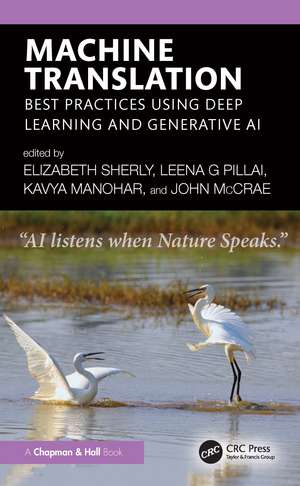
Machine Translation: Best Practices using Deep Learning and Generative AI
Editat de Elizabeth Sherly, Leena G Pillai, Kavya Manohar, John McCraeen Limba Engleză Hardback – 30 noi 2026
Preț: 1549.63 lei
Preț vechi: 2024.38 lei
-23% Precomandă
Puncte Express: 2324
Carte nepublicată încă
Livrare prin curier în România Precomanda se expediază când titlul devine disponibil.
Transport gratuit pentru acest produs Plată online sau ramburs, în funcție de opțiunile comenzii.
Retur gratuit în 14 zile Comandă securizată și suport în română.
Doresc să fiu notificat când acest titlu va fi disponibil:
Se trimite...
Specificații
ISBN-13: 9781032972329
ISBN-10: 1032972327
Pagini: 430
Ilustrații: 186
Dimensiuni: 156 x 234 mm
Greutate: 0.45 kg
Ediția:1
Editura: CRC Press
Colecția Chapman and Hall/CRC
ISBN-10: 1032972327
Pagini: 430
Ilustrații: 186
Dimensiuni: 156 x 234 mm
Greutate: 0.45 kg
Ediția:1
Editura: CRC Press
Colecția Chapman and Hall/CRC
Public țintă
AcademicCuprins
Preface
1. Five Waves of Machine Translation: Tides of Innovation
2. Looking into Different Dimensions and Aspects of Translation as an Applied Discipline
3. Linguistic Foundation for Machine Translation
4. Machine Translation: A Journey from Linguistic Rules to Neural Networks
5. Demystifying Machine Translation: Foundation, Growth and Emergence
6. Statistical Machine Translation for Morphologically Rich Languages: A Case Study with POS Tagging and NER
7. Fundamentals of Neural Machine Translation
8. Pivot-Based Neural Machine Translation
9. Hybrid Machine Translation
10. Generative AI in Machine Translation
11. Large Language Models and their Architectures for Machine Translation
12. Voice-Enabled Llama 3: Exploring Speech-to-Text Translation in Large Language Models
13. Speech Translation in Low Resource Language
14. Crossing Boundaries: The Moral Creativity of Machine Translation
15. Ethical Aspects of Machine Translation
16. Evaluation Techniques, Experiment Design and Common Misconceptions in Machine Translation Research
1. Five Waves of Machine Translation: Tides of Innovation
2. Looking into Different Dimensions and Aspects of Translation as an Applied Discipline
3. Linguistic Foundation for Machine Translation
4. Machine Translation: A Journey from Linguistic Rules to Neural Networks
5. Demystifying Machine Translation: Foundation, Growth and Emergence
6. Statistical Machine Translation for Morphologically Rich Languages: A Case Study with POS Tagging and NER
7. Fundamentals of Neural Machine Translation
8. Pivot-Based Neural Machine Translation
9. Hybrid Machine Translation
10. Generative AI in Machine Translation
11. Large Language Models and their Architectures for Machine Translation
12. Voice-Enabled Llama 3: Exploring Speech-to-Text Translation in Large Language Models
13. Speech Translation in Low Resource Language
14. Crossing Boundaries: The Moral Creativity of Machine Translation
15. Ethical Aspects of Machine Translation
16. Evaluation Techniques, Experiment Design and Common Misconceptions in Machine Translation Research
Notă biografică
Prof. (Dr.) Elizabeth Sherly is a Distinguished Professor of Computer Science at Kerala University of Digital Sciences, Innovation and Technology (Digital University Kerala), with over three decades of experience in teaching and research. She formerly served as the Director of the Indian Institute of Information Technology and Management-Kerala (IIITM-K) and the International Centre for Free and Open Source Software (ICFOSS).
Dr. Sherly earned her Ph.D. in Computer Science from the University of Kerala in 1995 in the topic Artificial Neural Network Approach in Renal Control Systems. Her research spans a broad spectrum, including Artificial Intelligence, Machine Learning, Natural Language Processing, Speech Recognition, and Medical Image Processing. She has guided 13 Ph.D. scholars and authored more than 100 research publications in reputed journals and conferences. She also serves on the editorial boards of various national and international journals. Recognized with numerous awards for her contributions, she has led several pioneering projects funded by both central and state governments.
She is the founder and heading centres ‘Virtual Resource Centre for Language Computing’ and ‘Centre of Excellence in Brain Computing’. She is also the visionary behind Women Innovation, Start-ups and Entrepreneurship (WISE) at Digital University, promoting women in technology through mentorship and inclusive initiatives. Dr. Sherly is deeply committed to empowering the next generation of women leaders in AI and continues to make significant contributions to both academia and industry.
Leena G. Pillai is currently an Assistant Professor in the Department of Artificial Intelligence and Machine Learning at Sree Saraswathi Thyagaraja College, Pollachi, Tamil Nadu. She served as a Research Scientist at the Virtual Resource Centre for Language Computing, Digital University Kerala, where she led research initiatives in low-resource language technologies and speech processing systems.
She was awarded the Doctor of Philosophy (Ph.D.) in Computer Science by the University of Kerala for her doctoral research titled “Acoustic and Articulatory Evaluation of Speech Signals using Machine Learning Techniques.” She also holds an M.Phil. in Computer Science from Cochin University of Science and Technology and a Master of Computer Applications (MCA) from Bharathidasan University.
Her research interests include natural language processing, automatic speech recognition, articulatory inversion, and AI-based assistive technologies. She has published in leading journals and conferences and has contributed to the development of ASR and transliteration models for underrepresented Indian languages, such as Malasar and Malayalam. Several of these resources are publicly hosted on Hugging Face.
She is the recipient of the Association for Computational Linguistics (ACL) grant to present at EMNLP 2024 and has received Best Paper Awards at national conferences. She has served as a reviewer for international journals and IEEE conferences and has contributed to organizing academic events on AI and language technology.
Kavya Manohar is currently a Machine Learning Researcher at Adalat AI. She served as a Computational Linguist at the Virtual Resource Centre for Language Computing, Digital University Kerala, where she led research initiatives in low-resource language technologies and speech processing systems.
She was awarded the Doctor of Philosophy (Ph.D.) in Electronics and Communication Engineering by APJ Abdul Kalam Technological University for her doctoral research titled “Linguistic challenges in Malayalam speech recognition: Analysis and solutions.”
Her research interests include automatic speech recognition, phonetic and phonemic studies of low resource Dravidian languages, typological complexity and its impacts on natural language processing and linguistic AI systems. She has published in leading journals and conferences and has contributed to the development of open speech and language models for Malayalam language. ßShe has served as a reviewer for international journals and IEEE conferences and has contributed to organizing academic events on AI and language technology.
John P. McCrae is an Associate Professor at the University of Galway, specializing in Natural Language Processing (NLP), computational lexicography, and knowledge graphs. He earned his MSci in Mathematics and Computer Science from Imperial College London (2006) and his PhD from the National Institute of Informatics, Japan (2009), where he focused on the automatic extraction of logically consistent ontologies from text. He later held research positions at the University of Bielefeld before joining the University of Galway faculty in 2017.
McCrae is internationally recognized for his contributions to lexical and ontology-based technologies, notably the W3C OntoLex-lemon model and the development of the Open English WordNet. His leadership in major European and national research projects, including the H2020-funded Prêt-à-LLOD and ELEXIS, has advanced the integration of linked data into lexicography. He is a principal investigator in Ireland’s Insight Centre for Data Analytics and the ADAPT Centre and has been awarded an IRC Consolidator Laureate grant.
A committed educator, McCrae has supervised numerous PhD students, mentored early-career researchers, and developed MSc-level courses in NLP and Knowledge Graphs. He founded the Language, Data, and Knowledge (LDK) Conference Series, fostering global collaboration between computational linguistics and knowledge representation communities. His work bridges academia and industry, with collaborations leading to patents and innovations for companies such as Fidelity Investments, Huawei, and Genesys. Beyond research, he is an advocate for gender equality in computer science.
Dr. Sherly earned her Ph.D. in Computer Science from the University of Kerala in 1995 in the topic Artificial Neural Network Approach in Renal Control Systems. Her research spans a broad spectrum, including Artificial Intelligence, Machine Learning, Natural Language Processing, Speech Recognition, and Medical Image Processing. She has guided 13 Ph.D. scholars and authored more than 100 research publications in reputed journals and conferences. She also serves on the editorial boards of various national and international journals. Recognized with numerous awards for her contributions, she has led several pioneering projects funded by both central and state governments.
She is the founder and heading centres ‘Virtual Resource Centre for Language Computing’ and ‘Centre of Excellence in Brain Computing’. She is also the visionary behind Women Innovation, Start-ups and Entrepreneurship (WISE) at Digital University, promoting women in technology through mentorship and inclusive initiatives. Dr. Sherly is deeply committed to empowering the next generation of women leaders in AI and continues to make significant contributions to both academia and industry.
Leena G. Pillai is currently an Assistant Professor in the Department of Artificial Intelligence and Machine Learning at Sree Saraswathi Thyagaraja College, Pollachi, Tamil Nadu. She served as a Research Scientist at the Virtual Resource Centre for Language Computing, Digital University Kerala, where she led research initiatives in low-resource language technologies and speech processing systems.
She was awarded the Doctor of Philosophy (Ph.D.) in Computer Science by the University of Kerala for her doctoral research titled “Acoustic and Articulatory Evaluation of Speech Signals using Machine Learning Techniques.” She also holds an M.Phil. in Computer Science from Cochin University of Science and Technology and a Master of Computer Applications (MCA) from Bharathidasan University.
Her research interests include natural language processing, automatic speech recognition, articulatory inversion, and AI-based assistive technologies. She has published in leading journals and conferences and has contributed to the development of ASR and transliteration models for underrepresented Indian languages, such as Malasar and Malayalam. Several of these resources are publicly hosted on Hugging Face.
She is the recipient of the Association for Computational Linguistics (ACL) grant to present at EMNLP 2024 and has received Best Paper Awards at national conferences. She has served as a reviewer for international journals and IEEE conferences and has contributed to organizing academic events on AI and language technology.
Kavya Manohar is currently a Machine Learning Researcher at Adalat AI. She served as a Computational Linguist at the Virtual Resource Centre for Language Computing, Digital University Kerala, where she led research initiatives in low-resource language technologies and speech processing systems.
She was awarded the Doctor of Philosophy (Ph.D.) in Electronics and Communication Engineering by APJ Abdul Kalam Technological University for her doctoral research titled “Linguistic challenges in Malayalam speech recognition: Analysis and solutions.”
Her research interests include automatic speech recognition, phonetic and phonemic studies of low resource Dravidian languages, typological complexity and its impacts on natural language processing and linguistic AI systems. She has published in leading journals and conferences and has contributed to the development of open speech and language models for Malayalam language. ßShe has served as a reviewer for international journals and IEEE conferences and has contributed to organizing academic events on AI and language technology.
John P. McCrae is an Associate Professor at the University of Galway, specializing in Natural Language Processing (NLP), computational lexicography, and knowledge graphs. He earned his MSci in Mathematics and Computer Science from Imperial College London (2006) and his PhD from the National Institute of Informatics, Japan (2009), where he focused on the automatic extraction of logically consistent ontologies from text. He later held research positions at the University of Bielefeld before joining the University of Galway faculty in 2017.
McCrae is internationally recognized for his contributions to lexical and ontology-based technologies, notably the W3C OntoLex-lemon model and the development of the Open English WordNet. His leadership in major European and national research projects, including the H2020-funded Prêt-à-LLOD and ELEXIS, has advanced the integration of linked data into lexicography. He is a principal investigator in Ireland’s Insight Centre for Data Analytics and the ADAPT Centre and has been awarded an IRC Consolidator Laureate grant.
A committed educator, McCrae has supervised numerous PhD students, mentored early-career researchers, and developed MSc-level courses in NLP and Knowledge Graphs. He founded the Language, Data, and Knowledge (LDK) Conference Series, fostering global collaboration between computational linguistics and knowledge representation communities. His work bridges academia and industry, with collaborations leading to patents and innovations for companies such as Fidelity Investments, Huawei, and Genesys. Beyond research, he is an advocate for gender equality in computer science.
Descriere
This book provides an in-depth discussion of the evolution of machine translation from rule-based systems to advanced deep learning models and Large Language Models (LLMs). Ideal for researchers, practitioners, and students in NLP and AI, this book bridges theoretical foundations with real-world applications.