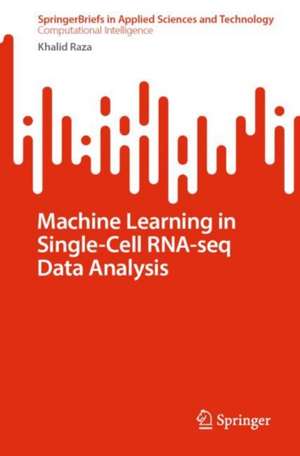
Machine Learning in Single-Cell RNA-seq Data Analysis: SpringerBriefs in Applied Sciences and Technology
Autor Khalid Razaen Limba Engleză Paperback – 3 sep 2024
Din seria SpringerBriefs in Applied Sciences and Technology
-
 Preț: 312.71 lei
 -
 Preț: 379.02 lei
 - 20%
 Preț: 326.97 lei
 -
 Preț: 378.77 lei
 -
 Preț: 470.50 lei
 -
 Preț: 382.08 lei
 -
 Preț: 429.04 lei
 -
 Preț: 382.68 lei
 -
 Preț: 380.26 lei
 - 20%
 Preț: 324.90 lei
 -
 Preț: 336.26 lei
 -
 Preț: 393.96 lei
 -
 Preț: 334.91 lei
 -
 Preț: 262.20 lei
 -
 Preț: 334.09 lei
 -
 Preț: 265.02 lei
 -
 Preț: 383.67 lei
 -
 Preț: 382.68 lei
 -
 Preț: 379.58 lei
 -
 Preț: 461.36 lei
 - 20%
 Preț: 226.91 lei
 -
 Preț: 363.26 lei
 -
 Preț: 385.41 lei
 -
 Preț: 391.30 lei
 -
 Preț: 396.35 lei
 -
 Preț: 332.21 lei
 -
 Preț: 379.88 lei
 -
 Preț: 251.49 lei
 -
 Preț: 330.32 lei
 - 5%
 Preț: 354.23 lei
 -
 Preț: 398.15 lei
 -
 Preț: 334.09 lei
 -
 Preț: 366.64 lei
 - 20%
 Preț: 286.05 lei
 -
 Preț: 333.81 lei
 -
 Preț: 378.48 lei
 -
 Preț: 382.08 lei
 -
 Preț: 369.31 lei
 -
 Preț: 333.28 lei
 -
 Preț: 381.54 lei
 -
 Preț: 400.85 lei
 -
 Preț: 379.88 lei
 -
 Preț: 378.48 lei
 -
 Preț: 379.31 lei
 - 20%
 Preț: 314.65 lei
 - 20%
 Preț: 326.02 lei
 -
 Preț: 413.73 lei
 -
 Preț: 368.70 lei
 - 15%
 Preț: 476.02 lei
 -
 Preț: 376.86 lei
Preț: 312.60 lei
Preț vechi: 390.74 lei
-20%
Puncte Express: 469
Carte tipărită la comandă
Livrare economică 25 noiembrie-09 decembrie
Livrare prin curier în România Termenul estimat este afișat lângă disponibilitate.
Transport gratuit de la 400.00 lei Plată online sau ramburs, în funcție de opțiunile comenzii.
Retur gratuit în 14 zile Comandă securizată și suport în română.
Specificații
ISBN-13: 9789819767021
ISBN-10: 9819767024
Pagini: 108
Ilustrații: Approx. 100 p. 25 illus., 15 illus. in color.
Dimensiuni: 155 x 235 x 7 mm
Greutate: 0.18 kg
Ediția:2025
Editura: Springer
Colecția SpringerBriefs in Applied Sciences and Technology
Seria SpringerBriefs in Applied Sciences and Technology
Locul publicării:Singapore, Singapore
ISBN-10: 9819767024
Pagini: 108
Ilustrații: Approx. 100 p. 25 illus., 15 illus. in color.
Dimensiuni: 155 x 235 x 7 mm
Greutate: 0.18 kg
Ediția:2025
Editura: Springer
Colecția SpringerBriefs in Applied Sciences and Technology
Seria SpringerBriefs in Applied Sciences and Technology
Locul publicării:Singapore, Singapore
Cuprins
Chapter 1. Introduction to Single-Cell RNA-seq Data Analysis.- Chapter 2. Preprocessing and Quality Control.- Chapter 3. Dimensionality Reduction and Clustering.- Chapter 4. Differential Expression Analysis.- Chapter 5. Trajectory Inference and Cell Fate Prediction.- Chapter 6. Emerging Topics and Future Directions.
Notă biografică
Dr. Khalid Raza is an Associate Professor at the Department of Computer Science, Jamia Millia Islamia (Central University), New Delhi, India. He also served as a ICCR Chair Visiting Professor at the Faculty of Computer & Information Sciences, Ain Shams University, Cairo, Egypt academic session 2017-2018. Dr. Raza has over 13 years of teaching and research experience at undergraduate, postgraduate and doctoral levels. He has contributed over 140 peer-reviewed articles in refereed international journals, conference proceedings, and as book chapters. Dr. Raza has authored/edited 10 Books published by reputed publishers like Springer-Nature, Elsevier, and CRC Press. Dr. Raza is an Academic Editor of PeerJ Computer Science International Journal, Guest Editor of the Natural Product Communications (SAGE), and Mini-Reviews in Medicinal Chemistry (Bentham Science). He has an active collaboration with the scientists from leading institutions of India and abroad. He is an Honorary Research Fellow of INIT International University, Malaysia. Dr. Raza has been featured in the list of World's Top 2% Scientists released by Stanford University (USA) in collaboration with Elsevier for the two consecutive years 2021 and 2022.
Textul de pe ultima copertă
This book provides a concise guide tailored for researchers, bioinformaticians, and enthusiasts eager to unravel the mysteries hidden within single-cell RNA sequencing (scRNA-seq) data using cutting-edge machine learning techniques. The advent of scRNA-seq technology has revolutionized our understanding of cellular diversity and function, offering unprecedented insights into the intricate tapestry of gene expression at the single-cell level. However, the deluge of data generated by these experiments presents a formidable challenge, demanding advanced analytical tools, methodologies, and skills for meaningful interpretation. This book bridges the gap between traditional bioinformatics and the evolving landscape of machine learning. Authored by seasoned experts at the intersection of genomics and artificial intelligence, this book serves as a roadmap for leveraging machine learning algorithms to extract meaningful patterns and uncover hidden biological insights within scRNA-seq datasets.
Caracteristici
Covers basic concepts of single cell RNA-seq Discusses integration of ML and scRNA-seq Presents hands-on examples and case studies