
Machine Learning for Tabular Data
Autor Mark Ryan, Luca Massaronen Limba Engleză Paperback – 25 mar 2025
Ceea ce diferențiază Machine Learning for Tabular Data de documentația tehnică standard este focalizarea strictă pe datele cu care companiile lucrează în mod curent: înregistrări în baze de date, log-uri și foi de calcul complexe. Observăm că, deși multe resurse tratează învățarea automată prin prisma viziunii computerizate sau a procesării limbajului natural, Mark Ryan și Luca Massaron prioritizează structurile tabelare, oferind soluții pentru problemele de business imediate, cum ar fi prognoza cererii sau detectarea fraudelor. Ne-a atras atenția modul în care autorii integrează algoritmi clasici de gradient boosting, precum XGBoost și LightGBM, cu abordări moderne de deep learning, explicând clar când și de ce o metodă este superioară celeilalte. Dacă Machine Learning for Business Analytics de Galit Shmueli v-a oferit cadrul teoretic și conceptele fundamentale de data mining, această carte publicată de Manning Publications oferă instrumentele practice și codul necesar pentru implementare. Structura este una progresivă, trecând de la procesarea avansată a caracteristicilor (feature engineering) la desfășurarea modelelor în producție, atât local, cât și în cloud. Un aspect distinctiv este capitolul dedicat conductelor (pipelines) MLOps, esențiale pentru menținerea modelelor într-un mediu de business dinamic. Stilul este tehnic și aplicat, reflectând experiența de Kaggle Grandmaster a lui Massaron, ceea ce transformă volumul într-un ghid de optimizare a performanței algoritmice pe seturi de date reale, adesea zgomotoase sau incomplete.
Preț: 340.55 lei
Preț vechi: 425.69 lei
-20%
Carte disponibilă
Livrare economică 28 octombrie-11 noiembrie
Livrare express 13-17 octombrie pentru 129.51 lei
Specificații
ISBN-10: 1633438546
Pagini: 504
Dimensiuni: 186 x 233 x 29 mm
Greutate: 0.87 kg
Editura: Manning Publications
V-ar putea interesa
-
 -20%Preț: 224.59 lei280.73 lei
 -
 Just Enough Data Science and Machine LearningMark LevenePreț: 342.01 lei
 -
 The AI PlaybookEric Siegel-16%Preț: 183.02 lei218.87 lei
 -
 Machine Learning in ProductionChristian Kastner-20%Preț: 572.46 lei715.57 lei
 -
 -39%Preț: 391.86 lei645.65 lei
 -
 -20%Preț: 192.78 lei240.98 lei
 -
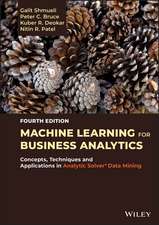 Machine Learning for Business AnalyticsGalit Shmueli-20%Preț: 867.13 lei1083.92 lei
 -
 -23%Preț: 780.53 lei1013.67 lei
 -
 -9%Preț: 571.23 lei627.73 lei
 -
 Applied Machine Learning for Data Science PractitionersVidya Subramanian-19%Preț: 434.04 lei535.85 lei
 -
 Dashboards That DeliverAndy CotgreavePreț: 210.38 lei
 -
 -23%Preț: 799.73 lei1038.62 lei
 -
 Storytelling with DataCole Nussbaumer KnaflicPreț: 249.99 lei
 -
 The Data Hero PlaybookMalcolm HawkerPreț: 202.67 lei
 -
 Machine Learning For DummiesLuca Massaron-20%Preț: 146.59 lei183.23 lei
 -
 Deep Learning with Structured DataMark Ryan-20%Preț: 326.02 lei407.53 lei
 -
 -20%Preț: 242.09 lei302.62 lei
 -
 Materials Data ScienceStefan Sandfeld-15%Preț: 591.20 lei695.53 lei
 -
 Business Analytics with R and PythonDavid L. Olson-20%Preț: 405.64 lei507.05 lei
 -
 Multivariate Analysis and Machine Learning TechniquesSrikrishnan Sundararajan-20%Preț: 534.82 lei668.53 lei
De ce să citești această carte
Această carte este esențială pentru profesioniștii care stăpânesc Python și doresc să treacă de la teorie la producție în analiza datelor de business. Veți câștiga expertiză în utilizarea XGBoost și Keras pentru date tabelare și veți învăța să construiți fluxuri automate de lucru. Este un salt necesar pentru oricine vrea să transforme bazele de date statice în modele predictive de înaltă precizie.