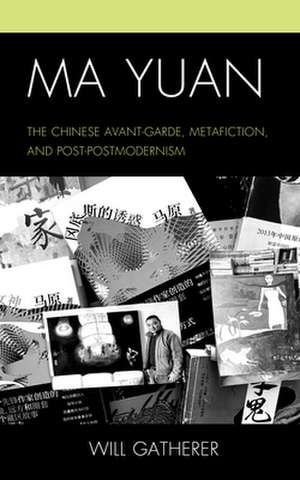
Ma Yuan: The Chinese Avant-Garde, Metafiction, and Post-Postmodernism
Autor Will Gathereren Limba Engleză Hardback – 11 noi 2021
Ma Yuan: The Chinese Avant-Garde, Metafiction, and Post-Postmodernism in the works of Ma Yuan provides the most comprehensive study to date on one of China's most influential contemporary authors, Ma Yuan. By engaging in close readings of narratologically complex works of metafiction, the author offers a reappraisal of the role Ma Yuan played within the rise of postmodern fiction within China and offers new interpretive possibilities for the Chinese Avant-Garde movement of the 1980s through demonstrating that rather than being predominantly 'formalist word games' or 'narrative traps', Ma Yuan's works of metafiction functioned as Foucauldian 'heterotopias' which allowed for the creation of distinctly Post-modern and Post-socialist 'possible worlds'. This book also analyses Ma Yuan's recent post-2000 output and in doing so explores the shifting dynamics of literary self-reflexivity and the 'Post-postmodern' within the contemporary context of 'Xi Jinping era modernity'. This book argues that Ma Yuan's recent works display a distinct movement towards 'metamodern' aesthetics alongside a rising anthropocenic awareness and eco-consciousness which offer key insights into the post-postmodern condition within a Chinese context.
Preț: 524.64 lei
Preț vechi: 815.59 lei
-36%
Puncte Express: 787
Carte tipărită la comandă
Livrare economică 30 noiembrie-14 decembrie
Livrare prin curier în România Termenul estimat este afișat lângă disponibilitate.
Transport gratuit pentru acest produs Plată online sau ramburs, în funcție de opțiunile comenzii.
Retur gratuit în 14 zile Comandă securizată și suport în română.
Specificații
ISBN-13: 9781793609014
ISBN-10: 1793609012
Pagini: 186
Ilustrații: 3 b/w photos; 1 textboxes;
Dimensiuni: 159 x 228 x 18 mm
Greutate: 0.43 kg
Editura: Bloomsbury Publishing
Colecția Lexington Books
Locul publicării:New York, United States
ISBN-10: 1793609012
Pagini: 186
Ilustrații: 3 b/w photos; 1 textboxes;
Dimensiuni: 159 x 228 x 18 mm
Greutate: 0.43 kg
Editura: Bloomsbury Publishing
Colecția Lexington Books
Locul publicării:New York, United States
Cuprins
1) Introduction
2) Chapter 1: Early Works
3) Chapter 2: High (Altitude) Metafiction: Self-reflexivity and Polyvocality in Tibet
4) Chapter 3: Later Works
5) Chapter 4: Monsters and Demons ????
6) Chapter 5: Entanglement ?? & The Huang Tang Family ????
7) Chapter 6: Guniangzhai ???
8) Chapter 7: Conclusions
9) References
10) About the Author
2) Chapter 1: Early Works
3) Chapter 2: High (Altitude) Metafiction: Self-reflexivity and Polyvocality in Tibet
4) Chapter 3: Later Works
5) Chapter 4: Monsters and Demons ????
6) Chapter 5: Entanglement ?? & The Huang Tang Family ????
7) Chapter 6: Guniangzhai ???
8) Chapter 7: Conclusions
9) References
10) About the Author
Recenzii
This reviewer had the opportunity to meet Ma Yuan in 2001, when he had just started his academic career in Shanghai. Now, 20 years later, the prolific writer has established a second wave in his career as a novelist, so this first book-length study of him in the English language is extremely welcome.. Gatherer argues that throughout his career, Ma Yuan has employed two distinct narrative modes, metafiction and realism, but has used them in symbiosis-unlike contemporary writers Yu Hua and Ge Fei, who had a distinct avant-garde period followed by a shift toward a realist period. Highly recommended. Lower-division undergraduates through faculty; general readers.
In this comprehensive and authoritative study, Will Gatherer presents new and thought-provoking perspectives on the work of Ma Yuan. Famous for his narrative experiments, Ma Yuan is conventionally seen as representative of a short-lived 'avant-garde' movement in Chinese fiction of the late 1980s. By subjecting all of Ma's work to analytical scrutiny, including his more recent writings since his return to the literary scene in the 2010s, Gatherer makes an elegant case for disassociating Ma from larger cultural "movements" and focusing on his individual aesthetic project. In doing so, Gatherer's scholarship also signals a long overdue return to the genre of 'author studies,' of which there are still far too few in the field of modern Chinese literature.
This illuminating study of Ma Yuan, a key figure in China's avant-garde fiction of the 1980s who later returned to the literary stage after a 20-year hiatus, offers the most probing and extensive study of the writer's work to date. Gatherer's focused readings of Ma Yuan's intricately absurdist and provocative work across the span of his career open up stimulating new understandings of how Chinese culture has evolved from postmodernism in the Dengist era to the post-postmodern condition under Xi Jinping. This elegantly-written book is key reading for anyone interested in China's literary scene over the last 40 years.
In this comprehensive and authoritative study, Will Gatherer presents new and thought-provoking perspectives on the work of Ma Yuan. Famous for his narrative experiments, Ma Yuan is conventionally seen as representative of a short-lived 'avant-garde' movement in Chinese fiction of the late 1980s. By subjecting all of Ma's work to analytical scrutiny, including his more recent writings since his return to the literary scene in the 2010s, Gatherer makes an elegant case for disassociating Ma from larger cultural "movements" and focusing on his individual aesthetic project. In doing so, Gatherer's scholarship also signals a long overdue return to the genre of 'author studies,' of which there are still far too few in the field of modern Chinese literature.
This illuminating study of Ma Yuan, a key figure in China's avant-garde fiction of the 1980s who later returned to the literary stage after a 20-year hiatus, offers the most probing and extensive study of the writer's work to date. Gatherer's focused readings of Ma Yuan's intricately absurdist and provocative work across the span of his career open up stimulating new understandings of how Chinese culture has evolved from postmodernism in the Dengist era to the post-postmodern condition under Xi Jinping. This elegantly-written book is key reading for anyone interested in China's literary scene over the last 40 years.