Cantitate/Preț
Produs

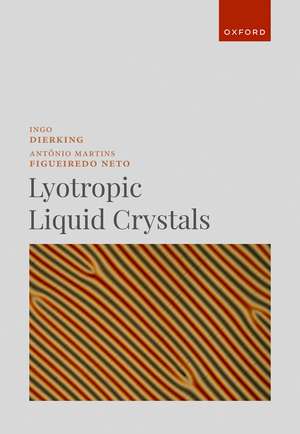
Lyotropic Liquid Crystals

Autor Ingo Dierking, Antônio Martins Figueiredo Neto
en Limba Engleză Hardback – 16 iul 2024

În peisajul fizicii materiilor condensate, studiul cristalelor lichide a fost mult timp dominat de sistemele termotrope, datorită succesului lor comercial masiv în industria display-urilor. Totuși, Lyotropic Liquid Crystals, publicată de OUP OXFORD, marchează o schimbare de paradigmă, repoziționând sistemele liotrope în centrul cercetării fundamentale și aplicate. Remarcăm modul în care autorii Ingo Dierking și Antônio Martins Figueiredo Neto reușesc să unifice două lumi anterior disparate: sistemele amfifile și cele coloidale. Textul demonstrează riguros că proprietățile observate la cristalele lichide standard se regăsesc și în aceste sisteme complexe, oferind un cadru teoretic solid pentru înțelegerea auto-asamblării la scară nanometrică.

Structura volumului reflectă evoluțiile din ultimul deceniu, explorând comportamentele cristalelor lichide în materiale precum oxidul de grafenă, nanocristalele de celuloză și fragmentele de ADN. Apreciem în mod deosebit secțiunile dedicate „cristalelor lichide vii”, o ramură emergentă care combină fluidele active cu proprietățile anizotrope. Comparabil cu Liquid Crystals Beyond Displays de Quan Li în ceea ce privește extinderea ariei de aplicabilitate, acest volum se diferențiază prin focalizarea strictă pe sistemele liotrope și prin profunzimea analizei structurilor coloidale minerale, precum argilele. Cele 259 de ilustrații facilitează înțelegerea unor fenomene vizuale complexe, transformând o materie abstractă într-o expunere clară a mecanismelor de formare a fazelor ordonate, esențiale în nanotehnologie și biosenzori.

Citește tot Restrânge

Preț: 59026 lei

Preț vechi: 88464 lei
-33%

Puncte Express: 885

Carte disponibilă

Livrare economică 08-13 mai


Specificații

ISBN-13: 9780192898654
ISBN-10: 0192898655
Pagini: 224
Ilustrații: 259 line drawings and halftones
Dimensiuni: 176 x 253 x 15 mm
Greutate: 0.6 kg
Editura: OUP OXFORD
Colecția OUP Oxford
Locul publicării:Oxford, United Kingdom

De ce să citești această carte

Recomandăm această lucrare cercetătorilor și studenților avansați în fizica stării lichide și nanotehnologie. Cititorul câștigă o perspectivă actualizată asupra modului în care auto-asamblarea sistemelor liotrope poate fi utilizată în medicină (drug delivery) și materiale inteligente. Este o resursă esențială pentru cei care doresc să depășească limitele tehnologiei LCD și să exploreze potențialul „cristalelor lichide vii” și al nanomaterialelor 2D.


Despre autor

Ingo Dierking și Antônio Martins Figueiredo Neto sunt cercetători de renume în domeniul fluidelor complexe. Dierking este recunoscut pentru contribuțiile sale în fizica cristalelor lichide și a sistemelor soft matter, având o vastă experiență în vizualizarea și caracterizarea defectelor topologice. Figueiredo Neto aduce o expertiză valoroasă în termodinamica și optica sistemelor liotrope. Împreună, cei doi autori sintetizează în acest volum decenii de cercetare experimentală și teoretică, oferind o viziune coerentă asupra evoluției disciplinei de la curiozitate academică la fundament pentru nanotehnologia modernă.


Descriere

This book aims to review the field of lyotropic liquid crystals from amphiphilic to colloidal systems, bridging the gap between the two worlds of lyotropics and thermotropics by showing that many of the features observed in standard thermotropic liquid crystals may also be observed in lyotropic systems and vice versa.Indeed, for a long time, lyotropic liquid crystals have been overshadowed by their thermotropic counterparts, mainly due to the potential for application of the latter in the display industry. This picture has somewhat shifted over the last decade, with numerous novel lyotropic systems having been discovered and formulated, bringing to light their importance in wider scientific research.For example, the understanding of viruses forming self-assembled ordered phases has largely increased as mineral liquid crystals and clays have experienced a renaissance leading to fundamental research and work on structure formation in nanotechnology. Similarly, nano-rods, nano-wires, nanotubes and 2D materials like graphene oxide and others have been shown to exhibit liquid crystalline behaviour, which may be exploited in self-assembly, drug delivery or biosensors. Cellulose nanocrystals have become an important and popular field of research. The self-assembly of short chain DNA fragments has led to liquid crystal behaviour previously thought to be impossible. Chromonics were shown to exhibit fascinating physical properties, and the combination of active fluids with liquid crystals has opened a whole new field of research to be explored - 'living liquid crystals'.

Recenzii

A book of high quality, and very timely. The field has been enjoying a rapid growth within the last few decades, thanks to the development of polymer-, DNA-, cellulose- and chromonic-based liquid crystalline phases.
An important contribution to the literature of complex fluids and liquid crystals in general, with the particularly important feature of organizing the solved and open problems as well as the challenges and perspectives of this fascinating research field.

Notă biografică

Ingo Dierking received his PhD at Clausthal University, Germany, in 1995 and then worked as a postdoc at the IBM TJ Watson Research Center, USA, before receiving a Humboldt fellowship for Chalmers University, Sweden. From 1999-2002 Dierking was a lecturer at Darmstadt University, Germany, before joining the University of Manchester where he is a Senior Lecturer. He has won several research awards, the GW Gray medal, the Cyril Hilsum medal and the Samsung Mid-career award and is currently the President of the International Liquid Crystal Society and a former Chair of the British Liquid Crystals Society.Antônio Martins Figueiredo Neto received his PhD at the University of São Paulo, Brazil, in 1981 and then worked as a postdoc at the Université Paris-Sud, France, from 1983 to 1985. In 1988 he became Full Professor of Physics at University of São Paulo. He is a member of the Brazilian Academy of Science and the State of São Paulo Academy of Science. He has published more than 200 papers in international journals and supervised more than 40 PhD and Master students.