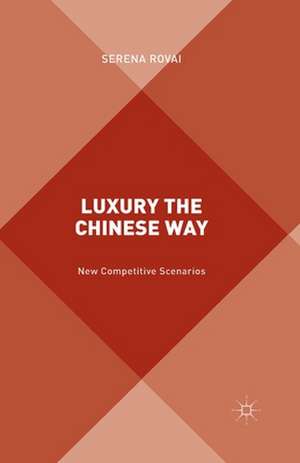
Luxury the Chinese Way
Autor S. Rovaien Limba Engleză Paperback – 27 aug 2021
Preț: 468.54 lei
Preț vechi: 551.23 lei
-15%
Puncte Express: 703
Carte tipărită la comandă
Livrare economică 23 noiembrie-07 decembrie
Livrare prin curier în România Termenul estimat este afișat lângă disponibilitate.
Transport gratuit pentru acest produs Plată online sau ramburs, în funcție de opțiunile comenzii.
Retur gratuit în 14 zile Comandă securizată și suport în română.
Specificații
ISBN-13: 9781349711239
ISBN-10: 1349711233
Pagini: 185
Ilustrații: XIV, 185 p.
Dimensiuni: 140 x 216 x 12 mm
Greutate: 0.26 kg
Ediția:2016 edition
Editura: Palgrave Macmillan UK
Locul publicării:London, United Kingdom
ISBN-10: 1349711233
Pagini: 185
Ilustrații: XIV, 185 p.
Dimensiuni: 140 x 216 x 12 mm
Greutate: 0.26 kg
Ediția:2016 edition
Editura: Palgrave Macmillan UK
Locul publicării:London, United Kingdom
V-ar putea interesa
-
 Preț: 152.28 lei
 -
 Preț: 179.11 lei
 -
 Social Media for Social Good: A How-to Guide for NonprofitsHeather MansfieldPreț: 237.97 lei
 -
 Content Marketing FDSusan GuneliusPreț: 131.27 lei
 -
 BrainfluenceRoger DooleyPreț: 147.01 lei
 -
 Hit BrandsS. JacksonPreț: 502.01 lei
 -
 Preț: 402.73 lei
 -
 How to Measure Digital MarketingL. FloresPreț: 470.68 lei
 -
 Why People (Don't) BuyAmitav ChakravartiPreț: 332.07 lei
 -
 Brand BreakoutNirmalya KumarPreț: 366.54 lei
 -
 Return of the HustleEric SheinkopPreț: 326.54 lei
 -
 Asian Brand StrategyM. RollPreț: 396.48 lei
 -
 PropagandaEdward BernaysPreț: 125.13 lei
Cuprins
Introduction
PART I: THE LUXURY INDUSTRY AND THE CHINESE SOCIO-CULTURAL CONTEXT IN TRANSITION
1.The birth of luxury in China and trends since Imperial times
2.The impact of cultural values and habits on the luxury market
3.Chinese institutional and legal barriers to the development of a luxury industry
4.The Chinese aesthetic and the new creative movement from East to West
PART II: CHINESE CUSTOMERS – INSIGHTS INTO THE NEW CHINESE LUXURY EXPERIENCE
5.The impact of geographical expansion and new urban dynamics on client segmentation
6.One-, two and multiple-segment Chinese luxury clients and the rise of the middle class
7.Digital innovation and communication and its key role in Chinese luxury consumption
8.The Chinese luxury client: current profile and new attitudes
PART III: THE EMERGENCE OF THE CREATIVE PHASE – FROM INTERNATIONAL TO CHINESE BRANDS
9.Luxury tourism: the new shopping perspective
10.The identity of international luxury brands
11.Chinese luxury brands: the new creative phase and identity in the local market
12.'Chineseness' in luxury: future challenges and perspectives
Conclusion
Bibliography
PART I: THE LUXURY INDUSTRY AND THE CHINESE SOCIO-CULTURAL CONTEXT IN TRANSITION
1.The birth of luxury in China and trends since Imperial times
2.The impact of cultural values and habits on the luxury market
3.Chinese institutional and legal barriers to the development of a luxury industry
4.The Chinese aesthetic and the new creative movement from East to West
PART II: CHINESE CUSTOMERS – INSIGHTS INTO THE NEW CHINESE LUXURY EXPERIENCE
5.The impact of geographical expansion and new urban dynamics on client segmentation
6.One-, two and multiple-segment Chinese luxury clients and the rise of the middle class
7.Digital innovation and communication and its key role in Chinese luxury consumption
8.The Chinese luxury client: current profile and new attitudes
PART III: THE EMERGENCE OF THE CREATIVE PHASE – FROM INTERNATIONAL TO CHINESE BRANDS
9.Luxury tourism: the new shopping perspective
10.The identity of international luxury brands
11.Chinese luxury brands: the new creative phase and identity in the local market
12.'Chineseness' in luxury: future challenges and perspectives
Conclusion
Bibliography
Notă biografică
Serena Rovai is Professor and Director of International Relations at La Rochelle Business School, France, teaching and researching on Luxury Internationalisation Management. Previously she designed and managed the Fashion and Luxury specialisation programmes at Grenoble Ecole de Management, France and spent fifteen years in Asia, mainly in China, in various academic and managerial positions.
Textul de pe ultima copertă
China's love for luxury is not a phenomenon brought on by the contemporary luxury market, but has been a part of Chinese culture and history for generations. The Chinese luxury industry is again re-emerging along modern cultural and socio-economic contexts, and is taking the market by storm. Luxury the Chinese Way identifies the main strengths and opportunities associated with the Chinese luxury market, explains the influence of 'Chinese characteristics' on its development and mode of operations, and reflects on the challenges associated with diverse consumption orientations. Using references from the fields and real-life data, this book provides a comprehensive overview on China's innovation in luxury, and is an important contribution to the study of the phenomenon that is the global luxury industry.