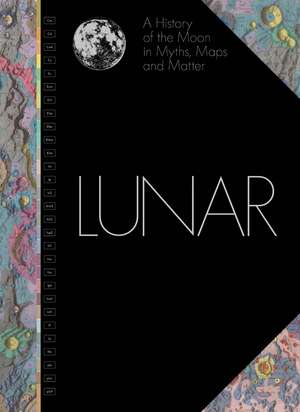
Lunar: A History of the Moon in Myths, Maps, and Matter
Matthew Shindellen Limba Engleză Hardback – 20 noi 2024
Remarcăm în Lunar o fuziune rară între rigoarea cartografică și antropologia culturală, oferind o resursă indispensabilă pentru înțelegerea modului în care satelitul natural al Pământului a fost sistematizat vizual. Aplicabilitatea practică a volumului rezidă în prezentarea integrală, pentru prima dată, a celor 44 de hărți geologice fundamentale realizate de US Geological Survey. Aceste documente, care au ghidat misiunile Apollo, nu sunt doar piese de arhivă, ci instrumente de studiu care permit observarea evoluției nomenclaturii și a tehnicilor de reprezentare a materiei lunare.
Din punct de vedere structural, Matthew Shindell organizează materialul într-o progresie cronologică și tematică, de la calendarele de piatră până la hărțile digitale contemporane. Notăm cu interes alternanța dintre secțiunile tehnice — precum cadrantele J. Herschel, Aristoteles sau Sinus Iridum — și eseurile ce explorează influența Lunii asupra mareelor, ciclurilor biologice sau artei suprarealiste. Această abordare extinde cadrul propus de The Moon: From Inner Worlds to Outer Space de Lærke Jørgensen cu date noi extrase direct din Geologic Atlas of the Moon, oferind o perspectivă mult mai tehnică asupra cartografierii efective.
În contextul operei sale, Lunar continuă preocuparea lui Matthew Shindell pentru intersecția dintre știință și imaginație, temă centrală și în For the Love of Mars. Dacă în lucrările anterioare, precum Discerning Experts, autorul analiza procesul de decizie în politicile de mediu, aici se concentrează pe procesul de decizie vizuală: cum transformă cartografii datele brute în hărți care definesc realitatea spațială. Rezultatul este un catalog vizual spectaculos, susținut de o analiză critică a miturilor și certitudinilor noastre despre „lumea de sus”.
Preț: 452.72 lei
Carte disponibilă
Livrare economică 09-23 noiembrie
Specificații
ISBN-10: 0226836517
Pagini: 256
Ilustrații: 500 color plates
Dimensiuni: 267 x 365 x 30 mm
Greutate: 2.11 kg
Ediția:First Edition
Editura: University of Chicago Press
Colecția University of Chicago Press
V-ar putea interesa
-
 Chasing the MoonAlan AndresPreț: 94.84 lei
 -
 Photographic Atlas of the MoonRobert ReevesPreț: 325.77 lei
 -
 The Moon: Discover the Mysteries of Earth's Closest NeighbourDr. Sanlyn Buxner-14%Preț: 84.12 lei97.76 lei
 -
 -19%Preț: 164.46 lei203.40 lei
 -
 -13%Preț: 292.30 lei334.57 lei
 -
 The Medieval Moon: A History of Haunting and BlessingAyoush LazikaniPreț: 174.73 lei
 -
 Exploring the MoonDavid M. HarlandPreț: 298.45 lei
 -
 -16%Preț: 401.58 lei478.89 lei
 -
 Sun and MoonMark Holborn-16%Preț: 443.77 lei527.13 lei
 -
 Apollo to the MoonTeasel E Muir-HarmonyPreț: 226.11 lei
 -
 Moon Mission: The Epic 400-Year Journey to Apollo 11Sigmund Brouwer-18%Preț: 100.54 lei122.20 lei
 -
 The Starspotter's GuideSheila Kanani-29%Preț: 101.47 lei142.83 lei
 -
 Our Moon: A Human HistoryRebecca Boyle-26%Preț: 69.04 lei93.54 lei
 -
 Still As BrightChristopher Cokinos-35%Preț: 124.45 lei191.20 lei
 -
 The Library of Lost MapsJames CheshirePreț: 275.46 lei
 -
 The Sky at NightMaggie Aderin-Pocock-19%Preț: 87.76 lei107.87 lei
 -
 Preț: 146.25 lei
 -
 Representations of the Moon in Literature and ArtGabriela Gândara TerenasPreț: 327.72 lei
 -
 The Moon: From Inner Worlds to Outer SpaceLaerke Rydal JorgensenPreț: 209.24 lei
De ce să citești această carte
Această ediție publicată de University of Chicago Press este esențială pentru pasionații de astronomie și istoria cartografiei. Cititorul câștigă acces la documentația vizuală originală a programului Apollo, însoțită de o analiză culturală profundă. Este un instrument de referință care explică nu doar cum arată Luna, ci și cum a fost ea „construită” în mintea umană prin mituri, calendare și observații telescopice riguroase.
Despre autor
Matthew Shindell este curator la National Air and Space Museum din cadrul Smithsonian Institution, fiind specializat în istoria științelor planetare. Expertiza sa în navigarea între datele tehnice și narativele culturale este evidentă în lucrări precum For the Love of Mars și Science and Technology in the Global Cold War. În volumul de față, Shindell utilizează accesul privilegiat la arhivele de explorare spațială pentru a contextualiza cele 44 de hărți istorice ale USGS, oferind cititorilor o perspectivă academică, dar accesibilă asupra evoluției cunoașterii noastre despre Lună.
Descriere scurtă
President John F. Kennedy’s rousing “We will go to the Moon” speech in 1961 before the US Congress catalyzed the celebrated Apollo program, spurring the US Geological Survey’s scientists to map the Moon. Over the next eleven years a team of twenty-two, including a dozen illustrator-cartographers, created forty-four charts that forever changed the path of space exploration.
For the first time, each of those beautifully hand-drawn, colorful charts is presented together in one stunning book. In Lunar, National Air and Space Museum curator Matthew Shindell’s expert commentary accompanies each chart, along with the key geological characteristics and interpretations that were set out in the original Geologic Atlas of the Moon. Interwoven throughout the book are contributions from scholars devoted to studying the multifaceted significance of the Moon to humankind around the world. Traveling from the Stone Age to the present day, they explore a wide range of topics: the prehistoric lunar calendar; the role of the Moon in creation myths of Ancient Egypt, Greece, and Rome; the role of the Moon in astrology; the importance of the Moon in establishing an Earth-centered solar system; the association of the Moon with madness and the menstrual cycle; how the Moon governs the tides; and the use of the Moon in surrealist art.
Combining a thoughtful retelling of the Moon’s cultural associations throughout history with the beautifully illustrated and scientifically accurate charting of its surface, Lunar is a stunning celebration of the Moon in all its guises.
Notă biografică
Cuprins
Dava Sobel
Introduction: Myths, Maps, Matter / Matthew Shindell
Introduction: The Lunar Atlas / Matthew Shindell
Introduction: Lunar Nomenclature
Introduction: Maps 1–44
The Prehistoric Lunar Calendar / Matthew Shindell
The Moon in Ancient Egyptian Creation Myths / Jennifer Houser Wegner
Facsimiles 1–4
The Moon in Ancient Greek and Roman Myth / Karen ní Mheallaigh
J. Herschel Quadrangle [11]
‘The Moon is my Mother’ – Lakota Perspectives / Suzanne Kite
Plato Quadrangle [12]
The Moon and a Geocentric Universe / Samantha Thompson
Aritstoteles Quadrangle [13]
Rümker Quadrangle [23]
Understanding the Phases of the Moon / Giles Sparrow
Facsimiles 5–8
The Female Cycle and the Moon / Rhianna Elliot
Sinus Iridum Quadrangle [24]
Cassini Quadrangle [25]
Mayan Lunar Astrology / Gerardo Aldana
Eudoxus Quadrangle [26]
Geminus Quadrangle [27]
The Moon and Medieval Natural Philosophy / Matthew Shindell
Facsimiles 9–12
‘Moonstruck’ – Lunacy and the Full Moon / Kate Golembiewski
Seleucus Quadrangle [38]
Aristarchus Quadrangle [39]
The Symbolism of the Moon in Astrology / Nicholas Campion
Timocharis Quadrangle [40]
Montes Apenninus Quadrangle [41]
The Theory of Lunar Eclipses / Giles Sparrow
Facsimiles 13–16
The Moon and the Heliocentric Worldview / Matthew Shindell
Mare Serenitatus Quadrangle [42]
Macrobius Quadrangle [43]
Early Telescopic Studies of the Moon / Giles Sparrow
Cleomedes Quadrangle [44]
Hevelius Quadrangle [56]
The Moon in Literature and Fiction / Alexandra Loske
Facsimiles 17–20
Moonscapes – The Moon in 19th-Century Painting / Hélène Valance
Kepler Quadrangle [57]
Copernicus Quadrangle [58]
How the Moon Governs the Tides / Giles Sparrow
Mare Vaporum Quadrangle [59]
Julius Caesar Quadrangle [60]
Lunar Photography – Opportunity and Challenge / David H. DeVorkin
Facsimiles 21–24
A Paper Moon – Cartes de Visite / Ian Haydn Smith
Taruntius Quadrangle [61]
Mare Undarum Quadrangle [62]
The Feminine Symbolism of the Moon / Elisabetta Fabrizi
Grimaldi Quadrangle [74]
Letronne Quadrangle [75]
The Moon in Popular Science Books / Alexandra Loske
Facsimiles 25–28
Riphaeus Mountains Quadrangle [76]
Ptolemaeus Quadrangle [77]
The Moon in Silent Cinema / Ian Haydn Smith
Theophilus Quadrangle [78]
Colombo Quadrangle [79]
Surrealists and the Moon / Melanie Vandenbrouck
Facsimiles 29–32
Langrenus Quadrangle [80]
Byrgius Quadrangle [92]
‘Selling’ the Moon in the 1950s / Michael J. Neufeld
Mare Humorum Quadrangle [93]
Pitatus Quadrangle [94]
The First Moon Race – Luna versus Pioneer / Michael J. Neufeld
Facsimiles 33–36
Purbach Quadrangle [95]
Rupes Altai Quadrangle [96]
The Cinematic Moon / Ian Haydn Smith
Fracastorius Quadrangle [97]
Petavius Quadrangle [98]
Flybys, Landers and Orbiters / Matthew Shindell
Facsimiles 37–40
Schickard Quadrangle [110]
Wilhelm Quadrangle [111]
The Far Side of the Moon / Emily S. Martin
Tycho Quadrangle [112]
Maurolycus Quadrangle [113]
The Apollo Programme / Teasel Muir-Harmony
Facsimiles 41–44
Rheita Quadrangle [114]
Schiller Quadrangle [125]
Contemporary Artists and the Moon / Melanie Vandenbrouck
Clavius Quadrangle [126]
Hommel Quadrangle [127]
The Artemis Missions / Emily A. Margolis
Endnotes
Geological Characteristics – Lunar Atlas Maps / Matthew Shindell
Glossary / Matthew Shindell
Sources of Illustrations
Further Reading
Index
Acknowledgments
Recenzii
“An iconic tour de- force for selenophiles and an eye-opener for even the most desultory moongazer.”