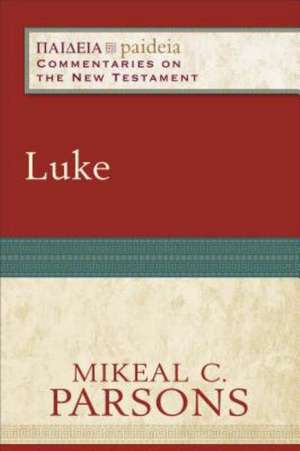
Luke
Autor Mikeal C. Parsons Editat de Charles Talbert, Bruce Longeneckeren Limba Engleză Paperback – 17 feb 2015
Preț: 201.90 lei
Puncte Express: 303
Carte tipărită la comandă
Livrare economică 07-21 noiembrie
Livrare prin curier în România Termenul estimat este afișat lângă disponibilitate.
Transport gratuit de la 400.00 lei Plată online sau ramburs, în funcție de opțiunile comenzii.
Retur gratuit în 14 zile Comandă securizată și suport în română.
Specificații
ISBN-13: 9780801031908
ISBN-10: 0801031907
Pagini: 444
Ilustrații: illustrations
Dimensiuni: 152 x 226 x 30 mm
Greutate: 0.59 kg
Editura: Baker Publishing Group
ISBN-10: 0801031907
Pagini: 444
Ilustrații: illustrations
Dimensiuni: 152 x 226 x 30 mm
Greutate: 0.59 kg
Editura: Baker Publishing Group
V-ar putea interesa
-
 Biblical Interpretation and Method: Essays in Honour of John BartonKatharine J. Dell-31%Preț: 966.21 lei1403.14 lei
 -
 Finding God in the PsalmsTom WrightPreț: 85.23 lei
 -
 Preț: 381.91 lei
 -
 The Jesus LegendPaul Rhodes EddyPreț: 254.83 lei
 -
 The Testimony of the Beloved DiscipleRichard BauckhamPreț: 247.33 lei
 -
 MiraclesCraig S. Keener-8%Preț: 430.52 lei467.96 lei
 -
 How We Got the New TestamentStanley E PorterPreț: 154.22 lei
 -
 Dictionary of Jesus and the GospelsJoel B. Green-8%Preț: 451.15 lei490.38 lei
 -
 Can We Still Believe the Bible?Craig L BlombergPreț: 155.19 lei
 -
 Thou Art ThatJoseph CampbellPreț: 90.39 lei
 -
 A Short History of the New TestamentHalvor Moxnes-23%Preț: 104.07 lei134.29 lei
 -
 Esau's BlessingOra Horn ProuserPreț: 127.71 lei
Textul de pe ultima copertă
Paideia: Critically Acclaimed Commentaries from Today's Top Scholars "With this outstanding commentary on the Gospel of Luke, Paideia: Commentaries on the New Testament adds another stellar volume. This lucid, concise commentary displays the distinctive strengths that Mikeal Parsons has brought to a distinguished career as scholar and author. With a keen eye for the literary artistry of Luke's narrative, impressive knowledge of Luke's cultural environment, and an ear carefully tuned to the rhetorical design and impact of this Gospel, Parsons provides a reliable guide for readers of Luke. I am pleased to give this book my enthusiastic endorsement."
--John T. Carroll, Union Presbyterian Seminary, Richmond, Virginia "Since his groundbreaking Departure of Jesus in Luke-Acts in 1987, Mikeal Parsons has been a leading voice in Lukan studies, and this outstanding Paideia commentary marks his latest important contribution to the field. Rich with illustrations and informative sidebars, this text not only explores the first-century literary, rhetorical, historical, cultural, and theological contexts of the Lukan narrative but also carefully interprets the final form of Luke section by section and distills critical theological issues raised by the Lukan text. No one is better suited than Parsons for the task of creating such a multifaceted commentary on the Gospel of Luke, and he delivers an innovative and helpful work--brilliant yet succinct and accessible."
--David B. Gowler, Oxford College of Emory University "Parsons deftly navigates through Luke's Gospel, attending to its rhetoric, theology, historical context, and interpretive history. His rich engagement with the text itself makes this companion volume to his Acts Paideia commentary a welcome read."
--Brittany E. Wilson, Duke University Divinity School "Parsons's Paidea commentary on Luke adds to the growing appreciation of the literary and rhetorical environment in which the Gospels were written. Working with a rich understanding of ancient literature and rhetorical education, Parsons leads the modern interpreter to a richer appreciation for the context of this Gospel. This will certainly be an important volume for readers of both Luke and the Gospels in general."
--Mark A. Matson, Milligan College "Filled with rich interdisciplinary and intertextual insights, Luke is vintage Parsons: tersely brilliant."
--David P. Moessner, Texas Christian University
--John T. Carroll, Union Presbyterian Seminary, Richmond, Virginia "Since his groundbreaking Departure of Jesus in Luke-Acts in 1987, Mikeal Parsons has been a leading voice in Lukan studies, and this outstanding Paideia commentary marks his latest important contribution to the field. Rich with illustrations and informative sidebars, this text not only explores the first-century literary, rhetorical, historical, cultural, and theological contexts of the Lukan narrative but also carefully interprets the final form of Luke section by section and distills critical theological issues raised by the Lukan text. No one is better suited than Parsons for the task of creating such a multifaceted commentary on the Gospel of Luke, and he delivers an innovative and helpful work--brilliant yet succinct and accessible."
--David B. Gowler, Oxford College of Emory University "Parsons deftly navigates through Luke's Gospel, attending to its rhetoric, theology, historical context, and interpretive history. His rich engagement with the text itself makes this companion volume to his Acts Paideia commentary a welcome read."
--Brittany E. Wilson, Duke University Divinity School "Parsons's Paidea commentary on Luke adds to the growing appreciation of the literary and rhetorical environment in which the Gospels were written. Working with a rich understanding of ancient literature and rhetorical education, Parsons leads the modern interpreter to a richer appreciation for the context of this Gospel. This will certainly be an important volume for readers of both Luke and the Gospels in general."
--Mark A. Matson, Milligan College "Filled with rich interdisciplinary and intertextual insights, Luke is vintage Parsons: tersely brilliant."
--David P. Moessner, Texas Christian University
Descriere
Descriere de la o altă ediție sau format:
Provides an overview of Luke and Acts, reading them in the context of ancient rhetorical criticism as practiced in the Hellenistic world. The depth and breadth of Mikeal Parson's study root Luke's narrative strategy, interpretive moves, and theological imagination in the pagan, Jewish, and Christian contexts of the period.
Provides an overview of Luke and Acts, reading them in the context of ancient rhetorical criticism as practiced in the Hellenistic world. The depth and breadth of Mikeal Parson's study root Luke's narrative strategy, interpretive moves, and theological imagination in the pagan, Jewish, and Christian contexts of the period.