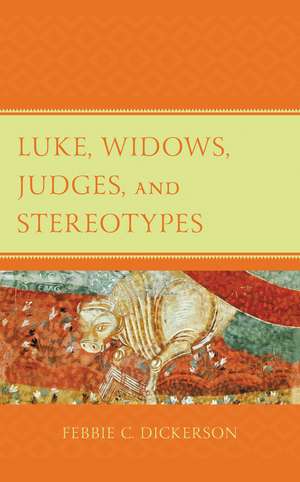
Luke, Widows, Judges, and Stereotypes: Womanist Readings of Scripture
Autor Febbie C. Dickersonen Limba Engleză Hardback – aug 2019

Preț: 583.65 lei
Preț vechi: 864.23 lei
-32%
Puncte Express: 875
Carte tipărită la comandă
Livrare economică 20 noiembrie-04 decembrie
Livrare prin curier în România Termenul estimat este afișat lângă disponibilitate.
Transport gratuit pentru acest produs Plată online sau ramburs, în funcție de opțiunile comenzii.
Retur gratuit în 14 zile Comandă securizată și suport în română.
Specificații
ISBN-13: 9781978701236
ISBN-10: 1978701233
Pagini: 238
Dimensiuni: 157 x 235 x 19 mm
Greutate: 0.54 kg
Editura: Fortress Academic
Colecția Womanist Readings of Scripture
Seria Womanist Readings of Scripture
Locul publicării:New York, United States
ISBN-10: 1978701233
Pagini: 238
Dimensiuni: 157 x 235 x 19 mm
Greutate: 0.54 kg
Editura: Fortress Academic
Colecția Womanist Readings of Scripture
Seria Womanist Readings of Scripture
Locul publicării:New York, United States
Descriere
Biblical narratives are not simply sacred stories for religious communities: They are stories that provide transformative insight into cultural biases. By putting historical criticism and reception history into dialogue with womanist biblical hermeneutics, Luke, Widows, Judges, and Stereotypes offers a provocative reading of Jesus' parable about a widow who confronts a judge and obtains what she seeks by means of physical threat. Rather than simply reading the widow as the model for "one who prays always and does not lose heart" (Luke 18:1), Dickerson shows that read in the context of Luke's wider narrative, the widow, domesticated and robbed both of her agency and moral ambiguity, is more likely demanding vengeance instead of justice. Likewise, rather than simply reading the judge as one "who neither feared God nor had respect for people" (Luke 18:2), Dickerson argues that the judge is both an ideal man and one who compromises standards of ancient masculinity. Then, reading both the widow and judge through African American stereotypes (Mammy, Jezebel, Sapphire, Cool Black Male, Master-Pastor, and Foolish Judge) that are used to degrade, debase, and control, and reading them into and in light of the parable, Dickerson demonstrates how the parable calls into question these stereotypes thereby producing new liberative readings.
Cuprins
Chapter 1: The Price of Stereotypes
Chapter 2: Parable of the Widow and Judge (Luke 18:2-5): Textual Problems and Stereotypes
Chapter 3: A History of Allegory, Stereotypes, and Challenge
Chapter 4: Luke, Widows, Judge, and Gender
Chapter 5: Mammy, Jezebel, and Sapphire in Conversation with Luke
Chapter 6: Luke, the Judge, and African American Male Stereotypes: Cool, Cruel, Foolish
Chapter 7: Conclusion
Chapter 2: Parable of the Widow and Judge (Luke 18:2-5): Textual Problems and Stereotypes
Chapter 3: A History of Allegory, Stereotypes, and Challenge
Chapter 4: Luke, Widows, Judge, and Gender
Chapter 5: Mammy, Jezebel, and Sapphire in Conversation with Luke
Chapter 6: Luke, the Judge, and African American Male Stereotypes: Cool, Cruel, Foolish
Chapter 7: Conclusion
Recenzii
This volume provides a stimulating case study of a short parable of Jesus from multiple angles, resisting superficial readings anchored in rigid stereotypes. It persuasively underscores how much context(s) matters in biblical interpretation.
Luke, Widows, Judges, and Stereotypes turns traditional interpretations of the parable of the widow and judge in Luke 18 on their heads by offering a unique twist on the story that will be sure to elicit lively conversation among readers--including Wednesday Bible study group participants and academic readers alike. Dickerson engages womanist concerns for dispelling controlling images of African American women by tackling head on stereotypes of the widow and judge using creativity and wit.
Luke, Widows, Judges, and Stereotypes turns traditional interpretations of the parable of the widow and judge in Luke 18 on their heads by offering a unique twist on the story that will be sure to elicit lively conversation among readers--including Wednesday Bible study group participants and academic readers alike. Dickerson engages womanist concerns for dispelling controlling images of African American women by tackling head on stereotypes of the widow and judge using creativity and wit.