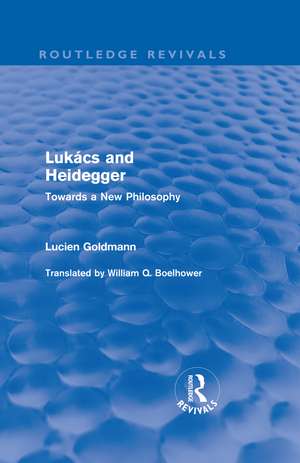
Lukács and Heidegger (Routledge Revivals): Towards a New Philosophy: Routledge Revivals
Autor Lucien Goldmann Traducere de William Q. Boelhoweren Limba Engleză Hardback – 14 aug 2009
Din seria Routledge Revivals
-
 Preț: 331.97 lei
 - 9%
 Preț: 1329.58 lei
 - 9%
 Preț: 1332.92 lei
 -
 Preț: 334.61 lei
 - 9%
 Preț: 1329.13 lei
 -
 Preț: 340.35 lei
 -
 Preț: 331.26 lei
 -
 Preț: 330.56 lei
 - 9%
 Preț: 1328.58 lei
 - 9%
 Preț: 1650.78 lei
 -
 Preț: 331.62 lei
 - 9%
 Preț: 1353.30 lei
 -
 Preț: 332.63 lei
 -
 Preț: 314.21 lei
 - 8%
 Preț: 437.60 lei
 -
 Preț: 314.42 lei
 -
 Preț: 319.14 lei
 - 9%
 Preț: 1129.14 lei
 - 5%
 Preț: 303.54 lei
 - 9%
 Preț: 981.60 lei
 - 9%
 Preț: 1331.10 lei
 - 9%
 Preț: 1328.90 lei
 -
 Preț: 359.67 lei
 - 9%
 Preț: 6718.93 lei
 -
 Preț: 466.95 lei
 -
 Preț: 332.93 lei
 - 9%
 Preț: 1328.05 lei
 -
 Preț: 415.66 lei
 -
 Preț: 328.42 lei
 -
 Preț: 331.26 lei
 -
 Preț: 324.38 lei
 -
 Preț: 322.28 lei
 - 14%
 Preț: 680.54 lei
 -
 Preț: 332.96 lei
 - 14%
 Preț: 649.36 lei
 -
 Preț: 238.51 lei
 -
 Preț: 329.60 lei
 -
 Preț: 330.98 lei
 - 14%
 Preț: 988.50 lei
 - 11%
 Preț: 379.69 lei
 - 9%
 Preț: 1628.13 lei
 - 18%
 Preț: 983.06 lei
 - 9%
 Preț: 1330.09 lei
 -
 Preț: 366.47 lei
 - 9%
 Preț: 809.58 lei
 - 9%
 Preț: 967.93 lei
 -
 Preț: 425.61 lei
 - 9%
 Preț: 1329.44 lei
 - 9%
 Preț: 1328.58 lei
 - 9%
 Preț: 3516.85 lei
Preț: 1247.84 lei
Preț vechi: 1521.75 lei
-18%
Puncte Express: 1872
Carte tipărită la comandă
Livrare economică 21 noiembrie-05 decembrie
Livrare prin curier în România Termenul estimat este afișat lângă disponibilitate.
Transport gratuit pentru acest produs Plată online sau ramburs, în funcție de opțiunile comenzii.
Retur gratuit în 14 zile Comandă securizată și suport în română.
Specificații
ISBN-13: 9780415552929
ISBN-10: 0415552923
Pagini: 140
Dimensiuni: 138 x 216 x 10 mm
Greutate: 0.42 kg
Ediția:1
Editura: Taylor & Francis
Colecția Routledge
Seria Routledge Revivals
Locul publicării:Oxford, United Kingdom
ISBN-10: 0415552923
Pagini: 140
Dimensiuni: 138 x 216 x 10 mm
Greutate: 0.42 kg
Ediția:1
Editura: Taylor & Francis
Colecția Routledge
Seria Routledge Revivals
Locul publicării:Oxford, United Kingdom
Public țintă
Postgraduate, Professional, and UndergraduateCuprins
Part 1: Introduction to Lukacs and Heidegger Part 2: Lectures during the 1967-8 Academic Year 1. Reification, Zuhandenheit and Praxis 2. Totality, Being and History 3. Objective Possibility and Possible Consciousness 4. Subject-object and Function 5. The Topicality of the Question of the Subject Part 3: Being and Dialectics
Notă biografică
Lucien Goldmann and translated by William Q. Boelhower.
Descriere
This text re-issues an important work by Lucien Goldmann, based on his university lectures from 1967-8, and first published in English in 1977. It focuses upon two of the twentieth century's most important philosophers, György Lukács and Martin Heidegger, demonstrating the origins of existentialist thought in the implicit connection between the two. This book represents the application of methodology already developed in The Hidden God and also sees Goldmann elaborating the differences between himself and Lukács for the sake of defining his own Marxist perspective.